Egypt unveils ancient rock-cut tombs and burial shafts in Luxor
Advertisement
Read this article for free:
or
Already have an account? Log in here »
To continue reading, please subscribe:

Digital Subscription
One year of digital access for only $205*
- Enjoy unlimited reading on winnipegfreepress.com
- Read the E-Edition, our digital replica newspaper
- Access News Break, our award-winning app
- Play interactive puzzles
*First annual payment billed as $205.00 + GST for one year. This annual subscription will automatically renew at $233.00 + GST every 52 weeks (10% off the regular annual price of $259.35). Offer available to new and qualified returning subscribers only. Cancel any time.
To continue reading, please subscribe:
Add Free Press access to your Brandon Sun subscription for only an additional
$1 for the first 4 weeks*
- Enjoy unlimited reading on winnipegfreepress.com
- Read the E-Edition, our digital replica newspaper
- Access News Break, our award-winning app
- Play interactive puzzles
*Your next Brandon Sun subscription payment will increase by $1.00 and you will be charged $17.95 plus GST for four weeks. After four weeks, your payment will increase to $24.95 plus GST every four weeks.
Read unlimited articles for free today:
or
Already have an account? Log in here »
Hey there, time traveller!
This article was published 08/01/2025 (646 days ago), so information in it may no longer be current.
CAIRO (AP) — Egypt unveiled several discoveries near the famed city of Luxor on Wednesday, including ancient rock-cut tombs and burial shafts dating back 3,600 years.
They were unearthed at the causeway of Queen Hatshepsut’s funerary temple at Deir al-Bahri on the Nile’s West Bank, according to a statement released by Zahi Hawass Foundation for Antiquities & Heritage. It said it worked in tandem with the Supreme Council of Antiquities on the site since September 2022.
Artifacts found at the tombs included bronze coins with the image of Alexander the Great dating to the Time of Ptolemy I (367-283), children’s toys made of clay, cartonnage and funerary masks that covered mummies, winged scarabs, beads and funerary amulets.
Hawass told reporters that the discoveries could “reconstruct history” and offer an understanding of the type of programs ancient Egyptians designed inside a temple.
The archaeologists also found the remains of Queen Hatshepsut’s Valley Temple, rock-cut tombs dating back to the Middle Kingdom (1938 B.C. – 1630 B.C.), burial shafts from the 17th dynasty, the tomb of Djehuti-Mes and part of the Assassif Ptolemaic Necropolis.
The rock-cut tombs had been previously robbed during the Ptolemaic period and later. Still, the Egyptian teams uncovered some artifacts such as pottery tables that were used to offer bread, wine and meat.
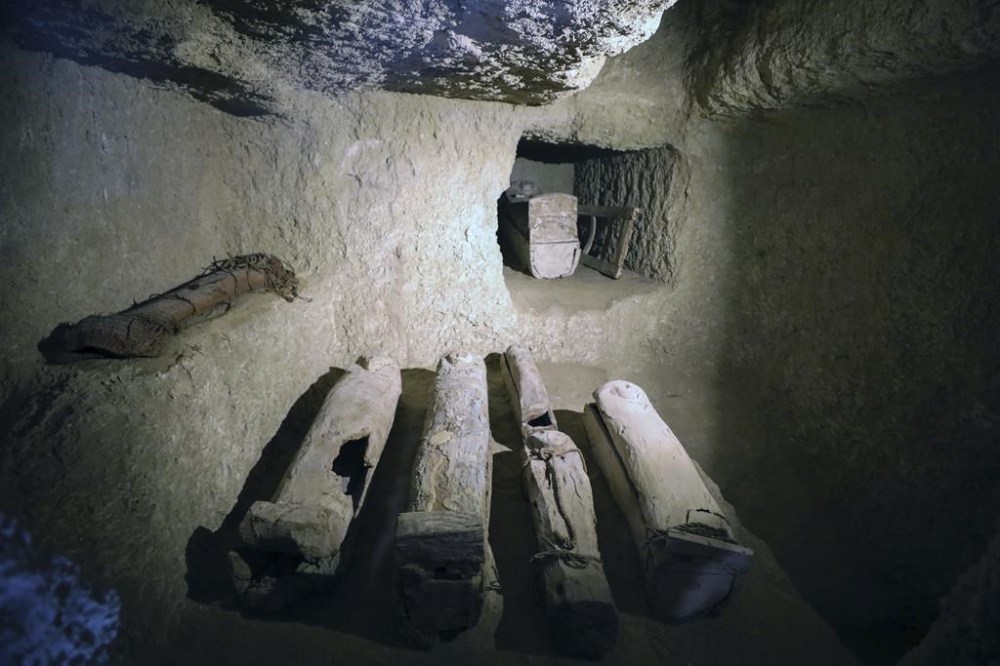
Inside the burial shafts dating back to 1580 B.C. – 1550 B.C., anthropoid wooden coffins were found, including one that belonged to a young child. It remained intact since its burial some 3,600 years ago. War archery bows were also found inside the burial chamber, indicating that those who owned the tombs had military backgrounds and fought to liberate Egypt from the Hyksos.
Not many artifacts from Djehuti Mes’s tomb were found, but the tomb itself reveals more about Djehuti Mes, who oversaw Queen Teti Sheri’s palace. The date engraved on the Djehuti Mes’ funerary stelae indicates that the tomb goes back to the 9th year of King Ahmose I’s reign (1550 B.C. – 1525 B.C.).

Part of the extended Ptolemaic necropolis that occupied the site of the causeway and the Valley Temple was also uncovered. The tombs in the cemetery were built of mud bricks over the remains of Queen Hatshepsut’s temple. A large part of the necropolis was unearthed earlier in the 20th century but wasn’t properly documented.
In November, Egyptian and American archaeologists excavated an ancient tomb with 11 sealed burials near Luxor. The tomb, which dates to the Middle Kingdom, was found in the South Asasif necropolis, next to the Temple of Hatshepsut.