Biden’s big semiconductor law will ramp up US chip production — but at a high cost, report finds

Advertisement

Advertise with us

WASHINGTON (AP) — A sweeping 2022 law, touted by President Joe Biden as a way to revive U.S. manufacturing of semiconductors and reduce the country’s reliance on foreign-made computer chips, will “sharply increase production’’ of semiconductors in the United States. But it will do so at a high cost and might not deliver the best bang for the buck, concludes a report out Wednesday by an economic think tank in Washington.

Read this article for free:


or

Already have an account? Log in here »

To continue reading, please subscribe:

Subscribe and receive a limited-edition Free Press branded hat or tote.

Digital Subscription

One year of digital access for only $205*

  • Enjoy unlimited reading on winnipegfreepress.com
  • Read the E-Edition, our digital replica newspaper
  • Access News Break, our award-winning app
  • Play interactive puzzles

*First annual payment billed as $205.00 + GST for one year. This annual subscription will automatically renew at $233.00 + GST every 52 weeks (10% off the regular annual price of $259.35). Offer available to new and qualified returning subscribers only. Cancel any time.

To continue reading, please subscribe:

Add Free Press access to your Brandon Sun subscription for only an additional

$1 for the first 4 weeks*

  • Enjoy unlimited reading on winnipegfreepress.com
  • Read the E-Edition, our digital replica newspaper
  • Access News Break, our award-winning app
  • Play interactive puzzles
Start now

*Your next Brandon Sun subscription payment will increase by $1.00 and you will be charged $17.95 plus GST for four weeks. After four weeks, your payment will increase to $24.95 plus GST every four weeks.

Hey there, time traveller!
This article was published 15/01/2025 (627 days ago), so information in it may no longer be current.

WASHINGTON (AP) — A sweeping 2022 law, touted by President Joe Biden as a way to revive U.S. manufacturing of semiconductors and reduce the country’s reliance on foreign-made computer chips, will “sharply increase production’’ of semiconductors in the United States. But it will do so at a high cost and might not deliver the best bang for the buck, concludes a report out Wednesday by an economic think tank in Washington.

Researchers at the Peterson Institute for International Economics calculated that the $280 billion CHIPS and Science Act will create about 93,000 construction jobs as chip factories go up in the United States and 43,000 permanent jobs once they’re in operation. But the government subsidies behind the expected chip manufacturing boom mean that each job created will cost taxpayers about $185,000 a year – twice the average annual salary of U.S. semiconductor employees, the Peterson report found.

“More production might not provide the best security for the money,’’ wrote researchers Gary Hufbauer and Megan Hogan.
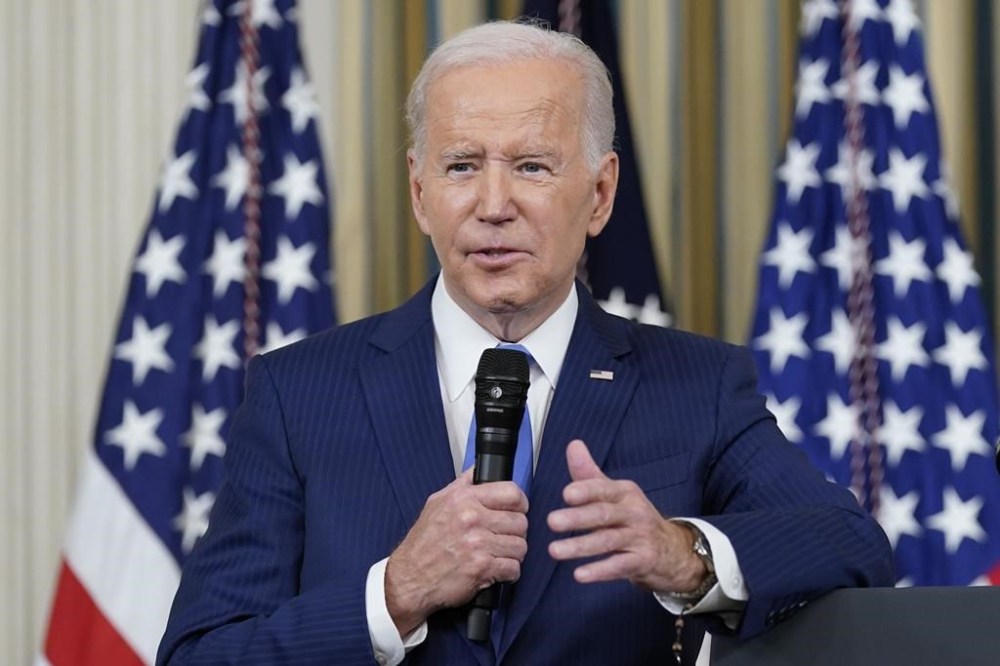
FILE - President Joe Biden answers questions from reporters as he speaks in the State Dining Room of the White House in Washington, Nov. 9, 2022. (AP Photo/Susan Walsh, File)

The Peterson report notes that in passing the CHIPS Act Congress “did not consider alternative ways’’ of spending billions of dollars to ensure the U.S. had adequate chip supplies. Other options could have included creating a chip stockpile run by the Federal Emergency Management Agency or providing financial incentives for U.S. chip users and foreign chip producers to keep bigger inventories of semiconductors in the United States.

In response to the report, the Commerce Department pointed to an earlier statement promising to be “vigilant” about the way it spends taxpayer money and hands out CHIPS Act grants. Commerce vowed to scrutinize companies’ investment plans ”with a fine-tooth comb and make sure that companies are not padding their models to ask for outsized incentives.”

Biden touted and Congress passed the CHIPS Act after semiconductor supplies ran short following COVID-19 lockdowns. The shortages disrupted production of automobiles and other products. The Biden administration also viewed ramping up made-in-America chip production as a national security issue because it would reduce U.S. reliance on foreign imports of chips, which are used by the military as well as private companies.

A study by the Boston Consulting Group and the Semiconductor Industry Association has found that America’s share of world chip production capacity, measured by volume and not dollar value, fell from 37% in 1990 to just 10% in 2022.

Policymakers are alarmed that U.S. industry depends heavily on chips manufactured in Taiwan, a supply that could be threatened if China launches military strikes intended to force the autonomous island to reunite politically with the Chinese mainland. The giant Taiwan Semiconductor Manufacturing Co., which supplies chips to Apple and Qualcomm, among others, is investing heavily in chip plants in Arizona.

The CHIPS Act also aims to boost the U.S. share of the world’s advanced chips to 20% by 2030 from none today. But the Peterson report argued that such a leap would require additional government subsidies and overcoming shortages of skilled labor and electricity. It also noted that South Korea and Taiwan are offering their own chipmaking giants generous tax credits to protect their lead in the market. Asking whether the U.S. can meet that 20% goal, the Peterson researchers conclude: “Maybe.”

It’s unclear whether the incoming Trump administration will scrap or make changes to the CHIPS Act. During the election campaign, President-elect Donald Trump had argued that tariffs on foreign chips – not subsidies to encourage U.S. production – would have done more to bring semiconductor plants to the United States.

But the Peterson researchers noted that in the past European Union tariffs had failed to revive chip production in Europe. “There is no compelling reason why a comparable tariff would prove more successful for the United States,’’ they wrote.


Report Error Submit a Tip

More Stories

Province looks to seize notorious drug den

Erik Pindera 5 minute read Preview

Province looks to seize notorious drug den

Erik Pindera 5 minute read Yesterday at 12:00 PM CDT

Provincial justice officials are trying to seize a Dominion Street drug den that has been the source of trouble in the West End for years.

The owner of 982 Dominion St., 45-year-old Robert Edward Johnson, was most recently arrested in June along with several others after a lengthy Winnipeg Police investigation into thefts and illicit drug sales connected to the house.

“The residence has a reputation within the neighbourhood as being a location where individuals habitually attend for the purpose of purchasing and/or consuming controlled substances,” reads a statement of claim filed by the province’s director of civil forfeiture in the Court of King’s Bench last week.

“For several years, the residence has been associated with criminal activity, violence, and disorder, resulting in numerous police attendances and complaints from members of the surrounding community.”

Read
Yesterday at 12:00 PM CDT

Board game company charts winning path

Aaron Epp 5 minute read Preview

Board game company charts winning path

Aaron Epp 5 minute read Friday, Oct. 2, 2026

Dennis Northcott has launched a game without frontiers.

The Winnipeg entrepreneur is the co-designer of Galactic Cruise, a board game published last year by Kinson Key Games LLC, the business he co-founded. Since its release, Galactic Cruise has been translated into 11 languages and sold around 50,000 copies worldwide.

It’s also one of three finalists for this year’s Deutsche Spiele Preis, a prestigious community-voted board game award. Northcott will travel to Essen, Germany, later this month, where the winner will be announced at Spiel Essen, an annual board game trade fair.

“It’s been amazing,” Northcott said of the response to Galactic Cruise during an interview in his Island Lakes neighbourhood home earlier this week. “The sales have been great, but it’s also been amazing in terms of people giving their reviews.”

Read
Friday, Oct. 2, 2026

Mayoral candidate Vogiatzakis criticized for living outside Winnipeg

Malak Abas 4 minute read Preview

Mayoral candidate Vogiatzakis criticized for living outside Winnipeg

Malak Abas 4 minute read Friday, Oct. 2, 2026

A mayoral hopeful took heat from other candidates Friday for living outside Winnipeg while running in the civic election.

Mike Vogiatzakis’s primary residence is in the Rural Municipality of St. Andrews, about 25 kilometres north of Winnipeg — a community with its own mayor and councillors.

But the funeral director said he owns a home in Winnipeg where he divides his time, and he would move to the city full-time if elected mayor.

“It doesn’t matter where a person lives. Why are we dividing St. Andrews and Manitoba and Winnipeg? I’ve met the criteria to run for mayor,” Vogiatzakis said Friday morning.

Read
Friday, Oct. 2, 2026

’Disgusting’ posters being investigated by police

Morgan Modjeski 4 minute read Yesterday at 2:22 PM CDT

The Winnipeg Police Service major crimes unit is investigating what some have labelled offensive and hateful posters on full-display at a Winnipeg home.

One of the people irked by the display is Gracie Garrett. She’s has lived on Ashburn Street in Winnipeg’s Minto neighbourhood for almost ten years. She’s never felt unsafe in the neighbourhood before, but now, a set of posters plastered on a nearby house are making her feel uneasy.

The five signs, posted facing the street prominently on a front window, contain a slur, refer to Nazis as “heroes” and call Muslims, Christians and other groups “evil.”

Learning of the signs Friday, Garrett said she’ll be reporting the posters to police, as she worries they incite and promote violence.

Letters, Oct. 3

7 minute read Yesterday at 2:01 AM CDT

A morning in the life …

My very first lesson does not start when I walk into that lecture hall, oh no — it starts long before. It begins when I walk to my car, check the estimated arrival time to the University of Manitoba and hope that Winnipeg traffic agrees with it.

A drive that appears completely manageable changes almost immediately when I’m greeted by a tsunami of orange pylons and a line of cars that appears to go on forever. Traffic moves by the inch, lanes magically disappear and the detour I took yesterday now has a detour of its own. These factors make me do a calculation that I have become all too familiar with. How late can I arrive and still find parking, run to my class across campus and get to class with enough time left to make it worth it?

I have grown used to people saying, “Why not just leave earlier?” I do. But when I’m already leaving for my 8:30 a.m. class at 7 a.m., there’s only so much I can do. This drive that some would think is relaxing is one that feels like an assignment that I didn’t know I had to complete and is due at 8:30 a.m.

Moving drama at MTYP gives voice to boy who changed law

Holly Harris 5 minute read Preview

Moving drama at MTYP gives voice to boy who changed law

Holly Harris 5 minute read Yesterday at 2:37 PM CDT

The heroic true tale of Norway House Cree Nation-born Jordan River Anderson came home Friday night, as Manitoba Theatre for Young People presented Yvette Nolan’s Jordan.

The touring production, a collaboration with Geordie Theatre, runs weekends through Oct. 11, with additional stops in Toronto, Vancouver and Ottawa’s National Arts Centre.

Having several of Anderson’s family members witness the local première underscored the evening with poignancy. Elder and Pine Creek First Nation member Barbara Nepinak added her own dignified presence and prayers following MTYP artistic director Pablo Felices-Luna’s welcoming remarks.

The season-opener also marks the Winnipeg-raised playwright’s homecoming; the Algonquin playwright, director, dramaturg, actor and educator was a fixture in our local theatre community for many years before going on to serve as artistic director for Native Earth Performing Arts from 2003 to ‘11, among other contributions.

Read
Yesterday at 2:37 PM CDT