Big Tech wants to plug data centers right into power plants. Utilities say it’s not fair
Advertisement
Read this article for free:
or
Already have an account? Log in here »
To continue reading, please subscribe:

Digital Subscription
One year of digital access for only $205*
- Enjoy unlimited reading on winnipegfreepress.com
- Read the E-Edition, our digital replica newspaper
- Access News Break, our award-winning app
- Play interactive puzzles
*First annual payment billed as $205.00 + GST for one year. This annual subscription will automatically renew at $233.00 + GST every 52 weeks (10% off the regular annual price of $259.35). Offer available to new and qualified returning subscribers only. Cancel any time.
To continue reading, please subscribe:
Add Free Press access to your Brandon Sun subscription for only an additional
$1 for the first 4 weeks*
- Enjoy unlimited reading on winnipegfreepress.com
- Read the E-Edition, our digital replica newspaper
- Access News Break, our award-winning app
- Play interactive puzzles
*Your next Brandon Sun subscription payment will increase by $1.00 and you will be charged $17.95 plus GST for four weeks. After four weeks, your payment will increase to $24.95 plus GST every four weeks.
Read unlimited articles for free today:
or
Already have an account? Log in here »
Hey there, time traveller!
This article was published 25/01/2025 (574 days ago), so information in it may no longer be current.
HARRISBURG, Pa. (AP) — Looking for a quick fix for their fast-growing electricity diets, tech giants are increasingly looking to strike deals with power plant owners to plug in directly, avoiding a potentially longer and more expensive process of hooking into a fraying electric grid that serves everyone else.
It’s raising questions over whether diverting power to higher-paying customers will leave enough for others and whether it’s fair to excuse big power users from paying for the grid. Federal regulators are trying to figure out what to do about it, and quickly.
Front and center is the data center that Amazon’s cloud computing subsidiary, Amazon Web Services, is building next to the Susquehanna nuclear plant in eastern Pennsylvania.
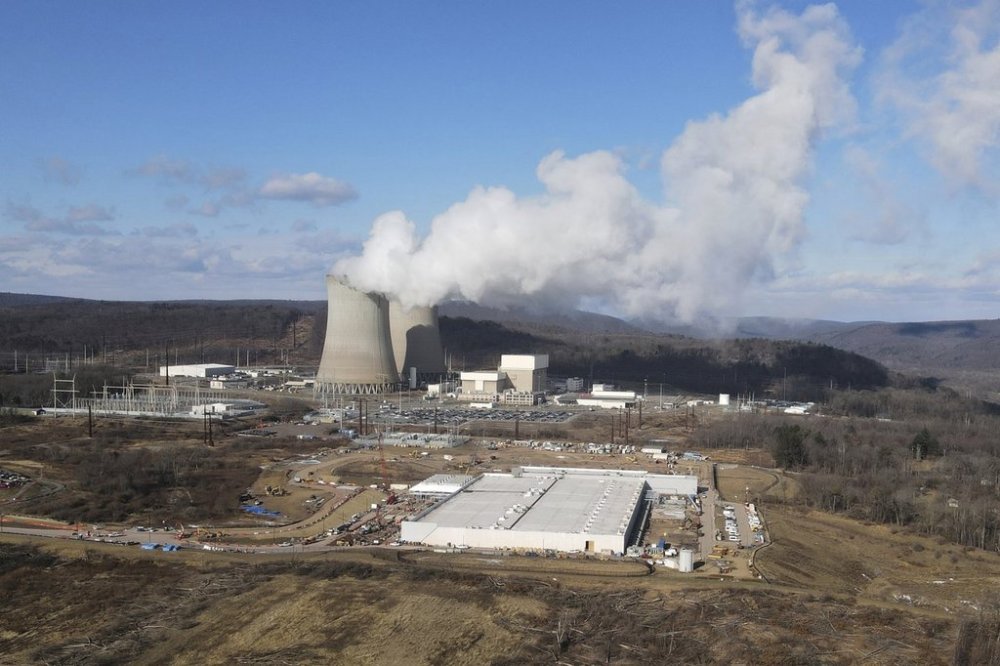
The arrangement between the plant’s owners and AWS — called a “behind the meter” connection — is the first such to come before the Federal Energy Regulatory Commission. For now, FERC has rejected a deal that could eventually send 960 megawatts — about 40% of the plant’s capacity — to the data center. That’s enough to power more than a half-million homes.
That leaves the deal and others that likely would follow in limbo. It’s not clear when FERC, which blocked the deal on a procedural ground, will take up the matter again or how the change in presidential administrations might affect things.
“The companies, they’re very frustrated because they have a business opportunity now that’s really big,” said Bill Green, the director of the MIT Energy Initiative. “And if they’re delayed five years in the queue, for example — I don’t know if it would be five years, but years anyway — they might completely miss the business opportunity.”
What’s driving demand for energy-hungry data centers
The rapid growth of cloud computing and artificial intelligence has fueled demand for data centers that need power to run servers, storage systems, networking equipment and cooling systems.
That’s spurred proposals to bring nuclear power plants out of retirement, develop small modular nuclear reactors and build utility-scale renewable installations or new natural gas plants. In December, California-based Oklo announced an agreement to provide 12 gigawatts to data center developer Switch from small nuclear reactors powered by nuclear waste.
Federal officials say fast development of data centers is vital to the economy and national security, including to keep pace with China in the artificial intelligence race.
For AWS, the deal with Susquehanna satisfies its need for reliable power that meets its internal requirements for sources that don’t emit planet-warming greenhouse gases, like coal, oil or gas-fueled plants.
Big Tech also wants to stand up their centers fast. But tech’s voracious appetite for energy comes at a time when the power supply is already strained by efforts to shift away from planet-warming fossil fuels.
They can build data centers in a couple years, said Aaron Tinjum of the Data Center Coalition. But in some areas, getting connected to the congested electricity grid can take four years, and sometimes much more, he said.
Plugging directly into a power plant would take years off their development timelines.
What’s in it for power providers
In theory, the AWS deal would let Susquehanna sell power for more than they get by selling into the grid. Talen Energy, Susquehanna’s majority owner, projected the deal would bring as much as $140 million in electricity sales in 2028, though it didn’t disclose exactly how much AWS will pay for the power.
The profit potential is one that other nuclear plant operators, in particular, are embracing after years of financial distress and frustration with how they are paid in the broader electricity markets. Many say they have been forced to compete in some markets against a flood of cheap natural gas as well as state-subsidized solar and wind energy.
Power plant owners also say the arrangement benefits the wider public, by bypassing the costly buildout of long power lines and leaving more transmission capacity on the grid for everyone else.
FERC’s big decision
A favorable ruling from FERC could open the door to many more huge data centers and other massive power users like hydrogen plants and bitcoin miners, analysts say.
FERC’s 2-1 rejection in November was procedural. Recent comments by commissioners suggest they weren’t ready to decide how to regulate such a novel matter without more study.
In the meantime, the agency is hearing arguments for and against the Susquehanna-AWS deal.
Monitoring Analytics, the market watchdog in the mid-Atlantic grid, wrote in a filing to FERC that the impact would be “extreme” if the Susquehanna-AWS model were extended to all nuclear power plants in the territory.
Energy prices would increase significantly and there’s no explanation for how rising demand for power will be met even before big power plants drop out of the supply mix, it said.
Separately, two electric utility owners — which make money in deregulated states from building out the grid and delivering power — have protested that the Susquehanna-AWS arrangement amounts to freeloading off a grid that ordinary customers pay to build and maintain. Chicago-based Exelon and Columbus, Ohio-based American Electric Power say the Susquehanna-AWS arrangement would allow AWS to avoid $140 million a year that it would otherwise owe.
Susquehanna’s owners say the data center won’t be on the grid and question why it should have to pay to maintain it. But critics contend that the power plant itself is benefiting from taxpayer subsidies and ratepayer-subsidized services, and shouldn’t be able to strike deals with private customers that could increase costs for others.
FERC’s decision will have “massive repercussions for the entire country” because it will set a precedent for how FERC and grid operators will handle the waiting avalanche of similar requests from data center companies and nuclear plants, said Jackson Morris of the Natural Resources Defense Council.
Stacey Burbure, a vice president for American Electric Power, told FERC at a hearing in November that it needs to move quickly.
“The timing of this issue is before us,” she said, “and if we take our typical five years to get this perfect, it will be too late.”
___
Follow Marc Levy on X at: https://x.com/timelywriter.
___
The Associated Press’ climate and environmental coverage receives financial support from multiple private foundations. AP is solely responsible for all content. Find AP’s standards for working with philanthropies, a list of supporters and funded coverage areas at AP.org.