Scientists solve the mystery of sea turtles’ ‘lost years’
Advertisement
Read this article for free:
or
Already have an account? Log in here »
To continue reading, please subscribe:

Digital Subscription
One year of digital access for only $205*
- Enjoy unlimited reading on winnipegfreepress.com
- Read the E-Edition, our digital replica newspaper
- Access News Break, our award-winning app
- Play interactive puzzles
*First annual payment billed as $205.00 + GST for one year. This annual subscription will automatically renew at $233.00 + GST every 52 weeks (10% off the regular annual price of $259.35). Offer available to new and qualified returning subscribers only. Cancel any time.
To continue reading, please subscribe:
Add Free Press access to your Brandon Sun subscription for only an additional
$1 for the first 4 weeks*
- Enjoy unlimited reading on winnipegfreepress.com
- Read the E-Edition, our digital replica newspaper
- Access News Break, our award-winning app
- Play interactive puzzles
*Your next Brandon Sun subscription payment will increase by $1.00 and you will be charged $17.95 plus GST for four weeks. After four weeks, your payment will increase to $24.95 plus GST every four weeks.
Read unlimited articles for free today:
or
Already have an account? Log in here »
Hey there, time traveller!
This article was published 04/02/2025 (610 days ago), so information in it may no longer be current.
WASHINGTON (AP) — Using satellite trackers, scientists have discovered the whereabouts of young sea turtles during a key part of their lives.
“We’ve had massive data gaps about the early baby to toddler life stages of sea turtles,” said Kate Mansfield, a marine scientist at the University of Central Florida. “This part of their long lives has been largely a mystery.”
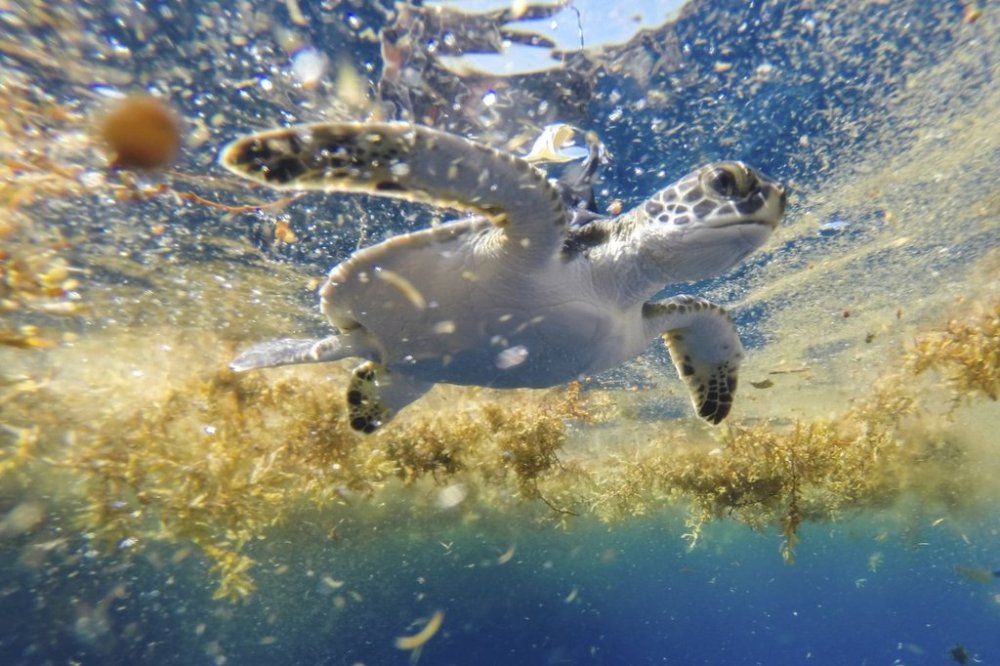
For decades, scientists have wondered about what happens during the so-called lost years between when tiny hatchlings leave the beach and when they return to coastlines nearly grown — a span of about one to 10 years.
New research published Tuesday begins to fill in that gap.
For over a decade, Mansfield and colleagues attached GPS tags to the fast-growing shells of young wild turtles. Steering small boats, they looked for young turtles drifting among algae in the Gulf of Mexico, eventually tagging 114 animals – including endangered green turtles, loggerheads, hawksbills and Kemp’s ridleys.
Eventually the GPS tags slough off because “the outside of a young turtle’s shell sheds as they grow very quickly,” said Katrina Phillips, a marine ecologist at the University of Central Florida and co-author of the new study published in Proceedings of the Royal Society B.
But each tag stayed on long enough to transmit a few weeks to a few months of location data. What the researchers found challenged many old ideas.
Scientists long thought that tiny turtles drifted passively with ocean currents, literally going with the flow.
“What we’ve uncovered is that the turtles are actually swimming,” said co-author Nathan Putman, an ecologist at LGL Ecological Research Associates in Texas.
The scientists confirmed this by comparing location data of young turtles with the routes of drifting buoys set in the water at the same time. More than half of the buoys washed ashore while the turtles did not.
“This tiny little hatchling is actually making its own decisions about where it wants to go in the ocean and what it wants to avoid,” said Bryan Wallace, a wildlife ecologist at Ecolibrium in Colorado.
The tracking data also showed more variability in locations than scientists expected, as the little turtles moved between continental shelf waters and open ocean.
Besides the painstaking work of finding turtles, the trick was developing flexible solar-powered tags that could hang onto shells long enough to send back data.

“For years, the technology couldn’t match the dream,” said Jeffrey Seminoff, a marine biologist at NOAA who was not involved in the study.
The findings give biologists a better idea of how young turtles use the Gulf of Mexico, a critical region for four species of endangered sea turtles.
“It’s not that the sea turtles were ever lost, but that we had lost track of them,” said Jeanette Wyneken at Florida Atlantic University, who had no role in the research.
___
The Associated Press Health and Science Department receives support from the Howard Hughes Medical Institute’s Science and Educational Media Group and the Robert Wood Johnson Foundation. The AP is solely responsible for all content.