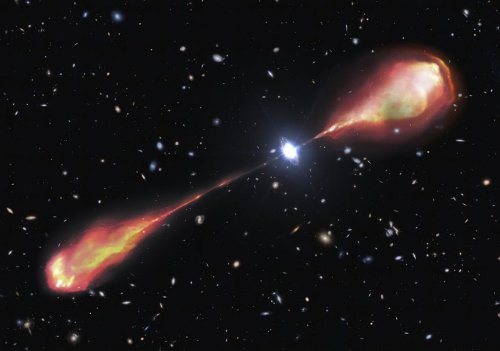
Telescopes spy a monster radio jet streaming from a bright and early object in the universe
Advertisement
Read this article for free:
or
Already have an account? Log in here »
To continue reading, please subscribe:

Digital Subscription
One year of digital access for only $205*
- Enjoy unlimited reading on winnipegfreepress.com
- Read the E-Edition, our digital replica newspaper
- Access News Break, our award-winning app
- Play interactive puzzles
*First annual payment billed as $205.00 + GST for one year. This annual subscription will automatically renew at $233.00 + GST every 52 weeks (10% off the regular annual price of $259.35). Offer available to new and qualified returning subscribers only. Cancel any time.
To continue reading, please subscribe:
Add Free Press access to your Brandon Sun subscription for only an additional
$1 for the first 4 weeks*
- Enjoy unlimited reading on winnipegfreepress.com
- Read the E-Edition, our digital replica newspaper
- Access News Break, our award-winning app
- Play interactive puzzles
*Your next Brandon Sun subscription payment will increase by $1.00 and you will be charged $17.95 plus GST for four weeks. After four weeks, your payment will increase to $24.95 plus GST every four weeks.
Read unlimited articles for free today:
or
Already have an account? Log in here »
Hey there, time traveller!
This article was published 06/02/2025 (609 days ago), so information in it may no longer be current.
CAPE CANAVERAL, Fla. (AP) — Telescopes around the world have spotted a monster radio jet streaming from a quasar dating back to the first 1 billion years of the universe.
At double the width of our Milky Way galaxy, this jet of radio waves is the biggest ever detected so early in the history of the universe, astronomers reported Thursday.
Radio jets like this are not uncommon in our cosmic neighborhood. But they’ve been elusive in the distant early universe — until now — because of the obscuring cosmic microwave background left over from the Big Bang.

“It’s only because this object is so extreme that we can observe it from Earth, even though it’s really far away,” lead author Anniek Gloudemans of the National Science Foundation’s NoirLab said in a statement.
Observatories across Europe and in Hawaii and Texas contributed to the study appearing in the Astrophysical Journal Letters.
The double-sided radio wave is estimated to be at least 200,000 light-years across. A light-year is 5.8 trillion miles.
Discovered just a few years ago, the quasar powering this jet formed when the universe was just 9% of its current age — within the first 1.2 billion years. Some of the brightest objects in the universe, quasars are galactic cores with gas and dust falling into a black hole, releasing a tremendous amount of energy that makes them exceedingly luminous.
The mass of this quasar is equivalent to 450 million times our sun with a black hole that is not particularly massive.

___
The Associated Press Health and Science Department receives support from the Howard Hughes Medical Institute’s Science and Educational Media Group and the Robert Wood Johnson Foundation. The AP is solely responsible for all content.