WEATHER ALERT

The spring equinox is here. What does that mean?

Advertisement

Advertise with us

Spring is almost here — officially, at least.

Read this article for free:

or

Already have an account? Log in here »

To continue reading, please subscribe:

Subscribe and receive a limited-edition Free Press branded hat or tote.

Digital Subscription

One year of digital access for only $205*

  • Enjoy unlimited reading on winnipegfreepress.com
  • Read the E-Edition, our digital replica newspaper
  • Access News Break, our award-winning app
  • Play interactive puzzles

*First annual payment billed as $205.00 + GST for one year. This annual subscription will automatically renew at $233.00 + GST every 52 weeks (10% off the regular annual price of $259.35). Offer available to new and qualified returning subscribers only. Cancel any time.

To continue reading, please subscribe:

Add Free Press access to your Brandon Sun subscription for only an additional

$1 for the first 4 weeks*

  • Enjoy unlimited reading on winnipegfreepress.com
  • Read the E-Edition, our digital replica newspaper
  • Access News Break, our award-winning app
  • Play interactive puzzles
Start now

*Your next Brandon Sun subscription payment will increase by $1.00 and you will be charged $17.95 plus GST for four weeks. After four weeks, your payment will increase to $24.95 plus GST every four weeks.

Hey there, time traveller!
This article was published 19/03/2025 (495 days ago), so information in it may no longer be current.

Spring is almost here — officially, at least.

The vernal equinox arrives on Thursday, marking the start of the spring season for the Northern Hemisphere and the fall in the Southern Hemisphere. On the equator, the sun will be directly overhead at noon. Equinoxes are the only time when both the north and south poles are lit by sunshine at the same time.

The events have been marked and celebrated around the world for centuries. Nowruz, the Iranian New Year, is based on the spring equinox, for example. And at the Mayan site Chichen Itza in Mexico, people gather during the equinox to watch the sun create a shadow pattern that resembles a serpent descending a building called El Castillo.

This image provided by NOAA on March 19, 2025 shows Earth. (NOAA via AP)

But what is happening in the heavens? Here’s what to know about how we split up the year using the Earth’s orbit.

What is the equinox?

As the Earth travels around the sun, it does so at an angle.

For most of the year, the Earth’s axis is tilted either toward or away from the sun. That means the sun’s warmth and light fall unequally on the northern and southern halves of the planet.

During the equinox, the Earth’s axis and its orbit line up so that both hemispheres get an equal amount of sunlight.

The word equinox comes from two Latin words meaning equal and night. That’s because on the equinox, day and night last almost the same amount of time — though one may get a few extra minutes, depending on where you are on the planet.

The Northern Hemisphere’s spring — or vernal — equinox can land between March 19 and 21, depending on the year. Its fall – or autumnal — equinox can land between Sept. 21 and 24.

What is the solstice?

The solstices mark the times during the year when the Earth is at its most extreme tilt toward or away from the sun. This means the hemispheres are getting very different amounts of sunlight — and days and nights are at their most unequal.

During the Northern Hemisphere’s summer solstice, the upper half of the earth is tilted in toward the sun, creating the longest day and shortest night of the year. This solstice falls between June 20 and 22.

Meanwhile, at the winter solstice, the Northern Hemisphere is leaning away from the sun — leading to the shortest day and longest night of the year. The winter solstice falls between December 20 and 23.

What’s the difference between meteorological and astronomical seasons?

These are just two different ways to carve up the year.

While astronomical seasons depend on how the Earth moves around the sun, meteorological seasons are defined by the weather. They break down the year into three-month seasons based on annual temperature cycles. By that calendar, spring starts on March 1, summer on June 1, fall on Sept. 1 and winter on Dec. 1.

___

The Associated Press Health and Science Department receives support from the Howard Hughes Medical Institute’s Science and Educational Media Group. The AP is solely responsible for all content.

Report Error Submit a Tip

More Stories

Visitors from across Canada make Somerset restaurant’s social media challenge a success

Zoe Pierce 3 minute read Preview

Visitors from across Canada make Somerset restaurant’s social media challenge a success

Zoe Pierce 3 minute read Saturday, Jul. 25, 2026

There may not be another restaurant in Manitoba that can say it has welcomed visitors from as many communities across the province and beyond as the Somerset Food Bar & Lounge has this summer.

In just over a two week span, visitors from more than 100 towns have come out to the family-owned restaurant tucked away in Somerset, a community of roughly 450 people in the Pembina Valley 130 kilometres southwest of Winnipeg.

It started as a challenge, “60 Towns in 60 Days,” where the restaurant wanted to document how many different places they could reach, as it often sees people travelling across Canada stop at the restaurant. The goal was also to encourage people to make a drive they normally wouldn’t.

“The more we started sharing, the more people really started getting behind it, and it turned into this really big thing fairly quickly,” said Jay Friesen, restaurant manager.

Read
Saturday, Jul. 25, 2026

Vacant Bay store on road to redevelopment, St. Vital Centre owner says

Gabrielle Piche 6 minute read Preview

Vacant Bay store on road to redevelopment, St. Vital Centre owner says

Gabrielle Piche 6 minute read Friday, Jul. 24, 2026

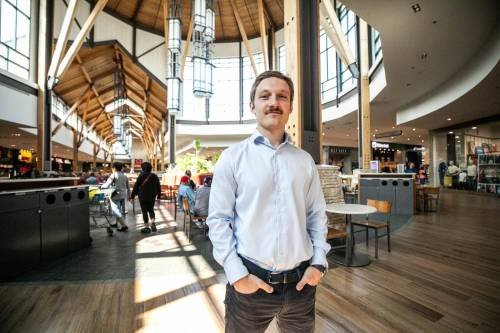
Entertainment attractions are coming to fill the former Hudson’s Bay space in St. Vital Centre.

Montreal-based real estate firm Leyad, the south Winnipeg mall’s owner, says it is finalizing an agreement for the vacant property. Further details should appear in the next couple months, said president Henry Zavriyev.

“We’re looking at what other types of experiences we can bring to the mall that aren’t just typical retail,” he said during a visit to Winnipeg this week.

“We want to create an experience where you can just come to the mall, hang out here for hours, no matter if you’re a kid, an adult, a retiree.”

Read
Friday, Jul. 24, 2026

Take care of them; there is enough

David Driedger 5 minute read 2:01 AM CDT

The parable of the Good Samaritan is one of those stories that has endured far beyond its original context, far beyond religion itself. Someone is robbed, assaulted and left for dead.

Bombers’ offence, defence, and special teams fail to show up against Stampeders

Taylor Allen 6 minute read Preview

Bombers’ offence, defence, and special teams fail to show up against Stampeders

Taylor Allen 6 minute read Saturday, Jul. 25, 2026

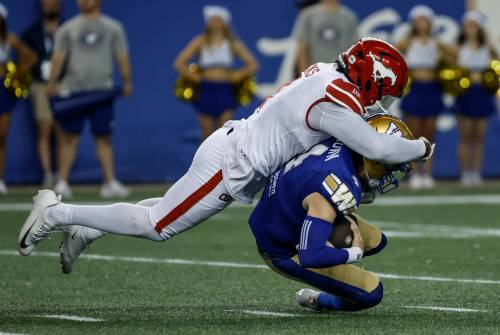
The Winnipeg Blue Bombers constantly preach the importance of playing three-phase football.

On Friday night, they went 0-for-3.

Their offence, defence, and special teams all played a significant role in losing 52-30 to the visiting Calgary Stampeders.

The team that erased a 17-point deficit to beat Ottawa last Sunday was nowhere to be found.

Read
Saturday, Jul. 25, 2026

Automation reaches new heights on farm

Laura Rance-Unger 4 minute read Preview

Automation reaches new heights on farm

Laura Rance-Unger 4 minute read Saturday, Jul. 25, 2026

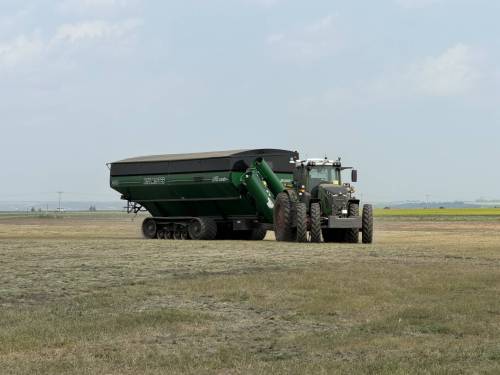
LANGHAM, Sask. — The thousands of farmers from across the Prairies who flock to the annual Ag in Motion show every July seem oblivious to the possibility the technology on display could one day replace many of them.

Families with children in tow, Hutterite colony workers, grandparents and young couples just starting out roamed through the 600 or more exhibitor displays, amazed at how everything about farming just keeps getting bigger, more efficient and increasingly more automated.

It’s now possible to seed using a 100-foot-wide drill — a 12-foot jump over the widest available a few years ago — provided the farmer can afford a tractor with enough horsepower to pull it. Those sell for around $850,000 and up.

Granted, the number of farms with enough acres to justify that kind of width and drawing power is still relatively small, but farms continue to grow. And it’s no secret the number of people who have the interest, skills and financial wherewithal to run them continues to shrink.

Read
Saturday, Jul. 25, 2026

Students continue to criticize handling of MITT’s closure

Morgan Modjeski 5 minute read Preview

Students continue to criticize handling of MITT’s closure

Morgan Modjeski 5 minute read 6:00 AM CDT

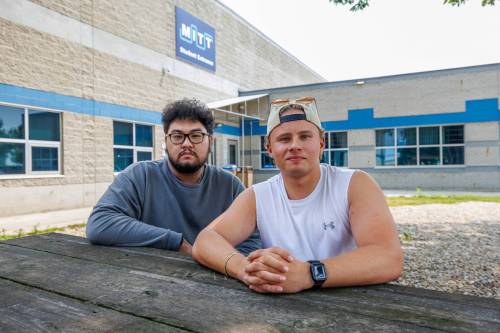
Students at a Manitoba trade college say their education has been hampered as a result of its impending closure and they blame government for a poor transition.

The provincial government announced in January it would close the Manitoba Institute of Trades and Technology because it was no longer financially viable following the federal government’s decision to cut the number of international students allowed to study in Canada.

Officials have said students would remain the top priority as 19 programs from MITT are set to be absorbed by Red River College Polytech.

Kieran Smith, an electrical applications student at MITT, said it feels like those in charge “don’t really care.”

Read
6:00 AM CDT