Waymo plans to bring its driverless taxis to Washington in 2026

Advertisement

Advertise with us

Waymo on Tuesday added Washington to its pioneering robotaxi service's steadily expanding list of U.S. markets, although passengers will have to wait until next year until they can take a driverless ride around the nation's capital city.

Read this article for free:


or

Already have an account? Log in here »

To continue reading, please subscribe:

Subscribe and receive a limited-edition Free Press branded hat or tote.

Digital Subscription

One year of digital access for only $205*

  • Enjoy unlimited reading on winnipegfreepress.com
  • Read the E-Edition, our digital replica newspaper
  • Access News Break, our award-winning app
  • Play interactive puzzles

*First annual payment billed as $205.00 + GST for one year. This annual subscription will automatically renew at $233.00 + GST every 52 weeks (10% off the regular annual price of $259.35). Offer available to new and qualified returning subscribers only. Cancel any time.

To continue reading, please subscribe:

Add Free Press access to your Brandon Sun subscription for only an additional

$1 for the first 4 weeks*

  • Enjoy unlimited reading on winnipegfreepress.com
  • Read the E-Edition, our digital replica newspaper
  • Access News Break, our award-winning app
  • Play interactive puzzles
Start now

*Your next Brandon Sun subscription payment will increase by $1.00 and you will be charged $17.95 plus GST for four weeks. After four weeks, your payment will increase to $24.95 plus GST every four weeks.

Hey there, time traveller!
This article was published 25/03/2025 (543 days ago), so information in it may no longer be current.

Waymo on Tuesday added Washington to its pioneering robotaxi service’s steadily expanding list of U.S. markets, although passengers will have to wait until next year until they can take a driverless ride around the nation’s capital city.

For now, Waymo’s robotaxis will continue to map Washington’s streets and corridors with a safety driver sitting behind the wheel to take control of the vehicle if something goes wrong — a precaution required under the regulations currently in force in the District of Columbia.

That’s something Waymo already has been doing since it began sending out its robotaxis in Washington in late January after a brief trial run in the capital last year.
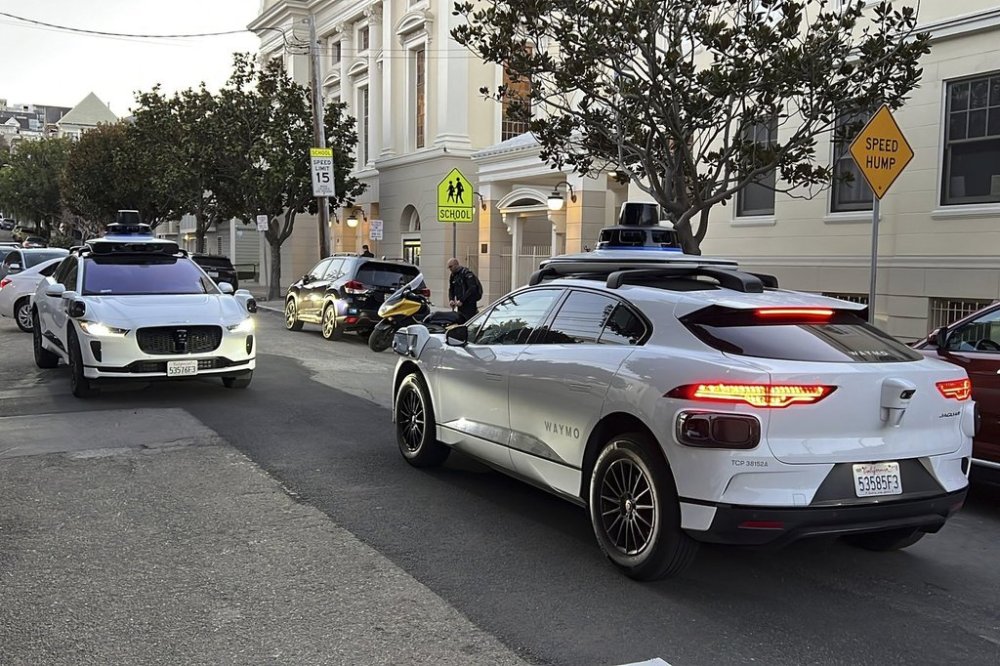
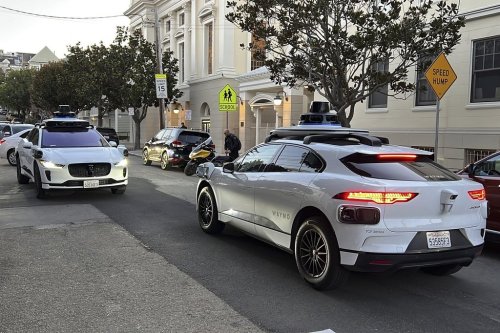
FILE - Two Waymo driverless taxis stop before passing one another on a San Francisco street on Feb. 15, 2023. (AP Photo/Terry Chea, File)

While the robotaxis continue to learn their way around the city, Waymo executives expressed confidence they will be able to work with regulators to clear the way for completely driverless rides at some point next year through its Waymo One app.

“We’re excited to bring the comfort, consistency, and safety of Waymo One to Washingtonians, those who work and play in the city every day, and the millions of people from around the world who travel to the District every year,” Waymo co-CEO Tekedra Mawakana said in a blog post.

If Waymo’s ambitions pan out, Washington and Miami next year will be added to four other U.S. markets where its robotaxis are transporting passengers — Phoenix, Los Angeles, the San Francisco Bay Area and Austin, Texas as part of a partnership with ride-hailing leader Uber. Waymo and Uber also are teaming up to begin dispatching its robotaxis in Atlanta later this year.

The growth has helped turn what began as a head-turning novelty in Phoenix and then in San Francisco into an increasingly common sight in the cities where Waymo operates. The company says it had provided more than 4 million driverless rides to paying customers through the end of last year, and is now providing them at a pace of 200,000 paid trips per week.

That has established Waymo as the early frontrunner in driverless technology while others are racing to catch up. Both Amazon and Tesla are gearing up to launch their own services in different U.S. cities while another ride-hailing service, Lyft, has announced plans to add robotaxis as an option in Atlanta and Dallas.

Waymo’s early lead in the still-nascent robotaxi market is a vindication of a technology that began as a secret project within Google in 2009 before it was spun off into a separate company owned by Alphabet Inc. in 2016.

Report Error Submit a Tip

More Stories

Hellebuyck standoff caused by… Nathan MacKinnon?

Mike McIntyre 6 minute read Preview

Hellebuyck standoff caused by… Nathan MacKinnon?

Mike McIntyre 6 minute read Yesterday at 6:34 PM CDT

Looking for someone to blame in the Connor Hellebuyck fiasco and cast as public enemy No. 1? How about long-time Winnipeg Jets nemesis Nathan MacKinnon?

Allow us to explain as we fire up the time machine and head back to February in Italy.

Oh, what could have been if MacKinnon had been able to score on what appeared to be an open net late in the third period of the men’s gold medal game with Hellebuyck down and seemingly out of position.

Instead, the star forward fired wide, keeping the score deadlocked at 1-1 as the clock ticked down on regulation.

Read
Yesterday at 6:34 PM CDT

Family account spiced with magic realism, geopolitical intrigue and a ghost story

Reviewed by Zilla Jones 4 minute read Preview

Family account spiced with magic realism, geopolitical intrigue and a ghost story

Reviewed by Zilla Jones 4 minute read 2:01 AM CDT

Tom Lin’s second novel Babylon, South Dakota moves beyond a historical account of an immigrant family’s struggle, delightfully blending and bending genres.

Lin is a Chinese-born novelist whose family emigrated to the U.S. when he was four years old. His debut novel, The Thousand Crimes of Ming Tsu, won the 2022 Andrew Carnegie Medal for Excellence in Fiction, making him the youngest ever recipient of that award. He earned a PhD in English from the University of California Davis and is currently an assistant professor of English and creative writing at the University of Iowa.

Babylon, South Dakota takes place in an unspecified time period that can be understood to be during the Mao era — likely the 1950s or ’60s. A young Chinese couple, the Hsuis, immigrate to the rural community that gives the book its title. They take the names Saul and Mei and settle on a 160-acre homestead left to them by a distant relative.

Saul’s dream is to breed and sell chrysanthemums from seeds he brought from China, while Mei wants to raise livestock. They speak no English, know nothing of life in the United States, are unprepared for the harshness of winter and the isolation of the farm and bring nothing with them except some gold, which Mei hides around the house for emergencies. Their only link to the outside world is a discarded and marginally functioning TV set, which Saul rescues and rigs up.

Read
2:01 AM CDT

Waymo plans to bring its driverless taxis to Washington in 2026

Michael Liedtke, The Associated Press 3 minute read Preview

Waymo plans to bring its driverless taxis to Washington in 2026

Michael Liedtke, The Associated Press 3 minute read Tuesday, Mar. 25, 2025

Waymo on Tuesday added Washington to its pioneering robotaxi service's steadily expanding list of U.S. markets, although passengers will have to wait until next year until they can take a driverless ride around the nation's capital city.

For now, Waymo's robotaxis will continue to map Washington's streets and corridors with a safety driver sitting behind the wheel to take control of the vehicle if something goes wrong — a precaution required under the regulations currently in force in the District of Columbia.

That's something Waymo already has been doing since it began sending out its robotaxis in Washington in late January after a brief trial run in the capital last year.

While the robotaxis continue to learn their way around the city, Waymo executives expressed confidence they will be able to work with regulators to clear the way for completely driverless rides at some point next year through its Waymo One app.

Read
Tuesday, Mar. 25, 2025

Canada-U.S. trade relationship is broken, but the damage can — and will — be repaired

Tom Brodbeck 5 minute read Preview

Canada-U.S. trade relationship is broken, but the damage can — and will — be repaired

Tom Brodbeck 5 minute read Thursday, Sep. 17, 2026

Canada needs to get serious about diversifying its trade beyond the United States. But at the same time, Canadians should expect relations with the U.S. to normalize after Donald Trump is no longer in the White House.

For generations, Canada-U.S. trade was considered almost a fact of geography. The two countries share the world’s longest undefended border, deeply integrated supply chains and a century of commercial relationships.

Canadian manufacturers depend on American customers. American manufacturers depend on Canadian suppliers. Energy, agriculture, automotive production and countless other industries operate across the border as though it barely exists.

That isn’t going to change dramatically, even in the midst of a bitter trade war unleashed by the U.S. president.

Read
Thursday, Sep. 17, 2026

United Way, other charities fight for dollars as donor base shrinks

Scott Billeck 7 minute read Preview

United Way, other charities fight for dollars as donor base shrinks

Scott Billeck 7 minute read Yesterday at 2:00 AM CDT

Winnipeg’s charitable sector is being squeezed from both sides: demand for help is growing while the pool of donors to meet that need is shrinking.

The imbalance is increasingly being carried by a relatively small group of deep-pocketed donors. Last year, 600 people — about three per cent of United Way Winnipeg’s individual donors — accounted for roughly $8 million, or 55 per cent of individual donations.

The fundraising pitch isn’t getting any easier.

Homelessness and public drug use have become increasingly visible, household budgets remain strained and the problems charities are trying to address can seem so entrenched that donors may reasonably wonder what difference another contribution can make.

Read
Yesterday at 2:00 AM CDT

Canada must not accept another Iranian autocracy

David Matas 5 minute read 2:01 AM CDT

Iran is a state run by a radical government victimizing its citizens and its neighbours. How do we change that? Any regime change that repeats the mistakes of the past is not a solution.

What went wrong in the past which led to the current regime? One answer is the U.K. and American aided coup which led to the ouster in 1953 of a democratically elected government headed at the time by Mohammad Mossadegh and its replacement with an American friendly autocrat, the Shah of Iran, Mohammad Reza Pahlavi.

The Shah imposed his rule through the Iranian National Intelligence and Security Organization — SAVAK, the acronym of its Persian name. SAVAK systematically inflicted torture, arbitrary killings and extra-judicial killings on perceived opponents of the regime. It was only a matter of time before repression of a regime directed to serving foreign interests would be overthrown.

What replaced the regime of the Shah, in 1979, the current regime of the mullahs, is a regime as intolerant and violent as the regime of the Shah and then some. That was not inevitable. But neither was it surprising. The vicious nature of the current regime, following the example set by the Shah, and its hatred for the United States, reacting to the U.S. aided imposition of the Shah, both echoes and reacts to the past. In 1979, the U.S. reaped what it sowed in 1953.