

A private European aerospace startup completes the first test flight of its orbital launch vehicle
Advertisement
Read this article for free:
or
Already have an account? Log in here »
To continue reading, please subscribe:
Monthly Digital Subscription
$1 per week for 24 weeks*
- Enjoy unlimited reading on winnipegfreepress.com
- Read the E-Edition, our digital replica newspaper
- Access News Break, our award-winning app
- Play interactive puzzles
*Billed as $4.00 plus GST every four weeks. After 24 weeks, price increases to the regular rate of $19.95 plus GST every four weeks. Offer available to new and qualified returning subscribers only. Cancel any time.
Monthly Digital Subscription
$4.99/week*
- Enjoy unlimited reading on winnipegfreepress.com
- Read the E-Edition, our digital replica newspaper
- Access News Break, our award-winning app
- Play interactive puzzles
*Billed as $19.95 plus GST every four weeks. Cancel any time.
To continue reading, please subscribe:
Add Free Press access to your Brandon Sun subscription for only an additional
$1 for the first 4 weeks*
*Your next subscription payment will increase by $1.00 and you will be charged $16.99 plus GST for four weeks. After four weeks, your payment will increase to $23.99 plus GST every four weeks.
Read unlimited articles for free today:
or
Already have an account? Log in here »
Hey there, time traveller!
This article was published 30/03/2025 (362 days ago), so information in it may no longer be current.
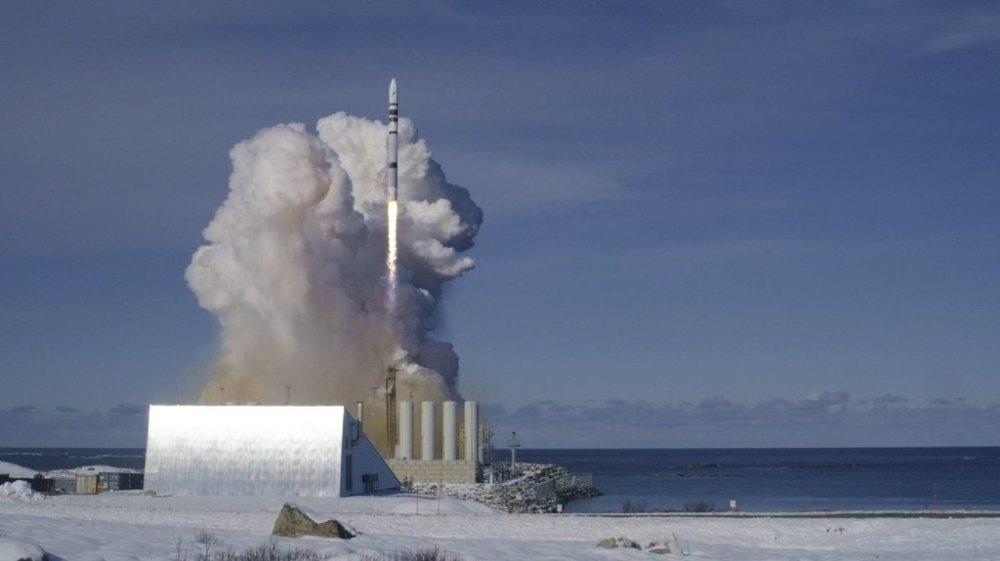
OSLO, Norway (AP) — A rocket by a private European aerospace company launched from Norway on Sunday and crashed into the sea 30 seconds later.
Despite the short test flight, Isar Aerospace said that it successfully completed the first test flight of its orbital launch vehicle by launching its Spectrum rocket from the island of Andøya in northern Norway.
The 28-meter-long (92-foot-long) Spectrum is a two-stage launch vehicle specifically designed to put small and medium satellites into orbit. The rocket lifted off from the pad at 12:30 p.m. (1030 GMT) Sunday and flew for about a half-minute before the flight was terminated, Isar said.

“This allowed the company to gather a substantial amount of flight data and experience to apply on future missions,” Isar said in a statement. “After the flight was terminated at T+30 seconds, the launch vehicle fell into the sea in a controlled manner.”
Video from the launch shows the rocket taking off from the pad, flying into the air and then coming back down to crash into the sea in a fiery explosion.
The launch was subject to various factors, including weather and safety, and Sunday’s liftoff followed a week of poor conditions, including a scrubbed launch on March 24 because of unfavorable winds, and on Saturday for weather restrictions.
“Our first test flight met all our expectations, achieving a great success,” Daniel Metzler, Isar’s chief executive and co-founder, said in the statement. “We had a clean liftoff, 30 seconds of flight and even got to validate our Flight Termination System.”
The company had largely ruled out the possibility of the rocket reaching orbit on its first complete flight, saying that it would consider a 30-second flight a success. Isar Aerospace aims to collect as much data and experience as possible on the first integrated test of all the systems on its in-house-developed launch vehicle.
Isar Aerospace is separate from the European Space Agency, or ESA, which is funded by its 23 member states.
“Success to get off the pad, and lots of data already obtained. I am sure @isaraerospace will learn a lot,” ESA Director General Josef Aschbacher posted on X. “Rocket launch is hard. Never give up, move forward with even more energy!”
ESA has been launching rockets and satellites into orbit for years, but mainly from French Guiana — an overseas department of France in South America — and from Cape Canaveral in Florida.