A stroke survivor speaks again with the help of an experimental brain-computer implant

Advertisement

Advertise with us

Scientists have developed a device that can translate thoughts about speech into spoken words in real time.

Read this article for free:


or

Already have an account? Log in here »

To continue reading, please subscribe:

Subscribe and receive a limited-edition Free Press branded hat or tote.

Digital Subscription

One year of digital access for only $205*

  • Enjoy unlimited reading on winnipegfreepress.com
  • Read the E-Edition, our digital replica newspaper
  • Access News Break, our award-winning app
  • Play interactive puzzles

*First annual payment billed as $205.00 + GST for one year. This annual subscription will automatically renew at $233.00 + GST every 52 weeks (10% off the regular annual price of $259.35). Offer available to new and qualified returning subscribers only. Cancel any time.

To continue reading, please subscribe:

Add Free Press access to your Brandon Sun subscription for only an additional

$1 for the first 4 weeks*

  • Enjoy unlimited reading on winnipegfreepress.com
  • Read the E-Edition, our digital replica newspaper
  • Access News Break, our award-winning app
  • Play interactive puzzles
Start now

*Your next Brandon Sun subscription payment will increase by $1.00 and you will be charged $17.95 plus GST for four weeks. After four weeks, your payment will increase to $24.95 plus GST every four weeks.

Hey there, time traveller!
This article was published 31/03/2025 (503 days ago), so information in it may no longer be current.

Scientists have developed a device that can translate thoughts about speech into spoken words in real time.

Although it’s still experimental, they hope the brain-computer interface could someday help give voice to those unable to speak.

A new study described testing the device on a 47-year-old woman with quadriplegia who couldn’t speak for 18 years after a stroke. Doctors implanted it in her brain during surgery as part of a clinical trial.
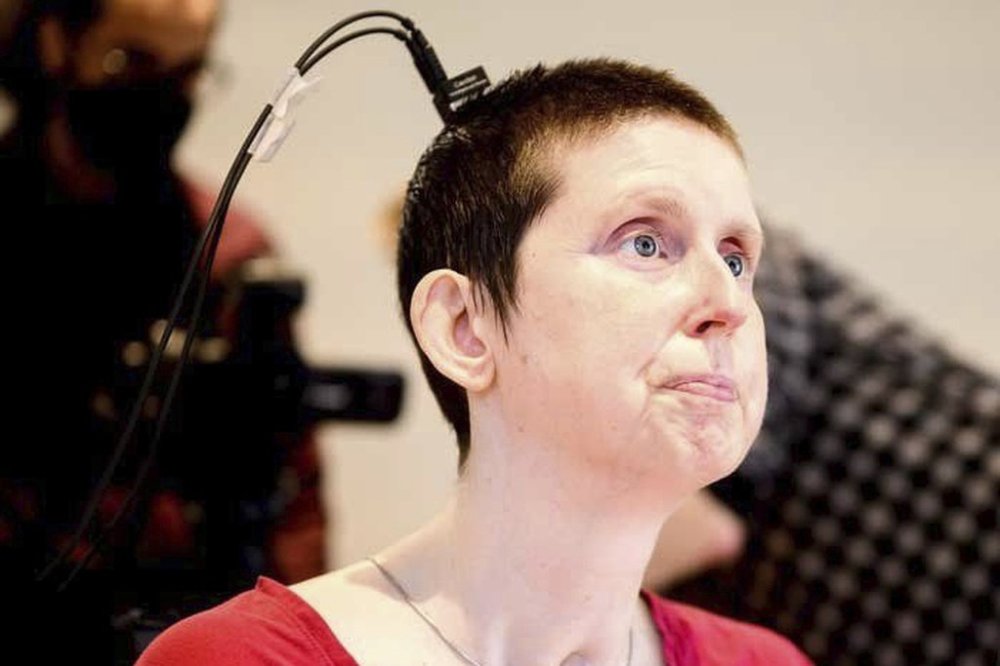
This photo provided by researchers at UCSF and UC Berkeley shows Ann, a participant in a study on speech neuroprostheses, in California in 2023. (Noah Berger/UCSF, UC Berkeley via AP)

It “converts her intent to speak into fluent sentences,” said Gopala Anumanchipalli, a co-author of the study published Monday in the journal Nature Neuroscience.

Other brain-computer interfaces, or BCIs, for speech typically have a slight delay between thoughts of sentences and computerized verbalization. Such delays can disrupt the natural flow of conversation, potentially leading to miscommunication and frustration, researchers said.

This is “a pretty big advance in our field,” said Jonathan Brumberg of the Speech and Applied Neuroscience Lab at the University of Kansas, who was not part of the study.

A team in California recorded the woman’s brain activity using electrodes while she spoke sentences silently in her brain. The scientists used a synthesizer they built using her voice before her injury to create a speech sound that she would have spoken. They trained an AI model that translates neural activity into units of sound.

It works similarly to existing systems used to transcribe meetings or phone calls in real time, said Anumanchipalli, of the University of California, Berkeley.

The implant itself sits on the speech center of the brain so that it’s listening in, and those signals are translated to pieces of speech that make up sentences. It’s a “streaming approach,” Anumanchipalli said, with each 80-millisecond chunk of speech – about half a syllable – sent into a recorder.

“It’s not waiting for a sentence to finish,” Anumanchipalli said. “It’s processing it on the fly.”

Decoding speech that quickly has the potential to keep up with the fast pace of natural speech, said Brumberg. The use of voice samples, he added, “would be a significant advance in the naturalness of speech.”

Though the work was partially funded by the National Institutes of Health, Anumanchipalli said it wasn’t affected by recent NIH research cuts. More research is needed before the technology is ready for wide use, but with “sustained investments,” it could be available to patients within a decade, he said.

___

The Associated Press Health and Science Department receives support from the Howard Hughes Medical Institute’s Science and Educational Media Group and the Robert Wood Johnson Foundation. The AP is solely responsible for all content.
Report Error Submit a Tip

More Stories

Today’s horoscope

Georgia Nicols 4 minute read Preview

Today’s horoscope

Georgia Nicols 4 minute read 2:00 AM CDT

MOON ALERT: There are no restrictions to shopping or important decisions today. The moon is in Libra.

ARIES (March 21-April 19)

The day is a mixed bag. For the most part, it’s romantic, friendly, congenial and a great time to socialize with others and enjoy playful activities with kids. Nevertheless, you might meet a real sourpuss or someone who is a wet blanket. Keep things light!

TAURUS (April 20-May 20)

Read
2:00 AM CDT

Big Loser’s latest a winning mix of country, folk

Ben Waldman 5 minute read Preview

Big Loser’s latest a winning mix of country, folk

Ben Waldman 5 minute read Yesterday at 6:00 AM CDT

The yellow trucker hat for sale on Facebook Marketplace said “Selkirk Lumber,” so Adam Wayne Brown knew he had to hammer home a deal.

Like the other millennial members of Winnipeg folk-country band Big Loser, the bassist has an affinity for the nostalgic, taking every opportunity — through music, through lyrics and through wardrobe — to recall the unique circumstances of growing up in a changing Interlake.

“I remember the matte yellow trucks driving around — the lumber trucks — and so I’ve had this strange memory of something disappearing from my youth and then persisting,” says Brown, who, like the band’s frontman Alex Paradoski, moved to Winnipeg more than a decade ago.

“I have a photo of the Lockport Bridge in my dining room,” chimes in Paradoski, whose first job as a teenager was bunning wieners and chopping fries at Skinner’s, a drive-in mainstay since 1929 along Highway 44.

Read
Yesterday at 6:00 AM CDT

Oliveira shines in win over Redblacks, Collaros rocked again

Taylor Allen 5 minute read Preview

Oliveira shines in win over Redblacks, Collaros rocked again

Taylor Allen 5 minute read Yesterday at 8:57 PM CDT

It wasn’t a stellar performance by any stretch.

But at this point, the Winnipeg Blue Bombers will take a win no matter what it looks like.

The Blue and Gold outlasted the winless Ottawa Redblacks 33-21 on a rainy Friday night at Princess Auto Stadium to improve to 5-4.

“It’s great to finally get a win at home for our fans and to go out and play a better game is very encouraging,” said right guard Patrick Neufeld.

Read
Yesterday at 8:57 PM CDT

Could renewed interest in strategically critical rare earth elements finally make sub-sector profitable?

Joel Schlesinger 6 minute read Preview

Could renewed interest in strategically critical rare earth elements finally make sub-sector profitable?

Joel Schlesinger 6 minute read Yesterday at 3:00 AM CDT

Rare earth elements are among the most critical of mined resources for modern economies.

They’re essential in manufacturing specialized magnets used in a host of technologies from wind turbines and electric vehicles to hard drives, smartphones, television screens, and fibre optics. Most notably, however, rare earth minerals are increasingly vital to the defence industry.

These 17 elements — closely related chemically and usually found all together in mineral deposits — have indeed been growing in geopolitical importance as the United States, Canada and other Western nations recognize their dependence on production from China.

It is the world’s largest producer and processor of rare earths, including the most in-demand elements neodymium and praseodymium used to manufacture very light and powerful magnets for an array of technologies, including the most advanced weapons of modern warfare.

Read
Yesterday at 3:00 AM CDT

Corroded Arlington overpass yields way for new hope of spanning urban chasm

Melissa Martin 6 minute read Preview

Corroded Arlington overpass yields way for new hope of spanning urban chasm

Melissa Martin 6 minute read Yesterday at 2:00 AM CDT

It’s an interesting quirk of timing, perhaps, that the end of two of Winnipeg’s most unlovely features are coming into view in the same few weeks. The rail lines that split the city in half, and the bridge that was built to tie it back together. The original problem, and the solution.

And in the confluence of those two ends, we have an opportunity to dream of what a better Winnipeg can be.

At a news conference on Wednesday, former federal transport minister Lloyd Axworthy laid out a vision for a rail line bypass that would remove more than 120 railway crossings from Winnipeg, route them through Crown and Manitoba Hydro corridor land south of the city, and reclaim 250 acres in the urban core for greenspace and development.

The next step is to focus on how to make it happen. Nothing of this scope comes easy. This new bypass plan emerged from a two-year feasibility study that Premier Wab Kinew had tasked Axworthy with back in 2024. Now, Axworthy will helm a new 90-day feasibility study zooming in on that route specifically.

Read
Yesterday at 2:00 AM CDT

West Kildonan Industrial residents call for speed bumps after child hit by truck

Morgan Modjeski 3 minute read Preview

West Kildonan Industrial residents call for speed bumps after child hit by truck

Morgan Modjeski 3 minute read Updated: Yesterday at 3:09 PM CDT

Residents in the West Kildonan Industrial neighbourhood are calling on the city to install speed bumps in their area after a child was hit and dragged by a vehicle Thursday.

Katelyn Bemister lives near the area where the child — who was hospitalized as a result of the incident and has been upgraded to stable condition — was struck. She says people frequently speed in the area.

“They’re going really fast, and they’re not really paying attention at all to the pedestrians in the area,” says Bemister.

In video supplied to the Free Press by a resident, the child can be seen riding a bike down a sidewalk along the 500 block of North Point Boulevard.

Read
Updated: Yesterday at 3:09 PM CDT