A day at Uranus just got 28 seconds longer
Advertisement
Read this article for free:
or
Already have an account? Log in here »
To continue reading, please subscribe:

Digital Subscription
One year of digital access for only $205*
- Enjoy unlimited reading on winnipegfreepress.com
- Read the E-Edition, our digital replica newspaper
- Access News Break, our award-winning app
- Play interactive puzzles
*First annual payment billed as $205.00 + GST for one year. This annual subscription will automatically renew at $233.00 + GST every 52 weeks (10% off the regular annual price of $259.35). Offer available to new and qualified returning subscribers only. Cancel any time.
To continue reading, please subscribe:
Add Free Press access to your Brandon Sun subscription for only an additional
$1 for the first 4 weeks*
- Enjoy unlimited reading on winnipegfreepress.com
- Read the E-Edition, our digital replica newspaper
- Access News Break, our award-winning app
- Play interactive puzzles
*Your next Brandon Sun subscription payment will increase by $1.00 and you will be charged $17.95 plus GST for four weeks. After four weeks, your payment will increase to $24.95 plus GST every four weeks.
Read unlimited articles for free today:
or
Already have an account? Log in here »
Hey there, time traveller!
This article was published 07/04/2025 (540 days ago), so information in it may no longer be current.
CAPE CANAVERAL, Fla. (AP) — A day at Uranus just got a little longer.
Scientists reported Monday that observations by the Hubble Space Telescope have confirmed it takes Uranus 17 hours, 14 minutes and 52 seconds to complete a full rotation. That’s 28 seconds longer than estimates by NASA’s Voyager 2 spacecraft in the 1980s.
A French-led team studied a decade’s worth of aurora observations at the ice giant to track its magnetic poles. That long-term tracking provided a more precise rotation period for Uranus, the seventh planet from the sun. From that distance, it takes about 84 Earth years for Uranus to orbit the sun.
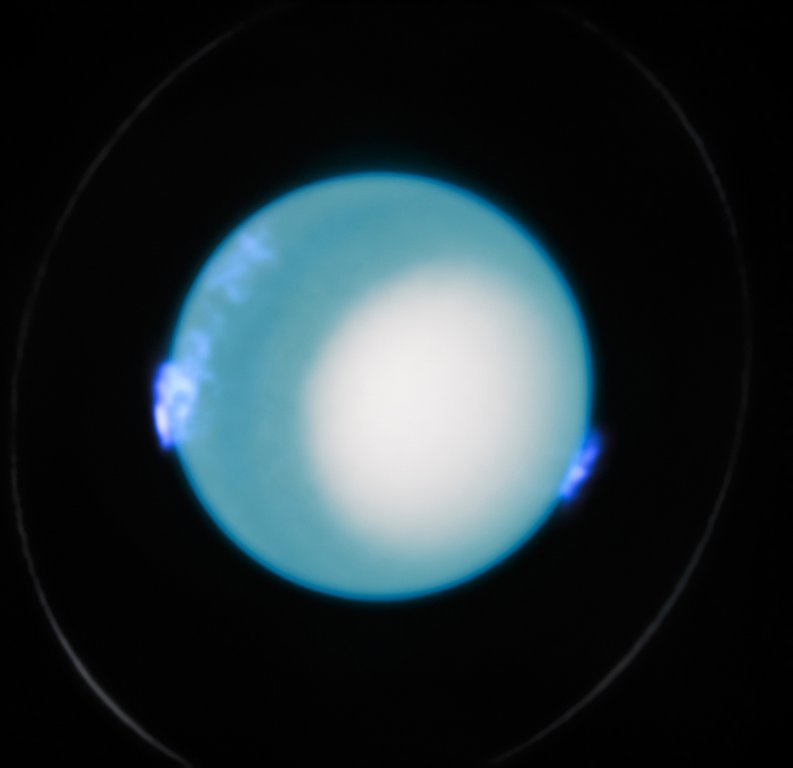
“The continuous observations from Hubble were crucial,” lead author Laurent Lamy of the Paris Observatory said in a statement.
Lamy and his international team said this new approach can help pinpoint the rotation of any world with auroras and a magnetosphere.
Published in the journal Nature Astronomy, the findings come a few weeks before the 35th anniversary of Hubble’s launch. NASA’s space shuttle Discovery delivered the space telescope to orbit on April 24, 1990.
___
The Associated Press Health and Science Department receives support from the Howard Hughes Medical Institute’s Science and Educational Media Group and the Robert Wood Johnson Foundation. The AP is solely responsible for all content.