

Altar found in Guatemalan jungle evidence of mingling of Mayan and Teotihuacan cultures, experts say
Advertisement
Read this article for free:
or
Already have an account? Log in here »
To continue reading, please subscribe:
Monthly Digital Subscription
$1 per week for 24 weeks*
- Enjoy unlimited reading on winnipegfreepress.com
- Read the E-Edition, our digital replica newspaper
- Access News Break, our award-winning app
- Play interactive puzzles
*Billed as $4.00 plus GST every four weeks. After 24 weeks, price increases to the regular rate of $19.95 plus GST every four weeks. Offer available to new and qualified returning subscribers only. Cancel any time.
Monthly Digital Subscription
$4.99/week*
- Enjoy unlimited reading on winnipegfreepress.com
- Read the E-Edition, our digital replica newspaper
- Access News Break, our award-winning app
- Play interactive puzzles
*Billed as $19.95 plus GST every four weeks. Cancel any time.
To continue reading, please subscribe:
Add Free Press access to your Brandon Sun subscription for only an additional
$1 for the first 4 weeks*
*Your next subscription payment will increase by $1.00 and you will be charged $16.99 plus GST for four weeks. After four weeks, your payment will increase to $23.99 plus GST every four weeks.
Read unlimited articles for free today:
or
Already have an account? Log in here »
Hey there, time traveller!
This article was published 07/04/2025 (353 days ago), so information in it may no longer be current.
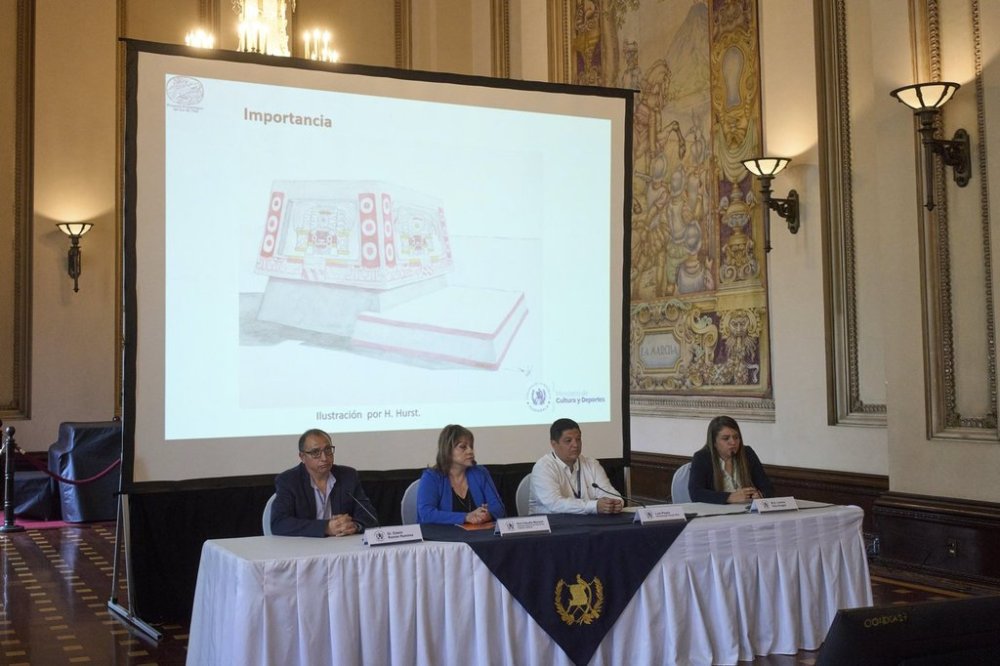
GUATEMALA CITY (AP) — An altar from the Teotihuacan culture, at the pre-Hispanic heart of what became Mexico, was discovered in Tikal National Park in Guatemala, the center of Mayan culture, demonstrating the interaction between the two societies, Guatemala’s Culture and Sports Ministry announced Monday.
The enormous city-state of Tikal, whose towering temples still stand in the jungle, battled for centuries with the Kaanul dynasty for dominance of the Maya world.
Far to the north in Mexico, just outside present day Mexico City, Teotihuacan — “the city of the gods” or “the place where men become gods” — is best known for its twin Temples of the Sun and Moon. It was actually a large city that housed over 100,000 inhabitants and covered around 8 square miles (20 square kilometers).
The still mysterious city was one of the largest in the world at its peak between 100 B.C. and A.D. 750. But it was abandoned before the rise of the Aztecs in the 14th century.
Lorena Paiz, the archaeologist who led the discovery, said that the Teotihuacan altar was believed to have been used for sacrifices, “especially of children.”
“The remains of three children not older than 4 years were found on three sides of the altar,” Paiz told The Associated Press.
“The Teotihuacan were traders who traveled all over the country (Guatemala),” Paiz said. “The Teotihuacan residential complexes were houses with rooms and in the center altars; that’s what the residence that was found is like, with an altar with the figure representing the Storm Goddess.”
It took archaeologists 1 1/2 years to uncover the altar in a dwelling and analyze it before the announcement.
Edwin Román, who leads the South Tikal Archaeological Project within the park, said the discovery shows the sociopolitical and cultural interaction between the Maya of Tikal and Teotihuacan’s elite between 300 and 500 A.D.
Román said the discovery also reinforces the idea that Tikal was a cosmopolitan center at that time, a place where people visited from other cultures, affirming its importance as a center of cultural convergence.

María Belén Méndez, an archaeologist who was not involved with the project, said the discovery confirms “that there has been an interconnection between both cultures and what their relationships with their gods and celestial bodies was like.”
“We see how the issue of sacrifice exists in both cultures. It was a practice; it’s not that they were violent, it was their way of connecting with the celestial bodies,” she said.
The altar is just over a yard (1 meter) wide from east to west and nearly 2 yards (2 meters) from north to south. It is about a yard (1 meter) tall and covered with limestone.
The dwelling where it was found had anthropomorphic figures with tassels in red tones, a detail from the Teotihuacan culture, according to the ministry’s statement.
Tikal National Park is about 325 miles (525 kilometers) north of Guatemala City, and the discovery site is guarded and there are no plans to open it to the public.