Scientists genetically engineer wolves with white hair and muscular jaws like the extinct dire wolf

Advertisement

Advertise with us

Three genetically engineered wolves that may resemble extinct dire wolves are trotting, sleeping and howling in an undisclosed secure location in the U.S., according to the company that aims to bring back lost species.

Read this article for free:


or

Already have an account? Log in here »

To continue reading, please subscribe:

Subscribe and receive a limited-edition Free Press branded hat or tote.

Digital Subscription

One year of digital access for only $205*

  • Enjoy unlimited reading on winnipegfreepress.com
  • Read the E-Edition, our digital replica newspaper
  • Access News Break, our award-winning app
  • Play interactive puzzles

*First annual payment billed as $205.00 + GST for one year. This annual subscription will automatically renew at $233.00 + GST every 52 weeks (10% off the regular annual price of $259.35). Offer available to new and qualified returning subscribers only. Cancel any time.

To continue reading, please subscribe:

Add Free Press access to your Brandon Sun subscription for only an additional

$1 for the first 4 weeks*

  • Enjoy unlimited reading on winnipegfreepress.com
  • Read the E-Edition, our digital replica newspaper
  • Access News Break, our award-winning app
  • Play interactive puzzles
Start now

*Your next Brandon Sun subscription payment will increase by $1.00 and you will be charged $17.95 plus GST for four weeks. After four weeks, your payment will increase to $24.95 plus GST every four weeks.

Hey there, time traveller!
This article was published 07/04/2025 (513 days ago), so information in it may no longer be current.

Three genetically engineered wolves that may resemble extinct dire wolves are trotting, sleeping and howling in an undisclosed secure location in the U.S., according to the company that aims to bring back lost species.

The wolf pups, which range in age from three to six months old, have long white hair, muscular jaws and already weigh in at around 80 pounds — on track to reach 140 pounds at maturity, researchers at Colossal Biosciences reported Monday.

Dire wolves, which went extinct more than 10,000 years old, are much larger than gray wolves, their closest living relatives today.
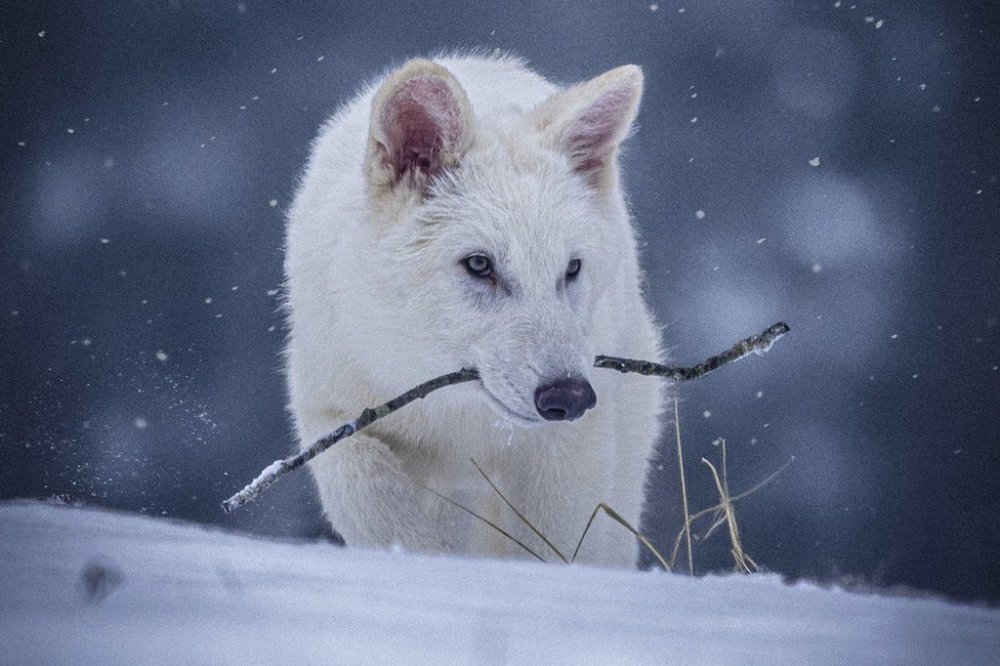
This undated photo provided by Colossal Biosciences shows a young wolf that was genetically engineered with similarities to the extinct dire wolf. (Colossal Biosciences via AP)

Independent scientists said this latest effort doesn’t mean dire wolves are coming back to North American grasslands any time soon.

“All you can do now is make something look superficially like something else”— not fully revive extinct species, said Vincent Lynch, a biologist at the University at Buffalo who was not involved in the research.

Colossal scientists learned about specific traits that dire wolves possessed by examining ancient DNA from fossils. The researchers studied a 13,000 year-old dire wolf tooth unearthed in Ohio and a 72,000 year-old skull fragment found in Idaho, both part of natural history museum collections.

Then the scientists took blood cells from a living gray wolf and used CRISPR to genetically modify them in 20 different sites, said Colossal’s chief scientist Beth Shapiro. They transferred that genetic material to an egg cell from a domestic dog. When ready, embryos were transferred to surrogates, also domestic dogs, and 62 days later the genetically engineered pups were born.

Colossal has previously announced similar projects to genetically alter cells from living species to create animals resembling extinct woolly mammoths, dodos and others.

Though the pups may physically resemble young dire wolves, “what they will probably never learn is the finishing move of how to kill a giant elk or a big deer,” because they won’t have opportunities to watch and learn from wild dire wolf parents, said Colossal’s chief animal care expert Matt James.

Colossal also reported today that it had cloned four red wolves using blood drawn from wild wolves of the southeastern U.S.’s critically endangered red wolf population. The aim is to bring more genetic diversity into the small population of captive red wolves, which scientists are using to breed and help save the species.

This technology may have broader application for conservation of other species because it’s less invasive than other techniques to clone animals, said Christopher Preston, a wildlife expert at the University of Montana who was not involved in the research. But it still requires a wild wolf to be sedated for a blood draw and that’s no simple feat, he added.

Colossal CEO Ben Lamm said the team met with officials from the U.S. Interior Department in late March about the project. Interior Secretary Doug Burgum praised the work on X on Monday as a “thrilling new era of scientific wonder” even as outside scientists said there are limitations to restoring the past.

“Whatever ecological function the dire wolf performed before it went extinct, it can’t perform those functions” on today’s existing landscapes, said Buffalo’s Lynch.

___

The Associated Press Health and Science Department receives support from the Howard Hughes Medical Institute’s Science and Educational Media Group and the Robert Wood Johnson Foundation. The AP is solely responsible for all content.

Report Error Submit a Tip

More Stories

New businesses start to creep up in former Winnipeg Slurpee shops

Tiago Resko 5 minute read Preview

New businesses start to creep up in former Winnipeg Slurpee shops

Tiago Resko 5 minute read Thursday, Aug. 27, 2026

The remnants of 7-Eleven can still be seen as new businesses move into spaces where Slurpee machines and taquitos once ruled.

As fresh paint dries on several new ventures — such as a pizza place and a convenience store with a name that might make a customer do a double-take — holes across Winnipeg once occupied by the international convenience chain are slowly being filled.

Business at a Domino’s Pizza in Elmwood, formerly a 7-Eleven, has been booming since it opened June 1, the store manager said.

“The issues that 7-Eleven would have had might be different than what we would have. They were dealing with a lot of theft where people can just walk in and out, but Domino’s isn’t set up that way,” said Paul Hemmerling.

Read
Thursday, Aug. 27, 2026

Autumn need not be melancholy forever

Maureen Scurfield 5 minute read Yesterday at 2:00 AM CDT

DEAR MISS LONELYHEARTS: Autumn is almost here (the most beautiful time of the year) but it always puts me in mind of my dearest love — a young man from my university days who died tragically in the fall, a couple decades ago. I lost him forever!

How can I get through this time, when it feels like I’ve been punched in the gut every September, and I have to stay home in bed pretending to have flu for a week or more?

— Numbing Out Again, Headingley

Dear Numb: See your physician and confess that you haven’t been able to heal this serious emotional wound. You should really book a visit to a psychiatrist, sooner rather than later, as this tragic loss from the past incapacitates you every fall. A professional therapist can help you to carefully undo these painful “knots,” and a psychiatrist would also be able to prescribe medication that could help you with the process of getting into an improved state of mind. That way, you won’t fall back into a serious state of mourning every autumn.

Filtering the worst of our behaviour

Gwynne Dyer 5 minute read 2:00 AM CDT

On Sunday, Aug. 30, a Falcon Heavy rocket delivered the Nancy Grace Roman space telescope onto a direct transfer trajectory to its permanent home at the Lagrange Two Point (L2), 1.5-million km from Earth. In 100 days it will reach its station, power up, and start observing the universe.

Astronomers will use it to try to understand the nature of dark matter, which makes up most of the mass in the universe (but some say may not even exist).

It is expected to find up to 100,000 new exoplanets circling other stars, and may be able to spot ones even smaller than Mars. Current methods can only see much bigger ones.

It will test a new technology called a coronagraph, which may one day be able to detect life on some of those planets by analyzing the light reflected from them. It would be nice to have a better answer to scientist Enrico Fermi’s famous question: “Where is everybody?”

Scientists genetically engineer wolves with white hair and muscular jaws like the extinct dire wolf

Christina Larson, The Associated Press 4 minute read Preview

Scientists genetically engineer wolves with white hair and muscular jaws like the extinct dire wolf

Christina Larson, The Associated Press 4 minute read Tuesday, Apr. 8, 2025

Three genetically engineered wolves that may resemble extinct dire wolves are trotting, sleeping and howling in an undisclosed secure location in the U.S., according to the company that aims to bring back lost species.

The wolf pups, which range in age from three to six months old, have long white hair, muscular jaws and already weigh in at around 80 pounds — on track to reach 140 pounds at maturity, researchers at Colossal Biosciences reported Monday.

Dire wolves, which went extinct more than 10,000 years old, are much larger than gray wolves, their closest living relatives today.

Independent scientists said this latest effort doesn't mean dire wolves are coming back to North American grasslands any time soon.

Read
Tuesday, Apr. 8, 2025

At last, some good news on homelessness

Editorial 4 minute read Preview

At last, some good news on homelessness

Editorial 4 minute read Yesterday at 2:00 AM CDT

There is no shortage of reasons to be frustrated about homelessness in Winnipeg. But the latest numbers provide something that has been increasingly difficult to find — evidence that at least some things are getting better.

Read
Yesterday at 2:00 AM CDT

Port of Churchill celebrates first grain shipment in six years

Aaron Epp 5 minute read Preview

Port of Churchill celebrates first grain shipment in six years

Aaron Epp 5 minute read Monday, Aug. 31, 2026

Approximately 30,000 tonnes of Canadian durum wheat from Saskatchewan-based AGT Foods is being loaded at the northern Manitoba port and will be shipped to customers in Europe.

Read
Monday, Aug. 31, 2026