A colossal squid is caught on camera for the first time in the deep sea
Advertisement
Read this article for free:
or
Already have an account? Log in here »
To continue reading, please subscribe:

Digital Subscription
One year of digital access for only $205*
- Enjoy unlimited reading on winnipegfreepress.com
- Read the E-Edition, our digital replica newspaper
- Access News Break, our award-winning app
- Play interactive puzzles
*First annual payment billed as $205.00 + GST for one year. This annual subscription will automatically renew at $233.00 + GST every 52 weeks (10% off the regular annual price of $259.35). Offer available to new and qualified returning subscribers only. Cancel any time.
To continue reading, please subscribe:
Add Free Press access to your Brandon Sun subscription for only an additional
$1 for the first 4 weeks*
- Enjoy unlimited reading on winnipegfreepress.com
- Read the E-Edition, our digital replica newspaper
- Access News Break, our award-winning app
- Play interactive puzzles
*Your next Brandon Sun subscription payment will increase by $1.00 and you will be charged $17.95 plus GST for four weeks. After four weeks, your payment will increase to $24.95 plus GST every four weeks.
Read unlimited articles for free today:
or
Already have an account? Log in here »
Hey there, time traveller!
This article was published 16/04/2025 (502 days ago), so information in it may no longer be current.
A colossal squid has been caught on camera for the first time in the deep sea by an international team of researchers steering a remotely operated submersible.
The sighting was announced Tuesday by the Schmidt Ocean Institute.
The squid filmed was a juvenile about 1 foot (30 centimeters) in length at a depth of 1,968 feet (600 meters) in the South Atlantic Ocean. Full-grown adult colossal squids, which scientists have uncovered from the bellies of whales and seabirds, can reach lengths up to 23 feet (7 meters) — almost the size of a small fire truck.
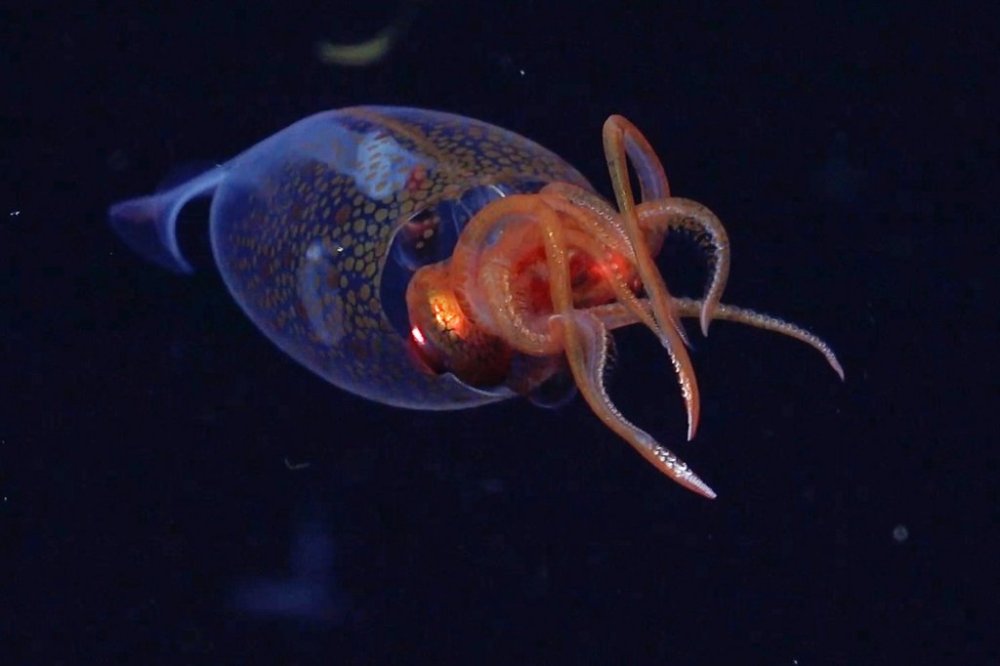
The squid was spied last month near the South Sandwich Islands during an expedition to search for new sea life. Researchers waited to verify the species identification with other independent scientists before releasing the footage.
“I really love that we have seen a young colossal squid first. This animal is so beautiful,” said Kat Bolstad, a squid researcher at the Auckland University of Technology in New Zealand, who helped confirm it.
Researchers are testing different cameras in hopes of catching an adult colossal squid, Bolstad said.
The young squid is almost entirely transparent, with thin arms. As adults, the squids lose this glassy appearance and become an opaque dark red or purple. When full grown, they are considered to be the world’s largest known invertebrates.
___
AP video journalist Mustakim Hasnath contributed to this report.
___
The Associated Press Health and Science Department receives support from the Howard Hughes Medical Institute’s Science and Educational Media Group and the Robert Wood Johnson Foundation. The AP is solely responsible for all content.