B.C. researchers confirm footprints of three-toed dinosaur with club-like tail
Advertisement
Read this article for free:
or
Already have an account? Log in here »
To continue reading, please subscribe:

Digital Subscription
One year of digital access for only $205*
- Enjoy unlimited reading on winnipegfreepress.com
- Read the E-Edition, our digital replica newspaper
- Access News Break, our award-winning app
- Play interactive puzzles
*First annual payment billed as $205.00 + GST for one year. This annual subscription will automatically renew at $233.00 + GST every 52 weeks (10% off the regular annual price of $259.35). Offer available to new and qualified returning subscribers only. Cancel any time.
To continue reading, please subscribe:
Add Free Press access to your Brandon Sun subscription for only an additional
$1 for the first 4 weeks*
- Enjoy unlimited reading on winnipegfreepress.com
- Read the E-Edition, our digital replica newspaper
- Access News Break, our award-winning app
- Play interactive puzzles
*Your next Brandon Sun subscription payment will increase by $1.00 and you will be charged $17.95 plus GST for four weeks. After four weeks, your payment will increase to $24.95 plus GST every four weeks.
Read unlimited articles for free today:
or
Already have an account? Log in here »
Hey there, time traveller!
This article was published 18/04/2025 (539 days ago), so information in it may no longer be current.
Armoured dinosaurs with clubbed tails once roamed in what is now northeastern British Columbia, a new study suggests, leaving three-toed footprints across the landscape when the Rocky Mountains were still in their infancy.
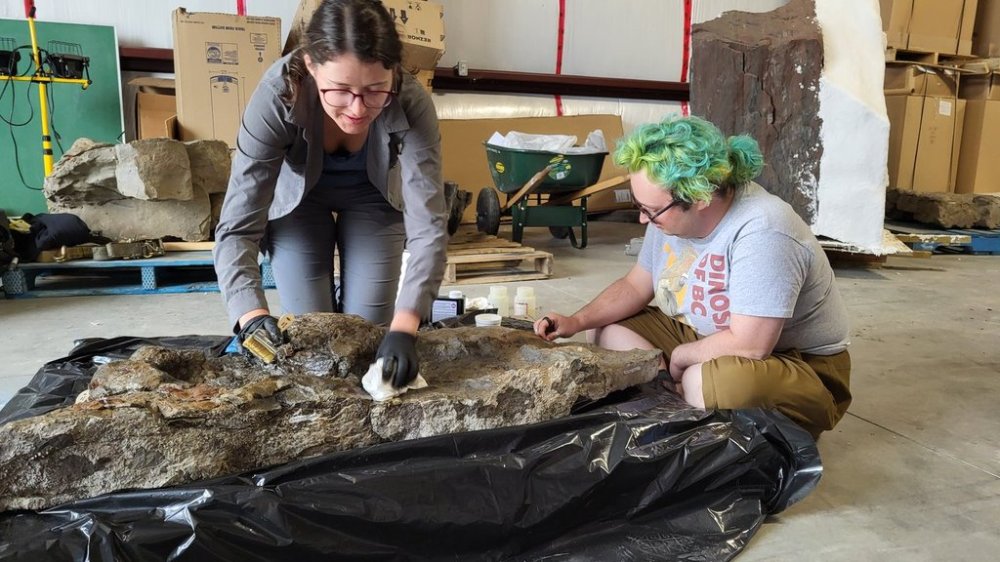
The study published this month in the peer-reviewed Journal of Vertebrate Paleontology analyzed fossilized footprints dating back about 100 million years in the Tumbler Ridge area, northeast of Prince George, as well as northwestern Alberta.
It concluded the tracks belonged to a species of ankylosaurid ankylosaurs, which had a clubbed tail and three toes on its hind feet, said Victoria Arbour, one of the researchers and curator of paleontology at the Royal BC Museum.
“It’s actually the first time we’ve identified them anywhere,” she said.
“It had been recognized … that these were footprints from ankylosaurs, from armoured dinosaurs. But what exactly kind of armoured dinosaur wasn’t really clear until now,” said Arbour, who is an evolutionary biologist and vertebrate paleontologist who specializes in the study of armoured dinosaurs.
The researchers named the species Ruopodosaurus clava, meaning “the tumbled-down lizard with a club (or) mace,” a statement from the Royal BC Museum said.
The finding doesn’t mean the area of northern B.C. and Alberta is the only place where the dinosaurs existed. The new research could be used to inform fresh analysis of fossilized tracks found elsewhere in the world, Arbour said.
“That’s often what happens is things click into place off one set of fossils and then other people run with that and go ‘Oh, you know what, we also have that, now that we know what we’re looking for,'” she said.
Arbour said ankylosaurid ankylosaurs differed from another type of better-known ankylosaurs, nodosaurid, which had a flexible tail and four hind toes.
“The nodosaurid footprints are called tetrapodosaurus. It just means four-toed lizard, and those have been known from British Columbia for a really long time and now we see them all over the world,” said Arbour.
But a different kind of three-toed footprint had been cropping up less often over the last two decades, pointing to a different kind of dinosaur, she said.
“It had just been kind of a mystery beforehand,” she said of the dinosaur responsible for leaving behind the three-toed tracks.
“Some of the footprints were found by just like members of town, people out hiking,” she added.
Arbour said Charles Helm, scientific adviser at the Tumbler Ridge Museum, had invited her to work together to interpret several of the three-toed footprints.
The researchers used skeletons of other species of tail-clubbed ankylosaurs to draw the linkage and conclusions about the tracks, she said.
The footprints measure about 30 centimetres in length, suggesting the animal would have been about five to six metres long, she said.
“Ankylosaurus as a group are very sort of short, fat dinosaurs,” she said. “They’ve got kind of short little legs and wide, wide bodies.”
Their most unique characteristics are the array of bony plates and spikes covering their bodies along with their club-like tail and three-toed hind feet, Arbour said.
The armour would have served to protect the mostly plant-eating dinosaurs from predators, while Arbour said her previous research suggests they may have used their clubbed tails to fight each other over territory, food or mates.
Arbour said tail-clubbed ankylosaurs have not been well documented in the fossil record in North America from around the same time period as the footprints.
The new research confirms their presence.
“They’re definitely here, we just aren’t finding their skeletons for some reason, and now, you know, that might also prompt us to (say), ‘OK, where can we go look for some bones?'” Arbour said.
In the statement issued by the Royal BC Museum, Helm said ankylosaurs and Tumbler Ridge have been “synonymous” ever since two boys discovered an ankylosaur trackway close to the community 25 years ago.
“It is really exciting to now know through this research that there are two types of ankylosaurs that called this region home, and that Ruopodosaurus has only been identified in this part of Canada,” he said.
Arbour said the ankylosaurs lived at a time when the Tumbler Ridge area consisted of expansive coastal floodplains, with the Rocky Mountains still in the process of rising up, with a “big inland seaway” to the east.
“There are other dinosaurs in this environment, so there’s some sort of small- and medium-sized meat eaters,” she said.
“There’s some relatives of duck-billed dinosaurs,” she said, adding previous research has also indicated “giant crocodiles” were part of the biodiversity mix at the time.
This report by The Canadian Press was first published April 18, 2025.