Canadians mark Victory in Europe Day in downtown ceremonies

Advertisement

Advertise with us

OTTAWA - Veterans, diplomats, members of the Armed Forces and political leaders gathered Thursday at events across Canada commemorating the 80th anniversary of the end of the Second World War in Europe.

Read this article for free:


or

Already have an account? Log in here »

To continue reading, please subscribe:

Subscribe and receive a limited-edition Free Press branded hat or tote.

Digital Subscription

One year of digital access for only $205*

  • Enjoy unlimited reading on winnipegfreepress.com
  • Read the E-Edition, our digital replica newspaper
  • Access News Break, our award-winning app
  • Play interactive puzzles

*First annual payment billed as $205.00 + GST for one year. This annual subscription will automatically renew at $233.00 + GST every 52 weeks (10% off the regular annual price of $259.35). Offer available to new and qualified returning subscribers only. Cancel any time.

To continue reading, please subscribe:

Add Free Press access to your Brandon Sun subscription for only an additional

$1 for the first 4 weeks*

  • Enjoy unlimited reading on winnipegfreepress.com
  • Read the E-Edition, our digital replica newspaper
  • Access News Break, our award-winning app
  • Play interactive puzzles
Start now

*Your next Brandon Sun subscription payment will increase by $1.00 and you will be charged $17.95 plus GST for four weeks. After four weeks, your payment will increase to $24.95 plus GST every four weeks.

Hey there, time traveller!
This article was published 08/05/2025 (468 days ago), so information in it may no longer be current.

OTTAWA – Veterans, diplomats, members of the Armed Forces and political leaders gathered Thursday at events across Canada commemorating the 80th anniversary of the end of the Second World War in Europe.

“Nearly every family knows somebody who suffered from the effect of war,” said Fraser McKee, a 100-year-old veteran who helped to lay a wreath at the Toronto ceremony.

“This is to remember people that will have to go to war, as well as remembering those that went and didn’t come back.”
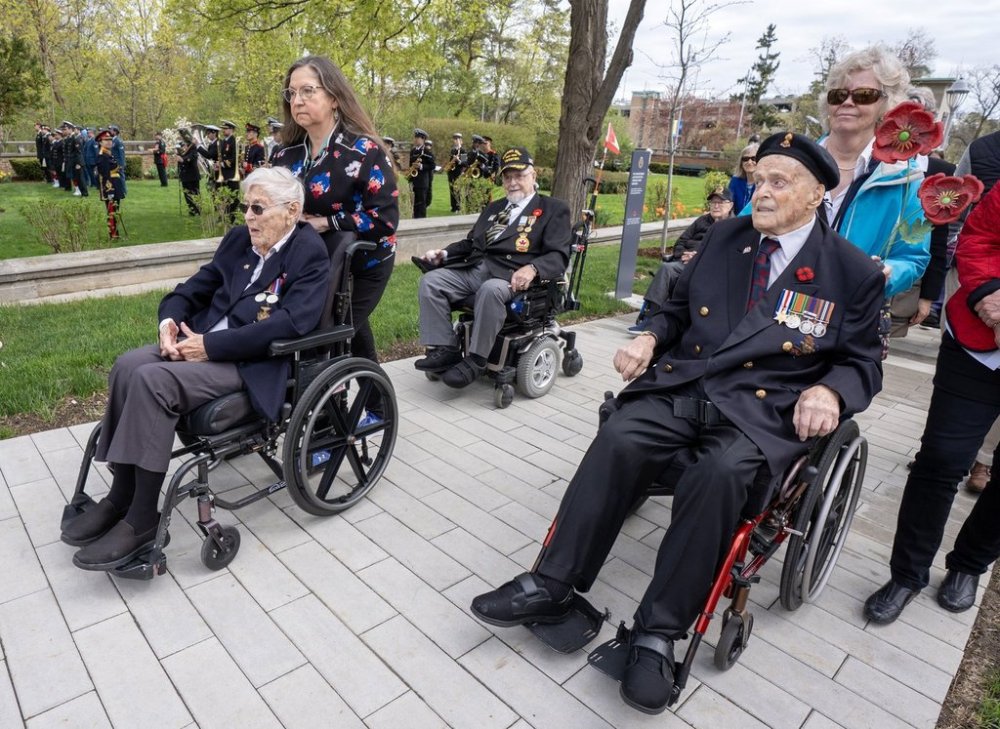
Veterans arrive to commemorate the 80th Anniversary of the Liberation of the Nethelands at a ceremony in Toronto, Tuesday, May 6, 2025. THE CANADIAN PRESS/Frank Gunn

Canadians and Allied soldiers accepted the surrender of German forces in the Netherlands on May 5, 1945. The remaining German forces subsequently surrendered across Europe and May 8, 1945, was declared Victory in Europe Day.

At the National War Memorial in Ottawa on Thursday, the head of the Canadian military said the day marks the end of a conflict that cost the country dearly but brought it closer to its allies.

“Row upon row of Canadian war graves bear witness to this enormous sacrifice,” said Chief of the Defence Staff Gen. Jennie Carignan.

“A sacrifice met with lasting gratitude that has not faded with time, but instead blossomed into some of our strongest friendships.”

Dutch Ambassador to Canada Margriet Vonno said children in the Netherlands have been taught for decades that their freedom came at the cost of Canadian lives.

“We remember the war vividly. The brutality of the Nazi occupation, the hunger,” she said.

“If anyone believes the liberation of Holland was a cakewalk, they should know 7,600 Canadians (are) buried in those cemeteries, and that sacrifice will never be forgotten.”

Dozens gathered at the cenotaph in Ottawa to hear speeches and musical performances, including two songs that were popular during the Second World War.

Retired corporal Matthew Carson, who served in Europe during the Cold War, said after the ceremony that he hopes the events remind Canadians about the importance of preventing wars.

“It probably instilled a little vigour in people’s memories, to know what we have and what we’re fighting for,” said Carson, 86.

He added that U.S. President Donald Trump’s talk of annexing Canada is “definitely” relevant to how Canadians see their country now.
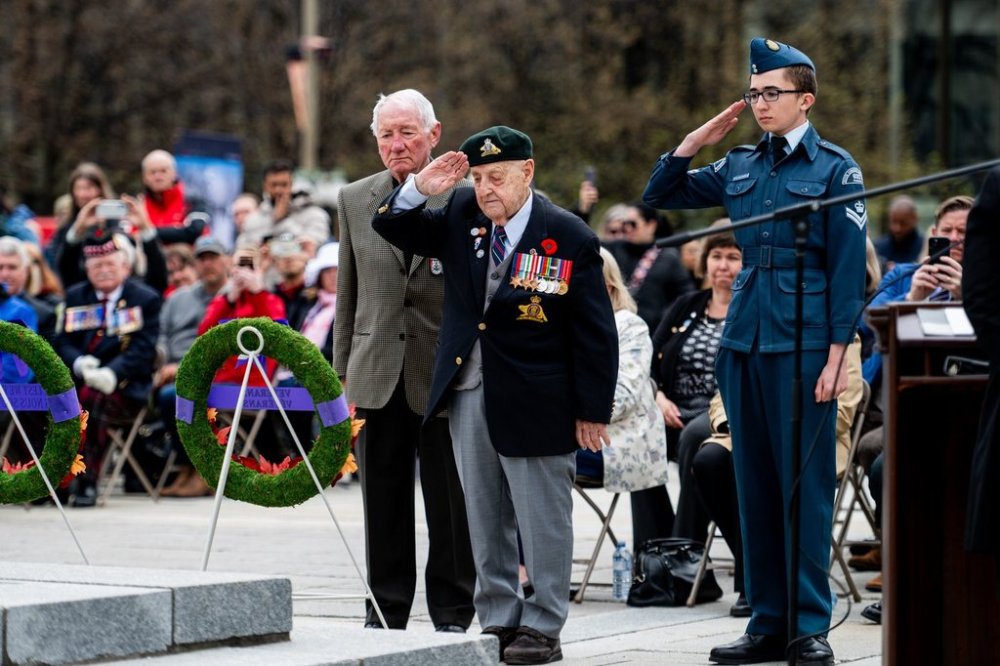
Second World War veteran Roland Lalonde, centre, salutes after placing a wreath with fellow Second World War veteran Roy Martel during a ceremony marking the 80th anniversary of the Liberation of the Netherlands and Victory in Europe Day at the National War Memorial in Ottawa on Thursday, May 8, 2025. THE CANADIAN PRESS/Spencer Colby

“It’s too bad that it takes political pressure from outside the country to make us realize what we have here,” he said.

At a wreath-laying ceremony at the Victory-Peace Monument in Coronation Park in Toronto, members of the Canadian Armed Forces band played the national anthems of Canada and the Netherlands under a large Canadian flag waving in the wind.

McKee, who served in the Royal Canadian Navy during the Second World War, said V-E Day should remind Canadians that those who served were “ordinary people” who risked their lives to protect others.

Toronto Mayor Olivia Chow, who also laid a wreath at the monument, said it’s a “sacred duty” to never forget the sacrifices of veterans and active service members.

“We owe them a debt of gratitude that can never be fully repaid,” said Chow.

— With files from Rianna Lim in Toronto

This report by The Canadian Press was first published May 8, 2025.

Report Error Submit a Tip

More Stories

An ambassador, a petition and 213,000 signatures

Editorial 4 minute read Preview

An ambassador, a petition and 213,000 signatures

Editorial 4 minute read Yesterday at 2:00 AM CDT

You have to admit, they have a point.

As of 7 a.m. on Monday, 209,909 Canadians had signed it. By 9:41 a.m., that number had reached 211,846. By 10:54 a.m., 213,124. And there are months left to sign.

It is an electronic petition to have the U.S. Ambassador to Canada, Pete Hoekstra, ousted and sent back to Trump’s America.

The reasons? Well, ambassadors are meant to represent the national positions of their governments and you could argue that Hoekstra is doing exactly that: his blunt pronouncements on things such as Canadian sovereignty sound very much like the words of one Donald Trump, President of the United States.

Read
Yesterday at 2:00 AM CDT

Carney touts ‘substantial progress’ after Trump delays tariffs for three days

Kelly Geraldine Malone, The Canadian Press 5 minute read Preview

Carney touts ‘substantial progress’ after Trump delays tariffs for three days

Kelly Geraldine Malone, The Canadian Press 5 minute read Updated: 6:27 AM CDT

WASHINGTON - U.S. President Donald Trump announced late Tuesday a last-minute deal to delay new tariffs from slamming an array of Canadian products for three days.

Prime Minister Mark Carney said in response there’s still important work to do.

"Over the last number of weeks, Canada has engaged in intensive discussions with the United States to address outstanding trade issues and deliver greater certainty and real benefits for Canadian businesses, workers, farmers and families," Carney said in a statement.

He said "substantial progress" has been made and Canada is focused on "building a stronger, more independent and more competitive economy at home."

Read
Updated: 6:27 AM CDT

Pharmacist who failed to disclose addiction, couldn’t account for ‘staggering’ amount of drugs fined $100K by disciplinary panel

Scott Billeck 4 minute read Preview

Pharmacist who failed to disclose addiction, couldn’t account for ‘staggering’ amount of drugs fined $100K by disciplinary panel

Scott Billeck 4 minute read Yesterday at 12:50 PM CDT

A June 9 disciplinary decision found more than 39,000 doses went unaccounted for while Glen Pauch, who worked at a Portage la Prairie pharmacy, was consuming drugs and improperly dispensing controlled substances — including opioids oxycodone and hydromorphone, and Concerta, a stimulant prescribed for ADHD — to 11 patients.

Read
Yesterday at 12:50 PM CDT

Rural Manitoba homeowner charged with shooting at accused thieves

Nicole Buffie 4 minute read Preview

Rural Manitoba homeowner charged with shooting at accused thieves

Nicole Buffie 4 minute read Yesterday at 5:51 PM CDT

A homeowner in southern Manitoba has been charged after he fired shots at a group of people accused of stealing from his property, police say.

Officers were sent to the Rural Municipality of Dufferin Saturday after a report of a theft in progress. RCMP said four people went to the property, located about 95 kilometres southwest of Winnipeg, and returned later the same day driving two vehicles stolen from Watrous, Sask.

The owner of the property, a 66-year-old man, saw the suspects on a motion-activated camera and saw someone transferring fuel from a portable container into one of the stolen vehicles. The man confronted the group and fired shots towards the vehicles, police said.

Three people stayed at the scene until officers arrived and took them into custody, RCMP said. Various items believed to have been stolen from the property were found in the back of a truck. A fourth suspect fled in the other vehicle.

Read
Yesterday at 5:51 PM CDT

The common abuse of ‘common sense’

Alex Passey 5 minute read 2:00 AM CDT

If you spend any amount of time having deep conversations on sensitive subject matters, you will undoubtedly encounter patterns of thought and speech peppered into the discourse as if certain people were helpless but to utter them.

Perhaps you are trying to get to the heart of a complicated matter and the disagreement with your conversational partner starts to get a little heated. Often somebody will dust off the old diplomatic gem of “let’s agree to disagree” to extinguish further argument.

Or perhaps you are trying to console a grief-stricken person who has gone through a traumatic event. People in such a state will often rail against the state of the universe with powerful philosophical sentiments, demanding to know how such injustice could be permitted. You would not be the first person to misguidedly try to soothe them with something like “everything happens for a reason.” Or, less secularly, “God works in mysterious ways.”

These are known as thought-terminating clichés. Pithy little sayings that sound like folksy wisdom but serve mostly to sever a train of thinking, often because it is either uncomfortable or more complicated than the person is willing to engage. Admittedly, they often come from a good-natured place of keeping the peace, though it could easily be argued that they mostly serve to preserve to comfort or indulge the intellectual laziness of those who speak them.

Working together in a trade war

Norman Brandson 5 minute read Preview

Working together in a trade war

Norman Brandson 5 minute read 2:00 AM CDT

In the Second World War, a grand coalition, held together politically by U.S. President Franklin D. Roosevelt, succeeded in defeating Nazi Germany, after many bumps in the road. The rich history of this period reinforces the truism that coalitions — bringing together parties of divergent strength and interests to face together a common challenge — are fraught with many points of potential fracture.

Canada was not only a partner in the great international war effort but also fashioned a national coalition — presided over by Prime Minister Mackenzie King — necessitated by the federalist nature of our government. It worked after a fashion — conscription notwithstanding — and we emerged as a trusted friend and ally of our southern neighbour.

Oh, how times have changed. We are again faced with an existential threat; not to be compared to a world war, but serious enough given it’s posed not by a distant foe on another continent, but by the most powerful country in the world, with whom we share 8,800 kilometres of heretofore undefended border.

The unprovoked attack on Canada has been economic; tariffs, threats of tariffs, scrapped trade agreements and so forth — measures that have already had significant impact and promise to escalate. How does a country of 10 quasi-independent provinces with a national government constitutionally pre-eminent in international relations respond?

Read
2:00 AM CDT