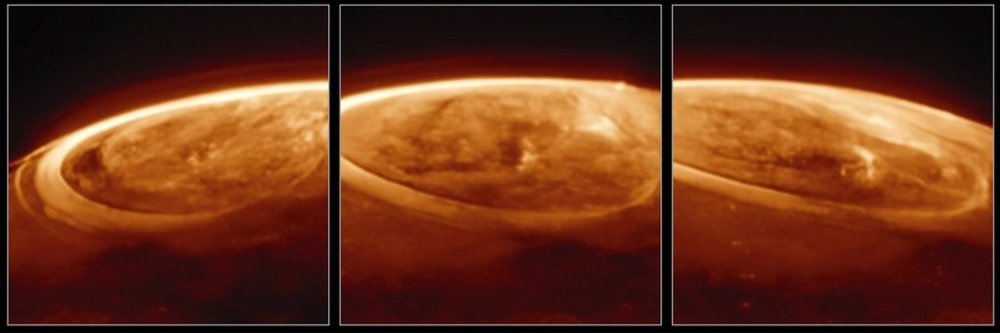
Bright auroras on Jupiter are captured by Webb Space Telescope
Advertisement
Read this article for free:
or
Already have an account? Log in here »
To continue reading, please subscribe:

Digital Subscription
One year of digital access for only $205*
- Enjoy unlimited reading on winnipegfreepress.com
- Read the E-Edition, our digital replica newspaper
- Access News Break, our award-winning app
- Play interactive puzzles
*First annual payment billed as $205.00 + GST for one year. This annual subscription will automatically renew at $233.00 + GST every 52 weeks (10% off the regular annual price of $259.35). Offer available to new and qualified returning subscribers only. Cancel any time.
To continue reading, please subscribe:
Add Free Press access to your Brandon Sun subscription for only an additional
$1 for the first 4 weeks*
- Enjoy unlimited reading on winnipegfreepress.com
- Read the E-Edition, our digital replica newspaper
- Access News Break, our award-winning app
- Play interactive puzzles
*Your next Brandon Sun subscription payment will increase by $1.00 and you will be charged $17.95 plus GST for four weeks. After four weeks, your payment will increase to $24.95 plus GST every four weeks.
Read unlimited articles for free today:
or
Already have an account? Log in here »
Hey there, time traveller!
This article was published 12/05/2025 (459 days ago), so information in it may no longer be current.
WASHINGTON (AP) — Jupiter’s dazzling auroras are hundreds of times brighter than those seen on Earth, new images from the James Webb Space Telescope reveal.
The solar system’s largest planet displays striking dancing lights when high-energy particles from space collide with atoms of gas in the atmosphere near its magnetic poles, similar to how the northern lights are triggered on Earth.
But Jupiter’s version has much greater intensity, according to an international team of scientists who analyzed the photos from Webb taken on Christmas in 2023.
Webb previously captured Neptune’s glowing auroras in the best detail yet, many decades after they were first faintly detected during a flyby of the Voyager 2 spacecraft.
___
The Associated Press Health and Science Department receives support from the Howard Hughes Medical Institute’s Science and Educational Media Group and the Robert Wood Johnson Foundation. The AP is solely responsible for all content.