Trump threatens 50% tariffs on EU and 25% penalties on smart phones as his trade war intensifies
Advertisement
Read this article for free:
or
Already have an account? Log in here »
To continue reading, please subscribe:

Digital Subscription
One year of digital access for only $205*
- Enjoy unlimited reading on winnipegfreepress.com
- Read the E-Edition, our digital replica newspaper
- Access News Break, our award-winning app
- Play interactive puzzles
*First annual payment billed as $205.00 + GST for one year. This annual subscription will automatically renew at $233.00 + GST every 52 weeks (10% off the regular annual price of $259.35). Offer available to new and qualified returning subscribers only. Cancel any time.
To continue reading, please subscribe:
Add Free Press access to your Brandon Sun subscription for only an additional
$1 for the first 4 weeks*
- Enjoy unlimited reading on winnipegfreepress.com
- Read the E-Edition, our digital replica newspaper
- Access News Break, our award-winning app
- Play interactive puzzles
*Your next Brandon Sun subscription payment will increase by $1.00 and you will be charged $17.95 plus GST for four weeks. After four weeks, your payment will increase to $24.95 plus GST every four weeks.
Read unlimited articles for free today:
or
Already have an account? Log in here »
Hey there, time traveller!
This article was published 23/05/2025 (501 days ago), so information in it may no longer be current.
WASHINGTON (AP) — President Donald Trump on Friday threatened a 50% tax on all imports from the European Union as well a 25% tariff on smartphones unless those products are made in America.
The threats, delivered over social media, reflect Trump’s ability to disrupt the global economy with a burst of typing, as well as the reality that his tariffs have yet to produce the trade deals he is seeking or the return of domestic manufacturing he has promised voters.
The Republican president said he wants to charge higher import taxes on goods from the EU, a longstanding US ally, than from China, a geopolitical rival that had its tariffs cut to 30% this month so Washington and Beijing could hold negotiations. Trump was upset by the lack of progress in trade talks with the EU, which has proposed mutually cutting tariffs to zero even as the president has publicly insisted on preserving a baseline 10% tax on most imports.
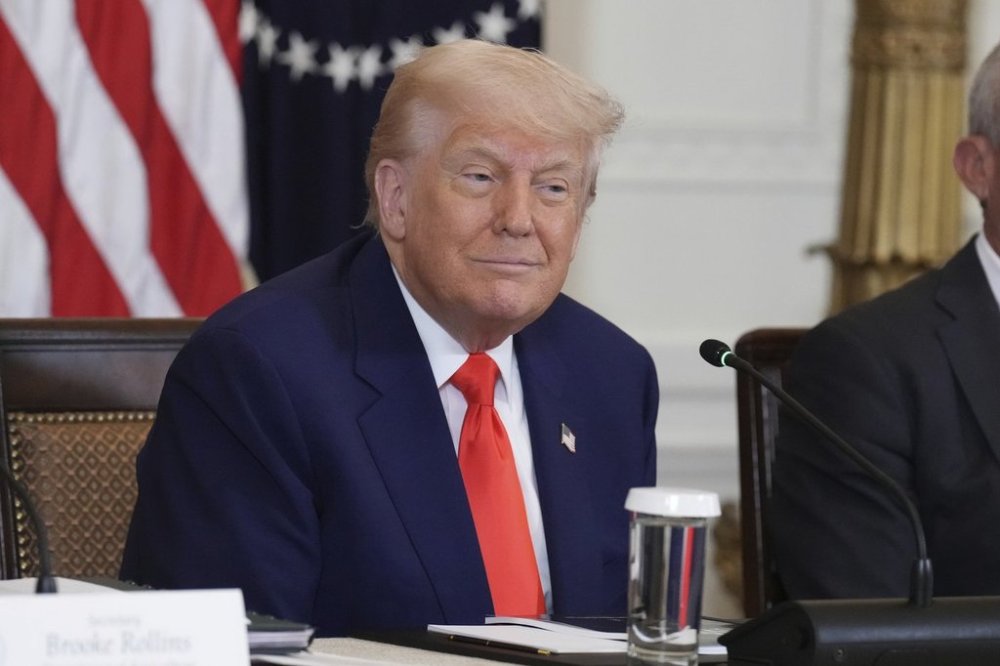
“Our discussions with them are going nowhere!” Trump posted on Truth Social. “Therefore, I am recommending a straight 50% Tariff on the European Union, starting on June 1, 2025. There is no Tariff if the product is built or manufactured in the United States.”
Speaking later in the Oval Office, Trump stressed that he was not seeking a deal with the EU and might delay the tariffs if more companies invested in the United States.
“I’m not looking for a deal,” Trump told the reporters. “We’ve set the deal. It’s at 50%.”
The EU’s top trade official, Maros Sefcovic, posted on the social media site X that he spoke Friday with U.S. Trade Representative Jamieson Greer and Commerce Secretary Howard Lutnick.
“The EU’s fully engaged, committed to securing a deal that works for both,” Sefcovic said. “EU-US trade is unmatched & must be guided by mutual respect, not threats. We stand ready to defend our interests.”
All smartphones could be affected
Trump’s tariffs against Europe had been preceded by a threat of import taxes against Apple for its plans to continue making its iPhone in Asia. Apple now joins Amazon, Walmart and other major U.S. companies in the White House’s crosshairs as they try to respond to the uncertainty and inflationary pressures unleashed by his tariffs.
“I have long ago informed Tim Cook of Apple that I expect their iPhone’s that will be sold in the United States of America will be manufactured and built in the United States, not India, or anyplace else,” Trump wrote. “If that is not the case, a Tariff of at least 25% must be paid by Apple to the U.S.”
Trump later clarified his post to say that all smartphones made abroad would be taxed and the tariffs could be coming as soon as the end of June.
“It would be also Samsung and anybody that makes that product,” Trump said. “Otherwise, it wouldn’t be fair.”
The statements by Trump are critical in that he suggests the company itself would bear the price of tariffs, contradicting his earlier claims as he rolled out a series of aggressive tariffs over the past several months that foreign countries would shoulder the cost of the import taxes. In general, importers pay the tariffs and the costs are often passed along to consumers in the form of higher prices.
In response to Trump’s tariffs on China, Apple CEO Tim Cook said earlier this month that most iPhones sold in the U.S. during the current fiscal quarter would come from India, with iPads and other devices being imported from Vietnam. After Trump rolled out tariffs in April, bank analysts estimated that a $1,200 iPhone would if made in America jump in price anywhere from $1,500 to $3,500.
Stocks sold off after Trump’s postings, with the S&P 500 index down roughly 0.67%. The markets have developed a hair-trigger sensitivity to the U.S. president’s statements, often slumping when he announces high tariffs and rallying when he retreats from those threats.
US vs. EU
U.S. Treasury Secretary Scott Bessent tried to provide some clarity on Trump’s postings in a Friday interview on the Fox News show “America’s Newsroom.”
Bessent said the EU has a “collective action problem” because its 27 member states are being represented by “this one group in Brussels,” such that the “underlying countries don’t even know what the EU is negotiating on their behalf.”
The Treasury secretary said he was not in a White House meeting this week that Cook attended, but he also spoke with the Apple CEO this week. Bessent said the goal was to have Apple bring more of its computer chip supply chain into the U.S.
The core of Trump’s argument against the EU is that America runs a “totally unacceptable” trade deficit with the 27 member states. Countries run trade deficits when they import more goods than they export.
From the vantage point of the EU’s executive commission, trade with the U.S. is roughly in balance if both goods and services are included. As a global center for finance and technology, the U.S. runs a trade surplus in services with Europe. That offsets some of the trade gap in goods and puts the imbalance at 48 billion euros ($54 billion).

German Foreign Minister Johann Wadephul said the EU’s executive commission has his country’s full support in working to “preserve our access to the American market.”
“I think such tariffs help no one, but would just lead to economic development in both markets suffering,” Wadephul said in Berlin. “So we are still counting on negotiations, and support the European Commission in defending Europe and the European market while at the same time working on persuasion in America.”
Trump aides have said the goal of his tariffs was to isolate China and strike new agreements with allies, but the president’s tariff threats undermine the logic of those claims. Not only could the EU face higher tariffs than China, but the bloc of member states might have been better off by establishing a broad front with China and other countries against Trump’s trade policy, said German economist Marcel Fratzscher.
“The strategy of the EU Commission and Germany in the trade conflict with Trump is a total failure,” Fratzscher, the head of the German Institute for Economic Research, said on X. “This was a failure you could see coming — Trump sees Europe’s wavering, hesitation and concessions as the weaknesses that they are.”
Mary Lovely, a senior fellow at the Peterson Institute for International Economics, said the 50% tariffs on Europe are most likely a “negotiating ploy” by Trump, as he has previously retreated on tariffs after taking a hard line.
She said Trump seems to believe that negotiations operate by going to a “threat point” that could risk self-harm to the U.S. just to demonstrate how serious he is, in hopes that doing so would produce an agreement.
But Lovely said that in the long-run Trump’s approach “suggests that the U.S. is an unreliable trading partner, that it operates on whim, not on rule of law.”
A history with Apple
Trump has run hot and cold on his relationship with Apple, a sign that currying favor with him might not necessarily shield a company from his anger. He has essentially told companies such as Walmart to “eat” the costs of his tariffs instead of raising prices, even though doing so could squeeze profits and cause layoffs. He now appears to deploying a similar degree of pressure to force Apple to accept the higher costs of relocating its supply chains.
Trump had previously created an exemption on electronics imported from China to help companies such as Apple, something he could now remove. He also threatened separate 25% import taxes on computer chips and could have the tariffs schedule rewritten in ways that could expose Apple products to the taxes.
Until recently, the U.S. president repeatedly bragged about the $500 billion that Apple in February pledged to invest domestically as part of its development of artificial intelligence technologies. But he publicly turned against the company last week while speaking in Qatar.

“I had a little problem with Tim Cook yesterday,” Trump told the audience. “I said to him: ‘Tim, you’re my friend. I treated you very good. You’re coming here with $500 billion, but now I hear you’re building all over India. I don’t want you building in India.’”
Analysts have been skeptical that Apple could quickly shift device manufacturing to the U.S., mainly because it has spent decades embedding complex supply chains in China to feed the factories. But it also has the challenge of grappling with “the unpredictable nature of the current U.S. administration,” said Ben Wood, chief analyst at U.K.-based research firm CCS Insight.
“At any moment, things can change overnight, making it extremely difficult for companies such as Apple to plan their business,” Wood said. “It seems that despite the best efforts of the Apple leadership team to lobby the U.S. administration to treat the iPhone more favorably, a curveball can come out of nowhere and derail any plans they have in place.”
___
AP writers Paul Wiseman, David McHugh in Frankfurt, Germany, Geir Moulson in Berlin and Kelvin Chan in London contributed to this report.
Advertisement Advertise With Us
Advertisement Advertise With Us