Astronomers track object that may have originated outside the solar system
Advertisement
Read this article for free:
or
Already have an account? Log in here »
To continue reading, please subscribe:

Digital Subscription
One year of digital access for only $205*
- Enjoy unlimited reading on winnipegfreepress.com
- Read the E-Edition, our digital replica newspaper
- Access News Break, our award-winning app
- Play interactive puzzles
*First annual payment billed as $205.00 + GST for one year. This annual subscription will automatically renew at $233.00 + GST every 52 weeks (10% off the regular annual price of $259.35). Offer available to new and qualified returning subscribers only. Cancel any time.
To continue reading, please subscribe:
Add Free Press access to your Brandon Sun subscription for only an additional
$1 for the first 4 weeks*
- Enjoy unlimited reading on winnipegfreepress.com
- Read the E-Edition, our digital replica newspaper
- Access News Break, our award-winning app
- Play interactive puzzles
*Your next Brandon Sun subscription payment will increase by $1.00 and you will be charged $17.95 plus GST for four weeks. After four weeks, your payment will increase to $24.95 plus GST every four weeks.
Read unlimited articles for free today:
or
Already have an account? Log in here »
Hey there, time traveller!
This article was published 02/07/2025 (388 days ago), so information in it may no longer be current.
CAPE CANAVERAL, Fla. (AP) — Astronomers are monitoring an object headed our way that may have wandered over from another star system.
Scientists have discovered what might be only the third known interstellar object to pass through our solar system, the European Space Agency said Wednesday.
The harmless object is currently near Jupiter hundreds of millions of miles (kilometers) away and moving toward Mars, but it should get no closer to the sun than that, according to scientists.
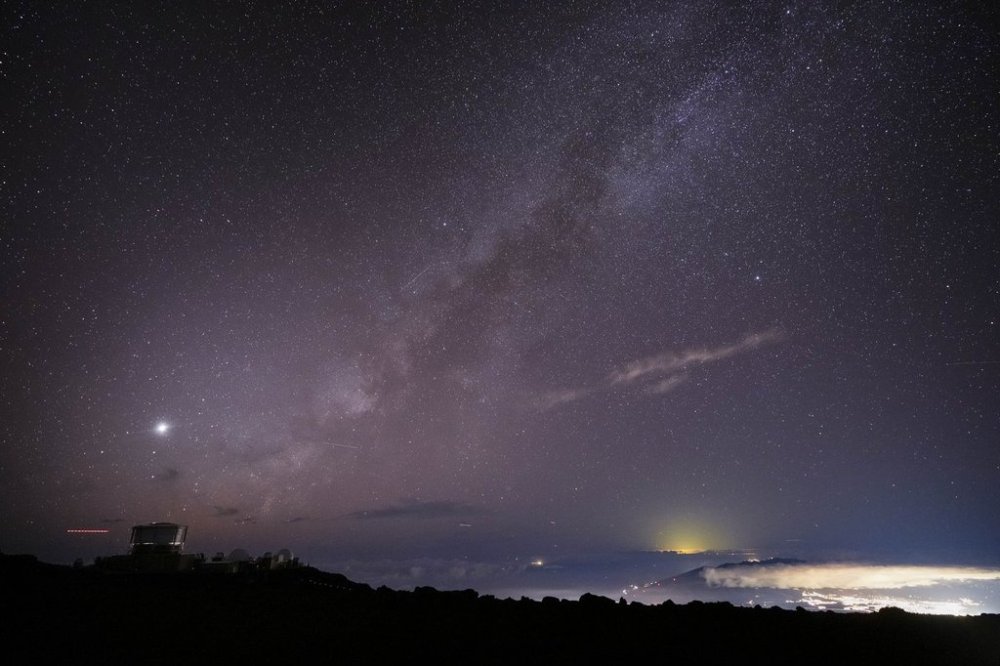
It’s too soon to know whether the object, designated for now as A11pl3Z, is a rocky asteroid or a icy comet, or how big and what shape it is. More observations are needed to confirm its origins. NASA said it is monitoring the situation.
Astrophysicist Josep Trigo-Rodriguez of the Institute of Space Sciences near Barcelona, Spain, believes it is an interstellar object based on its odd path and extreme speed cutting through the solar system. He estimates its size at roughly 25 miles (40 kilometers) across.
The first confirmed interstellar visitor was in 2017. It was dubbed Oumuamua, Hawaiian for scout, in honor of the observatory in Hawaii that discovered it. Classified at first as an asteroid, the elongated Oumuamua has since showed signs of being a comet.
The second object confirmed to have strayed from another star system into our own is 21/Borisov, discovered in 2019 and believed to be a comet.

___
The Associated Press Health and Science Department receives support from the Howard Hughes Medical Institute’s Department of Science Education and the Robert Wood Johnson Foundation. The AP is solely responsible for all content.