FACT FOCUS: No, weather modification did not cause the deadly flash floods in Texas
Advertisement
Read this article for free:
or
Already have an account? Log in here »
To continue reading, please subscribe:

Digital Subscription
One year of digital access for only $205*
- Enjoy unlimited reading on winnipegfreepress.com
- Read the E-Edition, our digital replica newspaper
- Access News Break, our award-winning app
- Play interactive puzzles
*First annual payment billed as $205.00 + GST for one year. This annual subscription will automatically renew at $233.00 + GST every 52 weeks (10% off the regular annual price of $259.35). Offer available to new and qualified returning subscribers only. Cancel any time.
To continue reading, please subscribe:
Add Free Press access to your Brandon Sun subscription for only an additional
$1 for the first 4 weeks*
- Enjoy unlimited reading on winnipegfreepress.com
- Read the E-Edition, our digital replica newspaper
- Access News Break, our award-winning app
- Play interactive puzzles
*Your next Brandon Sun subscription payment will increase by $1.00 and you will be charged $17.95 plus GST for four weeks. After four weeks, your payment will increase to $24.95 plus GST every four weeks.
Read unlimited articles for free today:
or
Already have an account? Log in here »
Hey there, time traveller!
This article was published 08/07/2025 (426 days ago), so information in it may no longer be current.
As authorities search for victims of the flash floods in Texas that killed more than 100 people over the Fourth of July holiday weekend, social media users are spreading false claims that the devastation was caused by weather modification.
Many pointed to one process in particular, blaming cloud seeding performed on July 2 by a California-based company for the tragedy.
But officials say there is no evidence that the floods are the result of cloud seeding and experts agree that cloud seeding would not result in precipitation of this magnitude.
Here’s a closer look at the facts.
CLAIM: A July 2 cloud seeding operation by Rainmaker Technology Corporation caused flash floods in the Texas Hill Country over the Fourth of July holiday weekend.
THE FACTS: This is false. It is not possible that cloud seeding generated the floods, according to experts, as the process can only produce limited precipitation using clouds that already exist. Forecasts predicted rain for that weekend prior to July 2 in an area that was already prone to flooding.
“The claim that cloud seeding played a role in this tragic event is complete nonsense,” said Andrew Dessler, director of Texas A&M University’s Texas Center for Extreme Weather.
Dev Niyogi, a professor at the University of Texas at Austin who studies extreme weather, said it is “extremely unlikely” cloud seeding played a role in the floods. He cited weather factors as the reason: “the moisture flow coming into the area and the widespread rains the system had, as well as the forecast of very heavy rains over the wider area.”
Sen. Ted Cruz of Texas said at a press briefing on Monday that “to the best of my knowledge, there is zero evidence of anything related to anything like weather modification” when asked about such speculation. He added: “The internet is a strange place. People can come up with all sorts of crazy theories.”
Nonetheless, social media users questioned whether Rainmaker’s operations could be connected to the disaster in Texas.
“Well … this is weird … A company called Rainmaker, conducted a cloud seeding mission on July 2 over Texas Hill Country,” reads one X post. “2 days later, the worst flood in their history occurred … in the exact same area that the Rainmaker flights were. The entire goal of Rainmaker is to increase the precipitation of existing clouds. Why do we let these corporations f — k with the weather?”
Many posts also noted Rainmaker’s connection to Silicon Valley billionaire Peter Thiel, who cofounded the data-mining outfit Palantir Technologies, a secretive company that has long relied on spies, police, and the military as its customers. The Thiel Foundation awarded Rainmaker founder and CEO Augustus Doricko $100,000 in 2024 as part of its fellowship program.
Cloud seeding utilizes an artificial material — typically silver iodide — to induce precipitation or clear fog. The practice is an imprecise undertaking with mixed results.
Dessler explained that “cloud seeding can work in certain limited situations and produce very modest increases in precipitation,” but often delivers nothing.”
Regardless, the process cannot create storms out of thin air. Ken Leppert, an associate professor of atmospheric science at the University of Louisiana Monroe, said it “had absolutely nothing” to do with the flash floods in Texas.
“Cloud seeding works by adding aerosols to existing clouds,” he said. “It doesn’t work by helping to create a cloud/storm that doesn’t already exist. The storms that produced the rainfall and flooding in Texas were not in existence two days before the event.”
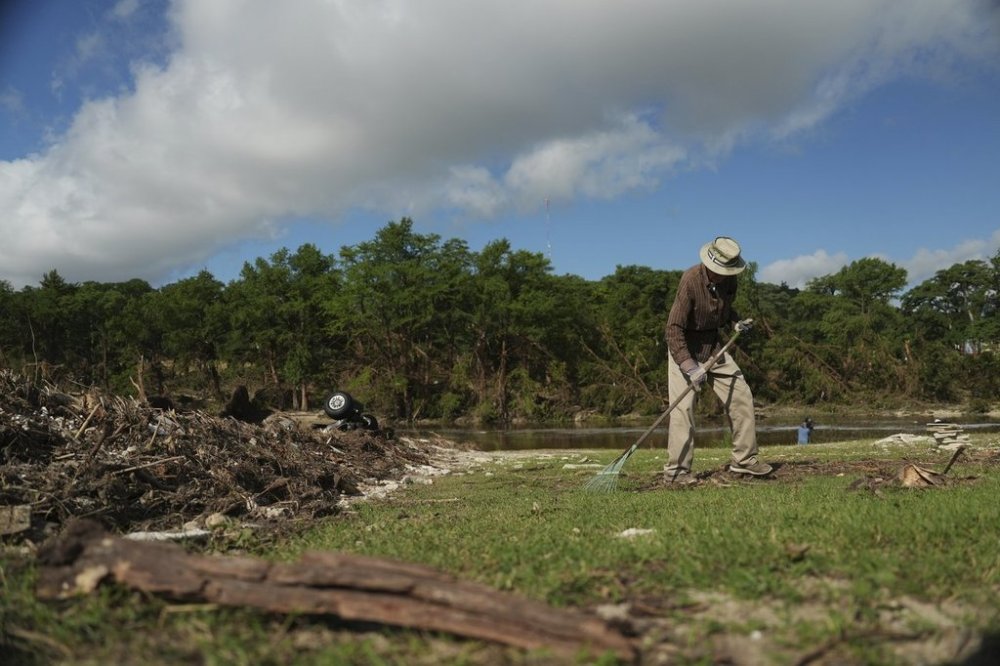
The Texas Hill Country, in the central part of the state, is naturally prone to flash flooding due to the dry, dirt-packed areas where the soil lets rain skid along the surface of the landscape instead of soaking it up.
After a flood watch notice was issued midday on July 3, the National Weather Service issued an urgent warning overnight for at least 30,000 people. The July 4 flash floods started with a particularly bad storm that dropped most of its 12 inches (30 centimeters) of rain in the dark early morning hours. There was so much rain that the Guadalupe River rose higher than it has in 93 years by almost a foot, according to local reports.
“The natural disaster in the Texan Hill Country is a tragedy. My prayers are with Texas,” Doricko, the Rainmaker CEO, wrote as part of a series of X posts. “Rainmaker did not operate in the affected area on the 3rd or 4th or contribute to the floods that occurred over the region.”
He said Rainmaker’s last cloud seeding operation prior to the floods occurred in the early afternoon on July 2 over eastern portions of south-central Texas. Two clouds were seeded and remained in the sky for about two hours before dissipating. Rainmaker suspended its cloud seeding operations indefinitely the same day in response to “unusually high moisture content.”
___
Find AP Fact Checks here: https://apnews.com/APFactCheck.