How a tree-killing beetle chose wrong human to fly into, revealing presence in B.C.
Advertisement
Read this article for free:
or
Already have an account? Log in here »
To continue reading, please subscribe:

Digital Subscription
One year of digital access for only $205*
- Enjoy unlimited reading on winnipegfreepress.com
- Read the E-Edition, our digital replica newspaper
- Access News Break, our award-winning app
- Play interactive puzzles
*First annual payment billed as $205.00 + GST for one year. This annual subscription will automatically renew at $233.00 + GST every 52 weeks (10% off the regular annual price of $259.35). Offer available to new and qualified returning subscribers only. Cancel any time.
To continue reading, please subscribe:
Add Free Press access to your Brandon Sun subscription for only an additional
$1 for the first 4 weeks*
- Enjoy unlimited reading on winnipegfreepress.com
- Read the E-Edition, our digital replica newspaper
- Access News Break, our award-winning app
- Play interactive puzzles
*Your next Brandon Sun subscription payment will increase by $1.00 and you will be charged $17.95 plus GST for four weeks. After four weeks, your payment will increase to $24.95 plus GST every four weeks.
Read unlimited articles for free today:
or
Already have an account? Log in here »
Hey there, time traveller!
This article was published 13/07/2025 (405 days ago), so information in it may no longer be current.
VANCOUVER – The tiny beetle could scarcely have picked a worse human to fly into.
Amateur entomologist Andrew Short was sitting on a bench in downtown Vancouver in June 2023 when the unfamiliar metallic green beetle hit him and fell to the ground.
He said he “needed to know what it was,” so he captured it, took it home to photograph, and later handed it over to authorities — who confirmed the insect to be the first emerald ash borer collected in Canada west of Manitoba.
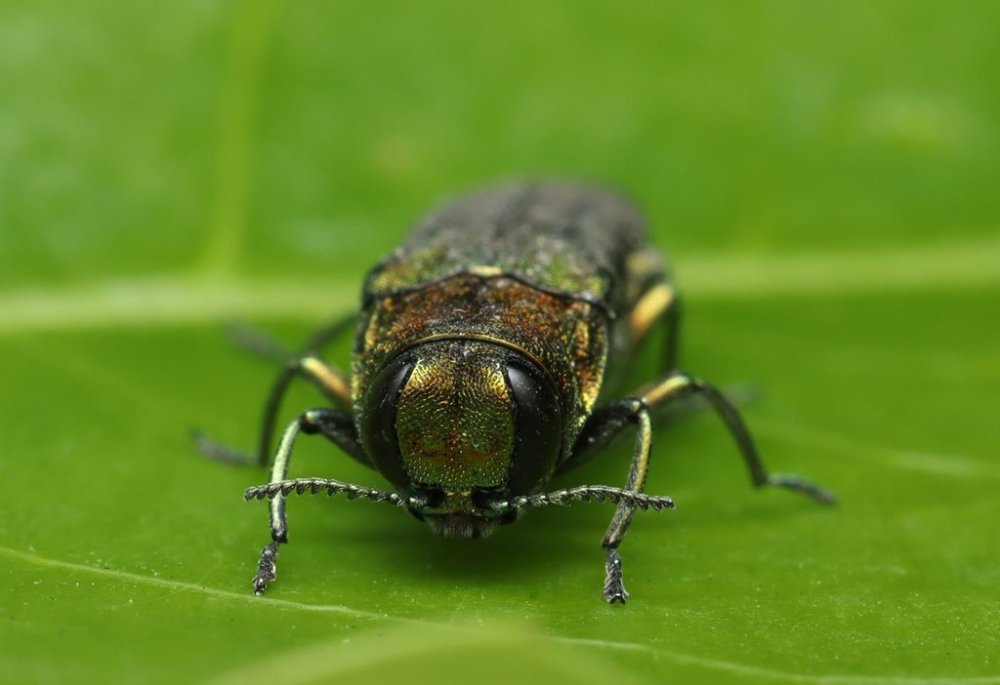
Short’s fortuitous encounter set in motion a chain reaction of research aimed at understanding and clamping down on the pest that has devastated ash forests across North America, killing millions of trees in Canada and the United States.
“I just happened to be in the right place at the right time. So, if that’s what some people consider fate, then I guess it was,” he said in an interview.
Short makes a hobby of searching for insects and plants, examining how they interact and photographing them.
“I’m quite versed in invasive species and what they can do, but I certainly hadn’t considered for a moment that I’d ever have a run-in with an emerald ash borer,” he said.
“It’s kind of a strange feeling to realize that you’ve found something that’s that important.”
A study published this spring in the peer-reviewed journal BioInvasions Records describes Short’s role in the beetle’s discovery in Vancouver, and subsequent findings that included “heavily infested” trees in Andy Livingstone Park, about 300 metres from the site of his encounter near BC Place stadium.
The study suggests emerald ash borers, which are native to East Asia, were likely first present in the downtown Vancouver park “no later than 2020.”
Lead author Chris MacQuarrie, a forest entomologist with Natural Resources Canada, said Short was “the best person” for the beetle to have run into — if not from the beetle’s perspective.
“There are lots of green beetles and people think they’ve found it and they turn it in and we’re really happy when it’s not (an emerald ash borer). But this time, it was.”
MacQuarrie said it’s “really rare” to find an adult emerald ash borer, which measures up to about 1.4 centimetres.
He said the discovery in Vancouver represents a “big jump” from pre-existing infestations in Canada and the United States.
MacQuarrie said Short had the “presence of mind” to capture the beetle, which he tucked into a makeshift container using material in his backpack, then took it home to photograph before enlisting the help of another hobbyist entomologist to identify it.
All they could conclude, Short said, was that it “was something that shouldn’t have been here.”
Short submitted a suspected invasive species report along with photographs of the beetle to the Canadian Food Inspection Agency.
He eventually met with someone from the agency and handed over the bug, which he had frozen.
After the agency confirmed Short’s beetle was an ash borer, MacQuarrie said he and other researchers met in Vancouver last year to investigate.
They set traps and took samples from trees near the bench. While the traps did not capture any adult ash borers, branch samples yielded 19 larvae.
MacQuarrie said the closest infestation in Canada is in Winnipeg, though there is another population in Oregon.
The researchers could not determine how the beetle was introduced to Vancouver, although the pest is commonly dispersed via infested wood. An infested tree found in nearby Burnaby last year suggests the beetles in Vancouver could be an “extension” of an older infestation that went undetected, the study says.
The beetles often go undetected for years in new places, with sick or dead trees usually the first sign of infestation.
The findings in Vancouver suggest there may be other undetected populations in western North America, the study says.
Short’s discovery has given researchers the opportunity to study the beetle’s behaviour in Vancouver. It grows faster in warmer conditions, and researchers “don’t really know” how fast it may kill trees in Vancouver’s maritime climate, MacQuarrie said.
Early detection allows for mitigation measures such as insecticides, removing infected trees, diversifying the tree canopy and educating the public, he said.
The Vancouver finding has sparked interest elsewhere, MacQuarrie added, with a British forestry researcher starting work with Canadian counterparts to examine how the beetle is behaving in European ash species in the city.
Short said some people think his bug-catching hobby is “weird.”
But it’s calming, he said, slowing down and focusing on what is right in front of you.
“You don’t have to look far to find really cool things.”
This report by The Canadian Press was first published July 13, 2025.