Europol-coordinated global operation takes down pro-Russian cybercrime network

Advertisement

Advertise with us

THE HAGUE, Netherlands (AP) — A coordinated international operation has hit the infrastructure of a pro-Russian cybercrime network linked to a string of denial of service attacks targeting Ukraine and its allies, the European Union's police agency Europol announced Wednesday.

Read this article for free:


or

Already have an account? Log in here »

To continue reading, please subscribe:

Subscribe and receive a limited-edition Free Press branded hat or tote.

Digital Subscription

One year of digital access for only $205*

  • Enjoy unlimited reading on winnipegfreepress.com
  • Read the E-Edition, our digital replica newspaper
  • Access News Break, our award-winning app
  • Play interactive puzzles

*First annual payment billed as $205.00 + GST for one year. This annual subscription will automatically renew at $233.00 + GST every 52 weeks (10% off the regular annual price of $259.35). Offer available to new and qualified returning subscribers only. Cancel any time.

To continue reading, please subscribe:

Add Free Press access to your Brandon Sun subscription for only an additional

$1 for the first 4 weeks*

  • Enjoy unlimited reading on winnipegfreepress.com
  • Read the E-Edition, our digital replica newspaper
  • Access News Break, our award-winning app
  • Play interactive puzzles
Start now

*Your next Brandon Sun subscription payment will increase by $1.00 and you will be charged $17.95 plus GST for four weeks. After four weeks, your payment will increase to $24.95 plus GST every four weeks.

Hey there, time traveller!
This article was published 16/07/2025 (427 days ago), so information in it may no longer be current.

THE HAGUE, Netherlands (AP) — A coordinated international operation has hit the infrastructure of a pro-Russian cybercrime network linked to a string of denial of service attacks targeting Ukraine and its allies, the European Union’s police agency Europol announced Wednesday.

Codenamed Eastwood, the operation targeted the so-called NoName057(16) group, which was identified last month by Dutch authorities as being behind a series of denial-of-service attacks on several municipalities and organizations linked to a NATO summit in the Netherlands.

Europol said that the cybercrime network was also involved in attacks in Sweden, Germany and Switzerland.

FILE- The Europol headquarters in The Hague, Netherlands, Wednesday, Oct. 10, 2018. (AP Photo/Peter Dejong, File)

The police agency said the international operation “led to the disruption of an attack-infrastructure consisting of over one hundred computer systems worldwide, while a major part of the group’s central server infrastructure was taken offline.”

Law enforcement and judicial authorities from France, Finland, Germany, Italy, Lithuania, Poland, Spain, Sweden, Switzerland, the Czech Republic, the Netherlands and the United States took simultaneous actions against offenders and infrastructure belonging to the pro-Russian cybercrime network, it said.

Western officials have accused Russia and its proxies of staging dozens of attacks, sabotage attempts and other incidents across Europe since the invasion of Ukraine, including cyberattacks. The Associated Press is tracking them in a detailed map that shows the breadth of efforts to sow division in European societies and undermine support for Ukraine.

As part of the latest operation, judicial authorities in Germany issued six arrest warrants for suspects in Russia, two of them accused of being the main leaders of the group, Europol said. Five of them were identified on Europol’s Europe’s Most Wanted website.

One suspect was placed under preliminary arrest in France and another detained in Spain, Europol said. The Paris prosecutor’s office said one person is in custody in France and communications equipment has been seized. No charges have yet been filed. In the United States, the Federal Bureau of Investigation was involved in the operation.

The attorney general’s office in Switzerland, which is not an EU member country, said in a statement Wednesday that joint investigations between Europol and Swiss federal police helped identify three leading members of the group, which is alleged to have targeted more than 200 Swiss websites.

Swiss prosecutors opened a criminal case over the incidents in June 2023, and since then identified several other denial-of-service attacks attributed to the activist group. The attacks included a video address by Ukrainian President Volodymyr Zelenskyy to the Swiss parliament and the popular Eurovision Song Contest, held in in Basel earlier this year.

Europol said members of the cybercrime group initially targeted Ukrainian institutions, “but have shifted their focus to attacking countries that support Ukraine in the ongoing defence against the Russian war of aggression, many of which are members of NATO.”

Law enforcement authorities in countries involved in the operation contacted hundreds of people believed to support the group to inform them of the crackdown and their alleged liability for its actions.
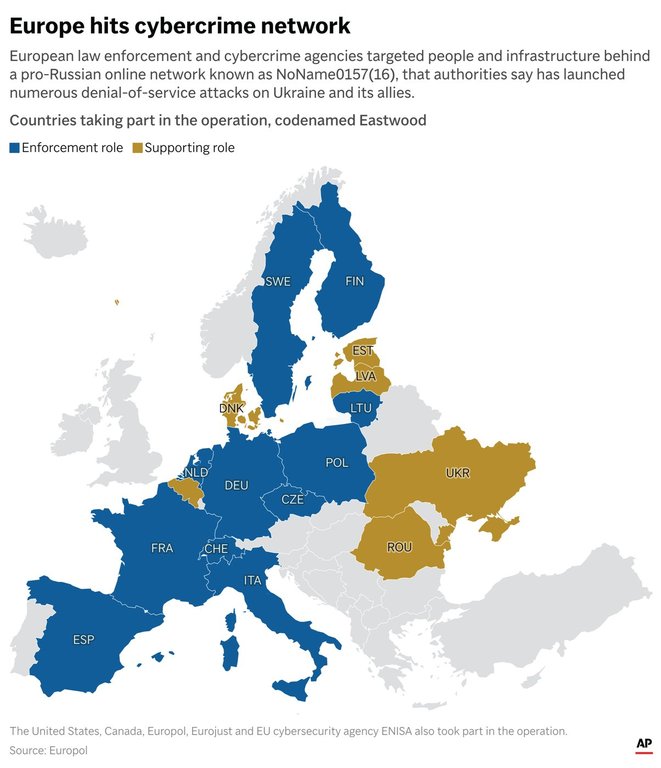
Law enforcement agencies from Europe and North America targeted a cybercrime network launching online attacks against Ukraine and its allies. (AP Graphic)

“Individuals acting for NoName057(16) are mainly Russian-speaking sympathisers who use automated tools to carry out distributed denial-of-service (DDoS) attacks. Operating without formal leadership or sophisticated technical skills, they are motivated by ideology and rewards,” Europol said.

It added that people recruited by the group were paid in cryptocurrency and motivated using online-gaming dynamics like leader boards and badges.

“This gamified manipulation, often targeted at younger offenders, was emotionally reinforced by a narrative of defending Russia or avenging political events,” Europol said.

___

Associated Press writers Jamey Keaten in Geneva, Geir Moulson in Berlin and Angela Charlton in Paris contributed.


Report Error Submit a Tip

More Stories

Police cracking down on gangs, organized crime in bars and lounges

Nicole Buffie 4 minute read Preview

Police cracking down on gangs, organized crime in bars and lounges

Nicole Buffie 4 minute read Updated: Yesterday at 6:56 PM CDT

Patrons can expect to see more police officers in and around bars and lounges in the coming months as the Winnipeg Police Service plans to crack down on gangs and organized crime.

Uniformed officers will be patrolling bars, lounges and other licensed establishments, targeting gang members and people associated with organized crime. Priority will be given to those who pose the greatest risk to public safety, WPS said in a news release Tuesday.

“We’ve seen — time and time again — where people involved in gangs, in organized crime, attract violence or commit violence, on people who they would perceive as their rivals,” Insp. Josh Ewatski, who heads the service’s organized crime unit said, noting the plan was in the works for a while.

He said while there was no specific incident that resulted in the new push, but said violence — including stabbings, assaults and shootings — over the years is behind the move.

Read
Updated: Yesterday at 6:56 PM CDT

Rogers, Telus deny blame for June twister alert barrage

Malak Abas 3 minute read Preview

Rogers, Telus deny blame for June twister alert barrage

Malak Abas 3 minute read Updated: Yesterday at 7:21 AM CDT

Telecom companies say they aren’t to blame for the barrage of tornado alerts Manitobans received during severe thunderstorms in early June.

The Canadian Radio-television and Telecommunications Commission announced in August it would investigate the unusually high number of alerts, and called on the Pelmorex Corp., which operates the national Alert Ready system, along with telecom companies Bell, Rogers and Telus to respond to a number of questions.

They were given until last Friday to describe their possible roles in the creation, receipt, processing or distribution of alerts issued from Environment and Climate Change Canada in the midst of the June 9 storm.

Telus said in its response that it received 133 alert requests targeted to Manitoba created by Environment Canada and forwarded by Pelmorex between 2:35 p.m. June 9 and 3:29 a.m. the following day. While the majority of those messages contained identical information and were automatically suppressed, 17 were ultimately sent out as alerts in Winnipeg.

Read
Updated: Yesterday at 7:21 AM CDT

Food literacy curriculum on the menu

Maggie Macintosh 5 minute read Preview

Food literacy curriculum on the menu

Maggie Macintosh 5 minute read 2:01 AM CDT

Manitoba has a new recipe for health class and “food literacy” is a key ingredient.

The in-class portion of phys-ed has historically involved lessons about puberty, the risks of consuming drugs and dissecting Canada’s food guide.

A new pilot program asks teachers to expand their nutrition units and include in-depth discussions about how everything from diet culture to food insecurity affects eating habits.

“This is really moving beyond a conception of food as only fuel, where you just boil down food to its calories, its vitamins,” said Sarah Elvins, a food historian at the University of Manitoba who researches popular culture and marketing.

Read
2:01 AM CDT

Manitoba’s police watchdog is investigating after a man was found dead eight days after officers were unable to locate him following a 911 call from Canupawakpa Dakota First Nation in 2024.

The Independent Investigation Unit said the call came in just after midnight on Nov. 22, 2024, with a disturbance audible in the background. GPS coordinates traced it to the First Nation, 305 kilometres west of Winnipeg, prompting Manitoba First Nations Police Service officers to search the area.

Officers could not find the caller, whom they believed to be a local man. Eight days later, on Nov. 30, MFNPS conducted another search and found a man dead.

The death was initially referred to RCMP Major Crime Services as suspicious. The RCMP later returned the case to MFNPS for possible referral to the IIU because of concerns about the eight-day delay in locating the man. MFNPS notified the IIU on Sept. 15, 2026 — nearly two years after the incident.

Two drivers suffer minor injuries in Highway 8 crash

1 minute read Yesterday at 12:30 PM CDT

Two men sustained minor, but not life-threatening injuries after a crash on Highway 8 at Whytewold Road in the RM of St. Andrews Monday afternoon.

At 3:45 p.m. Selkirk RCMP responded to the two-vehicle collision, which happened after a vehicle travelling south on Highway 8 collided with a westbound vehicle that was crossing the highway from Whytewold Road.

The driver of the southbound vehicle, a 26-year-old man, and the driver of the westbound vehicle, a 24-year-old man, both from the RM of Gimli, were involved. The 24-year-old was ticketed for proceeding before safe to do so.

BRANDON — The Manitoba government is seeking to build a soybean crushing plant and is looking for investment to make it happen.

The proposed facility is one of several projects the NDP government pitched at the international investment summit in Toronto this week.

“We’re in a new world of opportunities that I think provinces or the country of Canada needs to apprehend,” Manitoba Agriculture Minister Ron Kostyshyn said Monday.

The MLA for Dauphin said soybeans were a “very popular discussion” during recent trade missions in certain parts of Asia.