

Nvidia CEO downplays role in lifting US ban on chip sales to China
Advertisement
Read this article for free:
or
Already have an account? Log in here »
To continue reading, please subscribe:
Monthly Digital Subscription
$1 per week for 24 weeks*
- Enjoy unlimited reading on winnipegfreepress.com
- Read the E-Edition, our digital replica newspaper
- Access News Break, our award-winning app
- Play interactive puzzles
*Billed as $4.00 plus GST every four weeks. After 24 weeks, price increases to the regular rate of $19.95 plus GST every four weeks. Offer available to new and qualified returning subscribers only. Cancel any time.
Monthly Digital Subscription
$4.99/week*
- Enjoy unlimited reading on winnipegfreepress.com
- Read the E-Edition, our digital replica newspaper
- Access News Break, our award-winning app
- Play interactive puzzles
*Billed as $19.95 plus GST every four weeks. Cancel any time.
To continue reading, please subscribe:
Add Free Press access to your Brandon Sun subscription for only an additional
$1 for the first 4 weeks*
*Your next subscription payment will increase by $1.00 and you will be charged $16.99 plus GST for four weeks. After four weeks, your payment will increase to $23.99 plus GST every four weeks.
Read unlimited articles for free today:
or
Already have an account? Log in here »
Hey there, time traveller!
This article was published 16/07/2025 (256 days ago), so information in it may no longer be current.
BEIJING (AP) — The head of Nvidia downplayed his role in getting the U.S. government to lift a ban on selling an advanced computer chip in China and said it will take time to ramp up production once orders for the AI-processor come in.
CEO Jensen Huang, speaking Wednesday in the Chinese capital Beijing, was upbeat about the prospects for the H20 chip, which was designed to meet U.S. restrictions on technology exports to China but nonetheless blocked in April.
He met U.S. President Donald Trump before his trip and his company announced this week it had received assurances that sales to China would be approved.
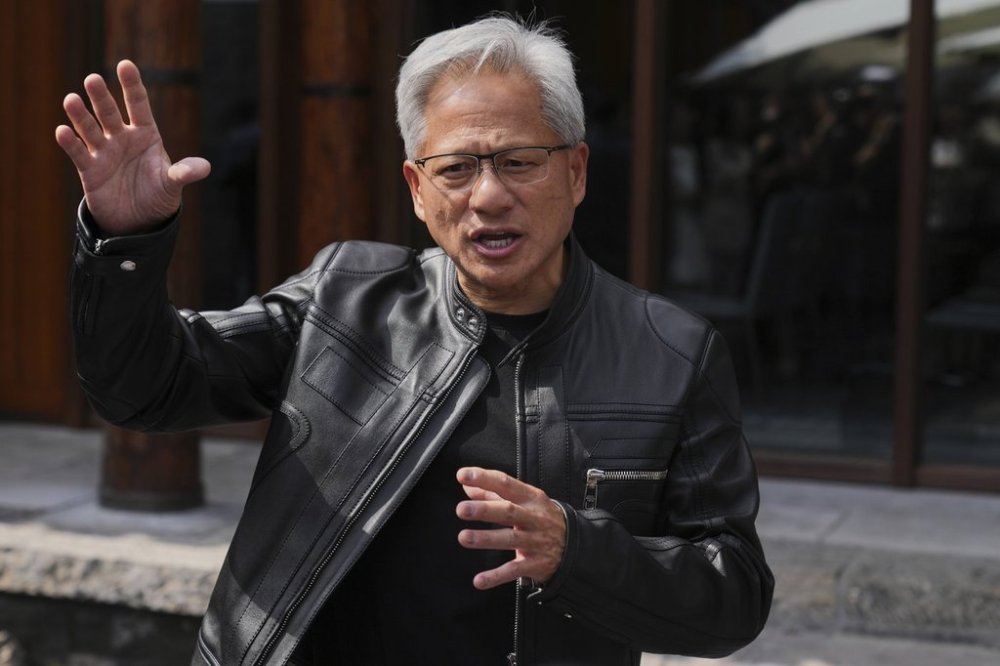
“I don’t think I changed his mind,” Huang told a cluster of journalists, many of whom asked for his autograph or to take selfies with him.
A carefully organized press conference at a luxury hotel descended into a crowd scene when Huang arrived in his trademark leather jacket and started taking questions randomly in his characteristic casual style.
Export controls and tariffs were something companies must adapt to in a world he said was reconfiguring itself. He described his role as informing governments in the U.S. and elsewhere of the nature and unintended consequences of their policies.
The decision to lift the ban on the H20 chip was entirely in the hands of the American and Chinese governments and whatever trade talks they had, he said.
“We can only influence them, inform them, do our best to provide them with facts,” Huang said. “And then beyond that is out of our control.”

Nvidia said in April that sales restrictions on its chip in China on national security grounds would cost the company $5.5 billion. The White House also blocked a chip from Advanced Micro Devices. Both companies say the Commerce Department is now moving forward with license applications to export them to China.
Huang said his company would likely be able to recover some of its losses but it’s unclear how much. That will depend on how many H20 orders are received and how quickly Nvidia can meet the demand.
“I think that H20 is going to be very successful here,” he said, noting the chip’s memory bandwidth makes it a good fit for the AI models being developed by Chinese companies such as DeepSeek and Alibaba.
Huang also touted the release of a new RTX Pro graphics chip that he said would power the development of humanoid robots. He described robotic systems with teams of robots working alongside people as the next wave in AI.
“Because there’s so much robotics innovation going on and so much smart factory work being done here and the supply chain is so vast, RTX Pro is perfect,” he said.