Companies taking concrete steps toward capturing revenues from carbon dioxide
Advertisement
Read this article for free:
or
Already have an account? Log in here »
To continue reading, please subscribe:

Digital Subscription
One year of digital access for only $205*
- Enjoy unlimited reading on winnipegfreepress.com
- Read the E-Edition, our digital replica newspaper
- Access News Break, our award-winning app
- Play interactive puzzles
*First annual payment billed as $205.00 + GST for one year. This annual subscription will automatically renew at $233.00 + GST every 52 weeks (10% off the regular annual price of $259.35). Offer available to new and qualified returning subscribers only. Cancel any time.
To continue reading, please subscribe:
Add Free Press access to your Brandon Sun subscription for only an additional
$1 for the first 4 weeks*
- Enjoy unlimited reading on winnipegfreepress.com
- Read the E-Edition, our digital replica newspaper
- Access News Break, our award-winning app
- Play interactive puzzles
*Your next Brandon Sun subscription payment will increase by $1.00 and you will be charged $17.95 plus GST for four weeks. After four weeks, your payment will increase to $24.95 plus GST every four weeks.
Read unlimited articles for free today:
or
Already have an account? Log in here »
Hey there, time traveller!
This article was published 03/08/2025 (406 days ago), so information in it may no longer be current.
It can be used to make fuel, fertilizer, building material and even soap, but can carbon dioxide be a money maker, too?
Carbon capture has long been a focus of emissions reduction efforts in Canada. It involves collecting the climate-warming gas from industrial sites and preventing it from entering the atmosphere, most often by stowing it away permanently underground.
Less common has been capturing CO2 and making it into something useful.
“Carbon utilization does not have a big history. It’s relatively nascent,” said Apoorv Sinha, chief executive of Carbon Upcycling. The Calgary-based company combines industrial waste products with carbon dioxide to make a cement-like product that can be used in concrete foundations and sidewalks.
“Canada actually punches well above its weight in carbon-to-value across the building material sector, even in carbon chemicals.”
Storing carbon has been the automatic go-to as industry has a wealth of experience doing it at a large scale, said David Sanguinetti, interim CEO at cleantech incubator Foresight Canada.
While carbon utilization has the benefit of generating direct revenues from usable products, the economics are uncertain in a lot of cases, he said.
“It’s either niche or not great right now with the current state of technology,” he said.
“If you don’t have a price on carbon, then a lot of the current concepts that are out there, which are technically feasible — people have done it in the lab, they’ve proven it out — there isn’t an economic driver to make it happen.”
The Canadian Gas Association commissioned a report from Foresight Canada last year into the carbon utilization market, which concluded that storing carbon from large industrial emitters is likely to beat out using it — at least for the time being. Foresight sees southwestern Ontario being a good spot for carbon utilization to take root as there are clusters of large emitters and innovation hubs, but little in the way of infrastructure for underground storage like Alberta has.
CO2 utilization falls into two categories — direct use or conversion. Direct use includes the long-standing practice of injecting the gas into mature oilfields to draw more barrels to the surface.
With conversion, the chemical makeup of the gas is altered to make products like aviation fuel and fertilizer. At a smaller scale, Calgary-based CleanO2 captures the gas from building heating systems and turns it into pearl ash used in its hand soap, shampoo and other products.
One of the more promising applications has been using the gas in building materials so it’s trapped permanently.
Last week, Carbon Upcycling held a groundbreaking ceremony at the Ash Grove cement plant in Mississauga, Ont., where work on a commercial demonstration project is underway. Production is to begin next spring.
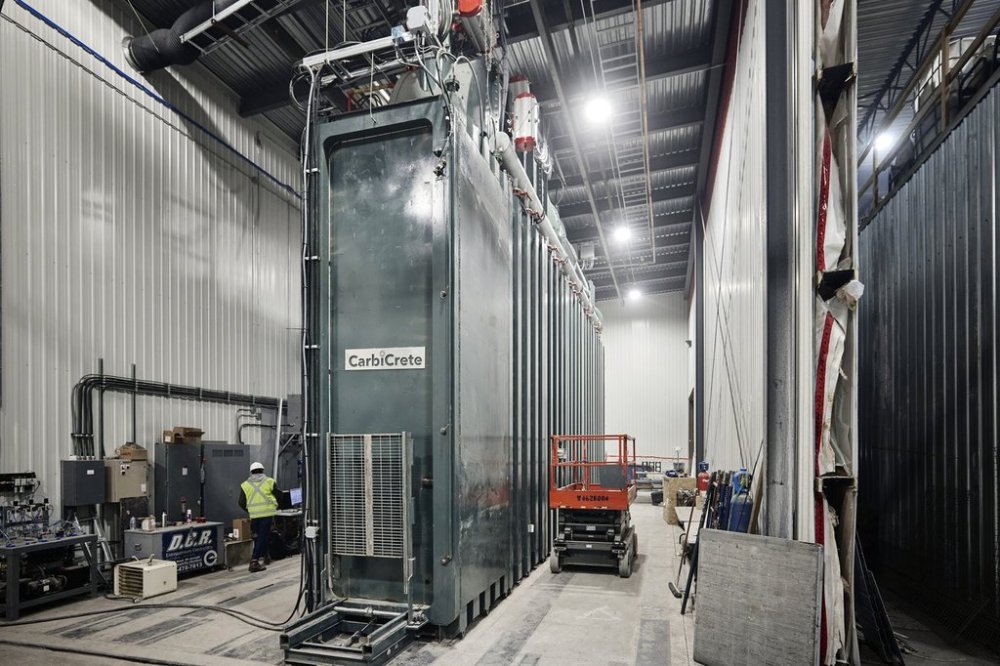
CarbiCrete, based in Montreal, has developed technology for greener precast masonry and hardscapes — think concrete blocks, retaining walls and paving stones that can be sent to a construction site, not the ready-mix stuff churning in a truck’s drum.
Concrete is traditionally made up of cement, aggregate like rocks or gravel, and water.
“It’s the most abundant manmade substance on the planet,” said Yuri Mytko, CarbiCrete’s chief marketing officer. “But cement has traditionally been the key ingredient and cement is hugely problematic in that it accounts for about eight per cent of the world’s greenhouse gas emissions.”
CarbiCrete uses steelmaking slag instead of cement, and cures it in a chamber with CO2 instead of applying heat and steam.
“You’re left with a concrete product that has the same properties as cement-based concrete, except with none of the emissions associated with it and also with carbon having been permanently mineralized and removed from the atmosphere,” said Mytko.
CarbiCrete licenses its technology to concrete product makers and helps them retrofit their plants.
Dave Sawyer, principal economist at the Canadian Climate Institute said utilization can work by helping companies generate credits to sell, but it’s a relatively small piece of the emissions-reduction picture.
Carbon capture, utilization and storage in general has been painted by business and industry as “one big silver bullet technology,” he said, but there are other emissions-busting approaches that should be getting more attention.
For example, sodium ion batteries may be just as technically feasible as carbon capture, utilization and storage — and maybe cheaper.
“But we just keep going to this big lumpy thing … that is really cost prohibitive.”
Sinha said carbon utilization gets a fraction of the support and resources of traditional storage projects, whose technology has been around for decades.
“What needs to happen is more support and a larger focus towards deploying these technologies quickly and testing them out. Because right now, just the amount of data — how to build these facilities, how to operate them — very little of it exists.”
This report by The Canadian Press was first published Aug. 3, 2025.