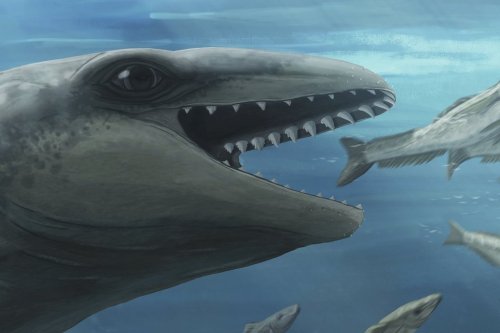
Scientists discover an ancient whale with a Pokémon face and a predator bite

Advertisement

Advertise with us

WELLINGTON, New Zealand (AP) — Long before whales were majestic, gentle giants, some of their prehistoric ancestors were tiny, weird and feral. A chance discovery of a 25 million-year-old fossil on an Australian beach has allowed paleontologists to identify a rare, entirely new species that could unlock mysteries of whale evolution.

Read this article for free:


or

Already have an account? Log in here »

To continue reading, please subscribe:

Subscribe and receive a limited-edition Free Press branded hat or tote.

Digital Subscription

One year of digital access for only $205*

  • Enjoy unlimited reading on winnipegfreepress.com
  • Read the E-Edition, our digital replica newspaper
  • Access News Break, our award-winning app
  • Play interactive puzzles

*First annual payment billed as $205.00 + GST for one year. This annual subscription will automatically renew at $233.00 + GST every 52 weeks (10% off the regular annual price of $259.35). Offer available to new and qualified returning subscribers only. Cancel any time.

To continue reading, please subscribe:

Add Free Press access to your Brandon Sun subscription for only an additional

$1 for the first 4 weeks*

  • Enjoy unlimited reading on winnipegfreepress.com
  • Read the E-Edition, our digital replica newspaper
  • Access News Break, our award-winning app
  • Play interactive puzzles
Start now

*Your next Brandon Sun subscription payment will increase by $1.00 and you will be charged $17.95 plus GST for four weeks. After four weeks, your payment will increase to $24.95 plus GST every four weeks.

Hey there, time traveller!
This article was published 14/08/2025 (368 days ago), so information in it may no longer be current.

WELLINGTON, New Zealand (AP) — Long before whales were majestic, gentle giants, some of their prehistoric ancestors were tiny, weird and feral. A chance discovery of a 25 million-year-old fossil on an Australian beach has allowed paleontologists to identify a rare, entirely new species that could unlock mysteries of whale evolution.

Researchers this week officially named Janjucetus dullardi, a cartoonish creature with bulging eyes the size of tennis balls, in the Zoological Journal of the Linnean Society. Unlike today’s whales, the juvenile specimen was small enough to fit in a single bed.

Boasting fiendish teeth and a shark-like snout, however, this oddball of the ocean was nasty, mean and built to hunt.
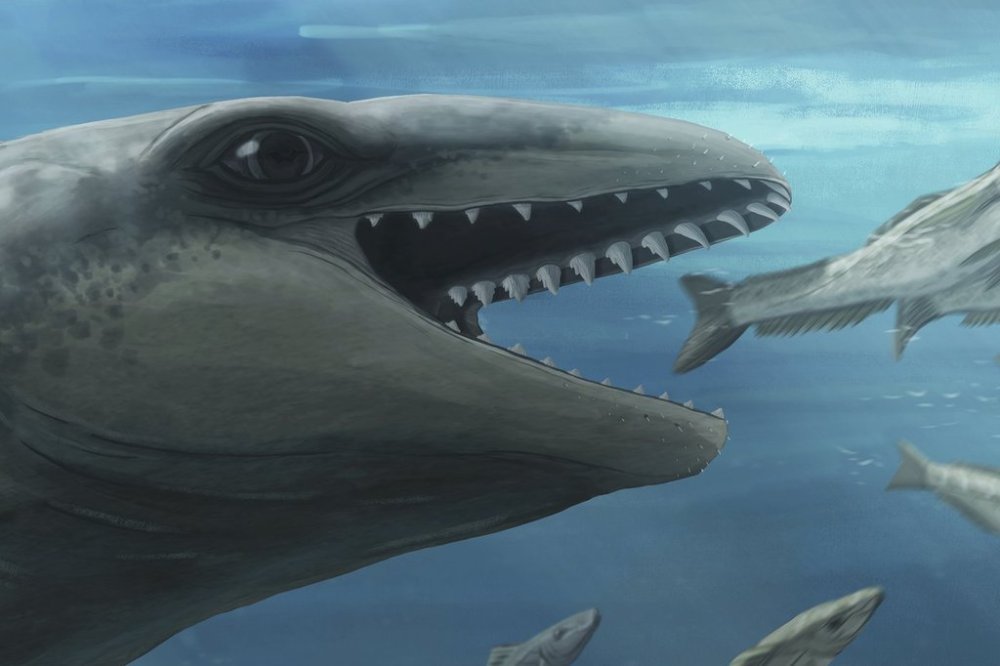
In this illustration provided by Ruairidh Duncan a Janjucetus dullardi is depicted chasing a fish. (Ruairidh Duncan via AP)

“It was, let’s say, deceptively cute,” said Erich Fitzgerald, senior curator of vertebrate paleontology at Museums Victoria Research Institute, and one of the paper’s authors.

“It might have looked for all the world like some weird kind of mash-up between a whale, a seal and a Pokémon but they were very much their own thing.”

Extinct species was an odd branch on the whale family tree

The rare discovery of the partial skull, including ear bones and teeth, was made in 2019 on a fossil-rich stretch of coast along Australia’s Victoria state. Jan Juc Beach, a cradle for some of the weirdest whales in history, is becoming a hotspot for understanding early whale evolution, Fitzgerald said.

Few family trees seem stranger than that of Janjucetus dullardi, only the fourth species ever identified from a group known as mammalodontids, early whales that lived only during the Oligocene Epoch, about 34 to 23 million years ago. That marked the point about halfway through the known history of whales.

The tiny predators, thought to have grown to 3 meters (10 feet) in length, were an early branch on the line that led to today’s great baleen whales, such as humpbacks, blues and minkes. But the toothy ancestors with powerful jaws would have looked radically different to any modern species.

“They may have had tiny little nubbins of legs just projecting as stumps from the wall of the body,” said Fitzgerald.

That mystery will remain tantalizingly unsolved unless a specimen is uncovered with more of its skeleton intact, which would be something of a miracle. Even the partial skull that allowed the initial identification this week was an astonishing discovery.

For an amateur paleontologist, a life-long obsession paid off

Janjucetus dullardi was named by researchers after an amateur fossil hunter who doesn’t mind its looks in the slightest.

“It’s literally been the greatest 24 hours of my life,” said Ross Dullard, who discovered the skull while fossil hunting at Jan Juc Beach. After Wednesday’s confirmation of the new species, the school principal walked like a rock star onto campus with “high fives coming left, right and center,” he said.

His friends and family are probably just relieved it’s over.

“That’s all they’ve heard from me for about the last six years,” he said.

Dullard was on a regular low-tide hunt at Jan Juc the day he spotted something black protruding from a cliff. Poking it dislodged a tooth.

He knew enough to recognize it was unlikely to belong to a dog or a seal.

“I thought, geez, we’ve got something special here,” he said. Dullard sent photos to Museums Victoria, where Fitzgerald saw them and immediately suspected a new species.

Ancient whale finds are rare but significant

Confirming the find was another matter. This was the first mammalodontid to be identified in Australia since 2006 and only the third on record in the country.

Fossils of sufficient quality, with enough of the right details preserved to confirm uniqueness, aren’t common.

“Cetaceans represent a fairly miniscule population of all life,” Fitzgerald said. Millions of years of erosion, scavengers and ocean currents take their toll on whale skeletons too.

“It’s only the chosen few, the vast minority of all whales that have ever lived and died in the oceans over millions of years, that actually get preserved as fossils,” he added.

Finds such as Janjucetus dullardi can unlock insights into how prehistoric whales ate, moved, behaved — and evolved. Researchers said the discoveries also helped to understand how ancient cetacean species adapted to warmer oceans, as they study how today’s marine life might respond to climate change.

Meanwhile, Dullard planned to host a fossil party this weekend, featuring cetacean-themed games and whale-shaped treats in jello, to celebrate his nightmare Muppet find, finally confirmed.

“That’s taken my concentration for six years,” he said. “I’ve had sleepless nights. I’ve dreamt about this whale.”

Report Error Submit a Tip

More Stories

Oliveira shines in win over Redblacks, Collaros rocked again

Taylor Allen 5 minute read Preview

Oliveira shines in win over Redblacks, Collaros rocked again

Taylor Allen 5 minute read Saturday, Aug. 15, 2026

It wasn’t a stellar performance by any stretch.

But at this point, the Winnipeg Blue Bombers will take a win no matter what it looks like.

The Blue and Gold outlasted the winless Ottawa Redblacks 33-21 on a rainy Friday night at Princess Auto Stadium to improve to 5-4.

“It’s great to finally get a win at home for our fans and to go out and play a better game is very encouraging,” said right guard Patrick Neufeld.

Read
Saturday, Aug. 15, 2026

Take advantage of hydroelectric potential

Jerry Storie 5 minute read Preview

Take advantage of hydroelectric potential

Jerry Storie 5 minute read 2:00 AM CDT

Manitoba Hydro tells us that we are going to need significant new electricity generation over the coming decades.

Hydro, like every other utility in the world has recognized this fact. Around the world, new generating capacity is being built. Countries that have access to hydroelectric potential are building dams and planning for the future. Other countries, without the natural advantage rivers provide, are building nuclear energy capacity. And yes, in almost all those countries solar and wind generating capacity are being developed as quickly as possible.

All that additional energy capacity is needed to fuel our endless need for technology, data storage and a thousand other things. Quickly moving to electric vehicles from combustion engines will also drive up demand.

Although it is tempting to think that ever larger and better battery storage will help, it will only help in how energy is distributed. The introduction of more and better battery storage is not likely to limit the total demand for energy. The enthusiasm for battery storage is understandable, but it is certainly possible that battery storage will effectively increase our use of energy, simply because it can be so reliably accessed from our battery storage systems.

Read
2:00 AM CDT

Today’s horoscope

Georgia Nicols 4 minute read Preview

Today’s horoscope

Georgia Nicols 4 minute read 2:00 AM CDT

MOON ALERT: Caution. Avoid shopping (except food and gas) or making important decisions from 6 a.m. until 5 p.m. After that, the moon moves from Libra into Scorpio.

ARIES (March 21-April 19)

This is a fun-loving, playful day. Enjoy shmoozing with everyone. Sports and fun times with kids will appeal. Be prepared to co-operate with others because you might have to go more than halfway when dealing with spouses, partners and close friends. Romantic vibes are strong.

TAURUS (April 20-May 20)

Read
2:00 AM CDT

Opera group hits pub to stage shows for sophisticated palates

Conrad Sweatman 3 minute read Preview

Opera group hits pub to stage shows for sophisticated palates

Conrad Sweatman 3 minute read 2:00 AM CDT

Opera’s famous drinking songs — La Traviata’s Brindisi, Don Giovanni’s Fin ch’han dal vino, Carmen’s Votre Toast — tend to flow with references to women and wine, not beer.

But that hasn’t stopped Winnipeggers from sipping 1919s or Generics at local bar and brewery Little Brown Jug over the past few years to the strains of Verdi, Puccini and Mozart.

Currently in its eighth season, Opera by the Pint has its next LBJ event Wednesday at 7 p.m. (The artists also perform at the Public Brewhouse and Gallery in Steinbach at 7 p.m. on Thursday.)

This week’s program focuses on musical hits, while also featuring traditional Filipino ballads and Mexican art songs.

Read
2:00 AM CDT

Scientists discover an ancient whale with a Pokémon face and a predator bite

Charlotte Graham-mclay, The Associated Press 4 minute read Preview

Scientists discover an ancient whale with a Pokémon face and a predator bite

Charlotte Graham-mclay, The Associated Press 4 minute read Friday, Aug. 15, 2025

WELLINGTON, New Zealand (AP) — Long before whales were majestic, gentle giants, some of their prehistoric ancestors were tiny, weird and feral. A chance discovery of a 25 million-year-old fossil on an Australian beach has allowed paleontologists to identify a rare, entirely new species that could unlock mysteries of whale evolution.

Researchers this week officially named Janjucetus dullardi, a cartoonish creature with bulging eyes the size of tennis balls, in the Zoological Journal of the Linnean Society. Unlike today's whales, the juvenile specimen was small enough to fit in a single bed.

Boasting fiendish teeth and a shark-like snout, however, this oddball of the ocean was nasty, mean and built to hunt.

“It was, let’s say, deceptively cute,” said Erich Fitzgerald, senior curator of vertebrate paleontology at Museums Victoria Research Institute, and one of the paper's authors.

Read
Friday, Aug. 15, 2025

Firefighter’s death fuels cancer fight

Zoe Pierce 5 minute read Preview

Firefighter’s death fuels cancer fight

Zoe Pierce 5 minute read Saturday, Aug. 15, 2026

The United Fire Fighters of Winnipeg is mourning the loss of Winnipeg firefighter Darrel Maynard while continuing its work to raise awareness of occupational cancer and improve health protections for firefighters.

Maynard, a senior firefighter II and acting lieutenant with the Winnipeg Fire Paramedic Service, died Aug. 5 at age 41 after a three-year battle with occupational cancer.

He served Winnipeg for nearly two decades and leaves behind his wife Francine and sons Colin and Christian.

“Darrel was an incredible, incredible person, an incredible firefighter, and really, really special to all of us,” said Nick Kasper, president of UFFW.

Read
Saturday, Aug. 15, 2026