Hijacked satellites and orbiting space weapons: In the 21st century, space is the new battlefield
Advertisement
Read this article for free:
or
Already have an account? Log in here »
To continue reading, please subscribe:

Digital Subscription
One year of digital access for only $205*
- Enjoy unlimited reading on winnipegfreepress.com
- Read the E-Edition, our digital replica newspaper
- Access News Break, our award-winning app
- Play interactive puzzles
*First annual payment billed as $205.00 + GST for one year. This annual subscription will automatically renew at $233.00 + GST every 52 weeks (10% off the regular annual price of $259.35). Offer available to new and qualified returning subscribers only. Cancel any time.
To continue reading, please subscribe:
Add Free Press access to your Brandon Sun subscription for only an additional
$1 for the first 4 weeks*
- Enjoy unlimited reading on winnipegfreepress.com
- Read the E-Edition, our digital replica newspaper
- Access News Break, our award-winning app
- Play interactive puzzles
*Your next Brandon Sun subscription payment will increase by $1.00 and you will be charged $17.95 plus GST for four weeks. After four weeks, your payment will increase to $24.95 plus GST every four weeks.
Read unlimited articles for free today:
or
Already have an account? Log in here »
Hey there, time traveller!
This article was published 17/08/2025 (420 days ago), so information in it may no longer be current.
WASHINGTON (AP) — As Russia held its Victory Day parade this year, hackers backing the Kremlin hijacked an orbiting satellite that provides television service to Ukraine.
Instead of normal programing, Ukrainian viewers saw parade footage beamed in from Moscow: waves of tanks, soldiers and weaponry. The message was meant to intimidate and was an illustration that 21st-century war is waged not just on land, sea and air but also in cyberspace and the reaches of outer space.
Disabling a satellite could deal a devastating blow without one bullet, and it can be done by targeting the satellite’s security software or disrupting its ability to send or receive signals from Earth.
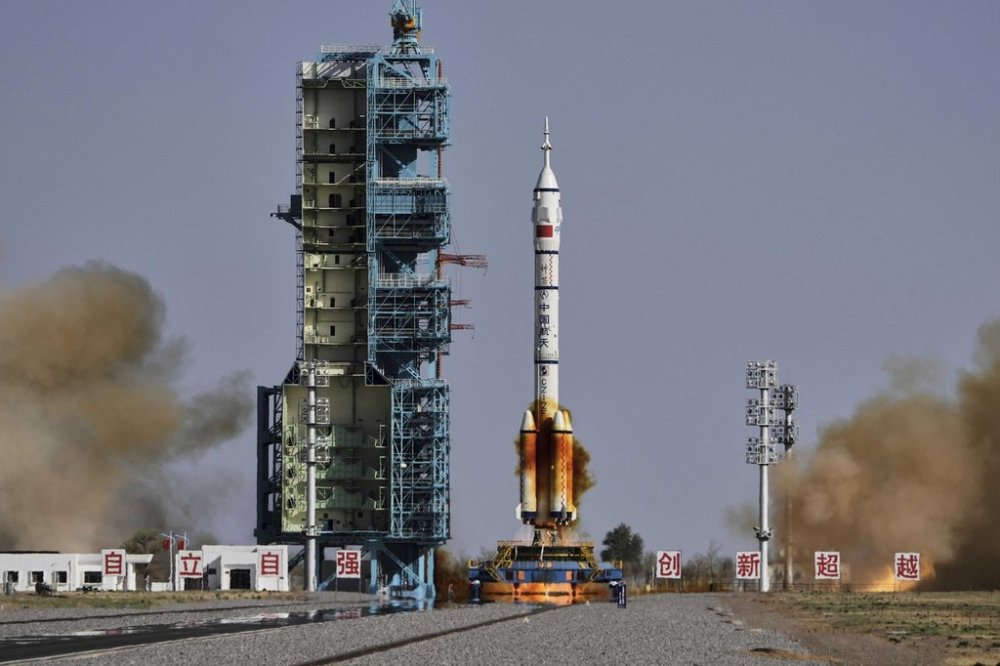
“If you can impede a satellite’s ability to communicate, you can cause a significant disruption,” said Tom Pace, CEO of NetRise, a cybersecurity firm focused on protecting supply chains.
“Think about GPS,” said Pace, who served in the Marines before working on cyber issues at the Department of Energy. “Imagine if a population lost that and the confusion it would cause.”
Satellites are the short-term challenge
More than 12,000 operating satellites now orbit the planet, playing a critical role not just in broadcast communications but also in military operations, navigation systems like GPS, intelligence gathering and economic supply chains. They are also key to early launch-detection efforts, which can warn of approaching missiles.
That makes them a significant national security vulnerability, and a prime target for anyone looking to undermine an adversary’s economy or military readiness — or deliver a psychological blow like the hackers supporting Russia did when they hijacked television signals to Ukraine.
Hackers typically look for the weakest link in the software or hardware that supports a satellite or controls its communications with Earth. The actual orbiting device may be secure, but if it’s running on outdated software, it can be easily exploited.
As Russian forces invaded Ukraine in 2022, someone targeted Viasat, the U.S.-based satellite company used by Ukraine’s government and military. The hack, which Kyiv blamed on Moscow, used malware to infect tens of thousands of modems, creating an outage affecting wide swaths of Europe.
National security officials say Russia is developing a nuclear, space-based weapon designed to take out virtually every satellite in low-Earth orbit at once. The weapon would combine a physical attack that would ripple outward, destroying more satellites, while the nuclear component is used to fry their electronics.
U.S. officials declassified information about the weapon after Rep. Mike Turner, R-Ohio, issued a public warning about the technology. Turner has pushed for the Department of Defense to provide a classified briefing to lawmakers on the weapon, which, if deployed, would violate an international treaty prohibiting weapons of mass destruction in space.
Turner said such a weapon could render low-Earth orbit unusable for satellites for as long as a year. If it were used, the effects would be devastating: potentially leaving the U.S. and its allies vulnerable to economic upheaval and even a nuclear attack.
Russia and China also would lose satellites, though they are believed to be less reliant on the same kinds of satellites as the U.S.
Turner compared the weapon, which is not yet ready for deployment, to Sputnik, the Russian satellite that launched the space age in 1957.
“If this anti-satellite nuclear weapon would be put in space, it would be the end of the space age,” Turner said. “It should never be permitted to go into outer space. This is the Cuban Missile Crisis in space.”
Mining the moon and beyond
Valuable minerals and other materials found on the moon and in asteroids could lead to future conflicts as nations look to exploit new technologies and energy sources.
Acting NASA Administrator Sean Duffy announced plans this month to send a small nuclear reactor to the moon, saying it’s important the U.S. does so before China or Russia.
“We’re in a race to the moon, in a race with China to the moon,” Duffy said. “To have a base on the moon, we need energy and some of the key locations on the moon. … We want to get there first and claim that for America.”
The moon is rich in a material known as helium 3, which scientists believe could be used in nuclear fusion to generate huge amounts of energy. While that technology is decades away, control over the moon in the intervening years could determine which countries emerge as superpowers, according to Joseph Rooke, a London-based cybersecurity expert who has worked in the U.K. defense industry and is now director of risk insights at the firm Recorded Future.
The end of the Cold War temporarily halted a lot of investments in space, but competition is likely to increase as the promise of mining the moon becomes a reality.
“This isn’t sci-fi. It’s quickly becoming a reality,” Rooke said. “If you dominate Earth’s energy needs, that’s game over.”
China and Russia have announced plans for their own nuclear plants on the moon in the coming years, while the U.S. is planning missions to the moon and Mars. Artificial intelligence is likely to speed up the competition, as is the demand for the energy that AI requires.
Messages left with Russia’s Embassy in Washington were not returned.
Despite its steps into outer space, China opposes any extraterrestrial arms race, according to Liu Pengyu, a spokesperson for China’s Embassy in Washington. He said it is the U.S. that is threatening to militarize the final frontier.
“It has kept expanding military strength in space, created space military alliances, and attempted to turn space into a war zone,” Liu said. “China urges the U.S. to stop spreading irresponsible rhetoric, stop expanding military build-up in space, and make due contribution to upholding the lasting peace and security in space.”
What the US is doing about security in space
Nations are scrambling to create their own rocket and space programs to exploit commercial prospects and ensure they aren’t dependent on foreign satellites. It’s an expensive and difficult proposition, as demonstrated last week when the first Australian-made rocket crashed after 14 seconds of flight.
The U.S. Space Force was created in 2019 to protect American interests in space and to defend U.S. satellites from attacks from adversaries.
The space service is far smaller than the more well-established services like the Army, Navy or Air Force, but it’s growing.
The U.S. military operates an unmanned space shuttle used to conduct classified military missions and research. The craft, known as the X-37B, recently returned to Earth after more than a year in orbit.

The Space Force called access to space a vital national security interest.
“Space is a warfighting domain, and it is the Space Force’s job to contest and control its environment to achieve national security objectives,” it said in the statement.
American dominance in space has been largely unquestioned for decades following the end of the Cold War and the fall of the Soviet Union. But the new threats and competition posed by Russia and China show the need for an aggressive response, U.S. officials say.
The hope, Turner said, is that the U.S. can take steps to ensure Russia and China can’t get the upper hand, and the frightening potential of space weapons is not realized.
“You have to pay attention to these things so they don’t happen,” Turner said.