How many giraffe species are in Africa? New scientific analysis quadruples the count

Advertisement

Advertise with us

WASHINGTON (AP) — Giraffes are a majestic sight in Africa with their long necks and distinctive spots. Now it turns out there are four different giraffe species on the continent, according to a new scientific analysis released Thursday.

Read this article for free:


or

Already have an account? Log in here »

To continue reading, please subscribe:

Subscribe and receive a limited-edition Free Press branded hat or tote.

Digital Subscription

One year of digital access for only $205*

  • Enjoy unlimited reading on winnipegfreepress.com
  • Read the E-Edition, our digital replica newspaper
  • Access News Break, our award-winning app
  • Play interactive puzzles

*First annual payment billed as $205.00 + GST for one year. This annual subscription will automatically renew at $233.00 + GST every 52 weeks (10% off the regular annual price of $259.35). Offer available to new and qualified returning subscribers only. Cancel any time.

To continue reading, please subscribe:

Add Free Press access to your Brandon Sun subscription for only an additional

$1 for the first 4 weeks*

  • Enjoy unlimited reading on winnipegfreepress.com
  • Read the E-Edition, our digital replica newspaper
  • Access News Break, our award-winning app
  • Play interactive puzzles
Start now

*Your next Brandon Sun subscription payment will increase by $1.00 and you will be charged $17.95 plus GST for four weeks. After four weeks, your payment will increase to $24.95 plus GST every four weeks.

Hey there, time traveller!
This article was published 21/08/2025 (420 days ago), so information in it may no longer be current.

WASHINGTON (AP) — Giraffes are a majestic sight in Africa with their long necks and distinctive spots. Now it turns out there are four different giraffe species on the continent, according to a new scientific analysis released Thursday.

Researchers previously considered all giraffes across Africa to belong to a single species. New data and genetic studies have led a task force of the International Union for Conservation of Nature to split the tallest mammal on land into four groups — Northern giraffes, reticulated giraffes, Masai giraffes and Southern giraffes.

Key studies have emerged in the past decade highlighting significant differences between the four species, said the IUCN’s Michael Brown, a researcher in Windhoek, Namibia, who led the assessment.
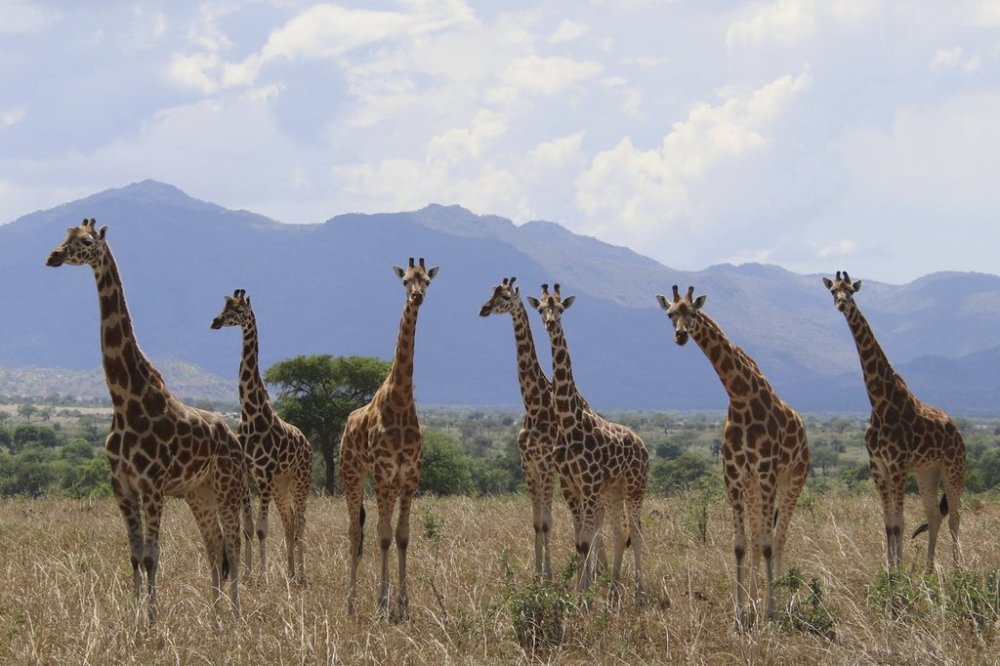
This photo provided by Michael Brown with the International Union for Conservation of Nature in August 2025 shows a herd of northern giraffes (Giraffa camelopardalis) in Uganda's Kidepo Valley National Park. (Michael Brown/IUCN via AP)

Naming different giraffes matters because “each species has different population sizes, threats and conservation needs,” he said. “When you lump giraffes all together, it muddies the narrative.”

Northern giraffes — whose range includes parts of Democratic Republic of Congo, South Sudan and Central African Republic – face threats from political instability and poaching. Masai giraffes in Kenya and Tanzania face pressure from habitat loss, as open savannas are converted to cattle pastures and fields.

Considering four giraffe species “is absolutely the right decision, and it’s long overdue,” said Stuart Pimm, a Duke University ecologist who wasn’t involved in the analysis.

While in the past researchers scrutinized giraffes’ spots, the new categories made use of newer methods including extensive analysis of genetic data and studies highlighting key anatomical differences, such as skull shape.

What appear like horns sticking up from the foreheads of giraffes are actually permanent bony protrusions from the skull, different from deer antlers that are shed annually.

Over the past 20 years, scientists have also gathered genetic samples from more than 2,000 giraffes across Africa to study the differences, said Stephanie Fennessy at the nonprofit Giraffe Conservation Foundation, who helped in the research.

It used to cost tens of thousands of dollars to sequence each genome, but advances in technology have brought the cost down to about $100, making it more accessible to nonprofit and conservation groups, she said.

According to population estimates from the foundation, the most endangered giraffe is the Northern giraffe, with only about 7,000 individuals left in the wild.

“It’s one of the most threatened large mammals in the world,” said Fennessy.

Southern giraffes are the most populous species, with around 69,000 individuals. There are around 21,000 reticulated giraffes left in the wild, and 44,000 Masai giraffes, according to the foundation.

“If not all giraffes are the same, then we have to protect them individually,” said Fennessy.

___

The Associated Press Health and Science Department receives support from the Howard Hughes Medical Institute’s Department of Science Education and the Robert Wood Johnson Foundation. The AP is solely responsible for all content.


Report Error Submit a Tip

More Stories

Women’s centre gets $568K for expansion project

Staff 2 minute read 3:28 PM CDT

A Winnipeg women’s centre is getting a grant from the provincial government to support its capital expansion project.

Families Minister Nahanni Fontaine announced Thursday the North Point Douglas Women’s Centre is receiving $568,400 in provincial funding.

The one-time grant will help the organization plan for its proposed development at 197 Euclid Ave. The proposed project includes construction of a new 10,500-sq-ft. resource centre designed to better meet the needs of women and families in North Point Douglas. Future phases of development will include up to 18 units of on-site supportive housing.

The site is near the organization’s current location at 221 Austin St. N.

Man pleads guilty to manslaughter for chasing, stabbing man downtown

Erik Pindera 3 minute read Preview

Man pleads guilty to manslaughter for chasing, stabbing man downtown

Erik Pindera 3 minute read Updated: 6:28 AM CDT

An intellectually disabled man who drunkenly chased down a man he had been arguing with and fatally stabbed him in broad daylight admitted to manslaughter on Wednesday.

Matthew Gerald Tomack Pelletier, now 38, chased Ricky Dwayne Mancheese, 49, down Kennedy Street before stabbing him six times in front of his wife on the sidewalk between Sargent and Cumberland avenues, at about 11:50 a.m. on June 11, 2024.

Pelletier, who police arrested the next day, was charged with second-degree murder, but instead pleaded guilty to the lesser offence of manslaughter in front of Court of King’s Bench Justice Joan McKelvey on Wednesday.

“This type of incident on Winnipeg streets is all too common and must be strongly deterred,” said McKelvey.

Read
Updated: 6:28 AM CDT

A man is dead and a woman is in hospital after a vehicle rollover on Highway 44 and Floodway Drive early Sunday.

Selkirk RCMP attended the scene at 12:31 a.m. in the Rural Municipality of St. Clements. The vehicle was found in a field northwest of the intersection.

The passenger, an 18-year-old woman from West St. Paul, was sent to hospital with non-life-threatening injuries.

The driver, a 24-year-old man from Beausejour, was sent to hospital but has since died.

Jets top line powers win over Wild

Ken Wiebe 7 minute read Preview

Jets top line powers win over Wild

Ken Wiebe 7 minute read Tuesday, Oct. 13, 2026

Cole Perfetti has made it clear he doesn’t want to get ahead of himself.

The Winnipeg Jets winger has first-hand knowledge on how humbling the NHL can be, coming off a quiet campaign as he worked his way back from a high ankle sprain.

But with the benefit of a full summer of training and a return to health, Perfetti has taken advantage of his promotion to the top line and quickly shown he belongs.

The latest proof came Tuesday, with Perfetti scoring a pair of goals — including the game-winner — in a 5-2 victory over the Minnesota Wild at Canada Life Centre.

Read
Tuesday, Oct. 13, 2026

Maritime modern gothic fiction sees Free Press Book Club get spooky

2 minute read Preview

Maritime modern gothic fiction sees Free Press Book Club get spooky

2 minute read 12:52 PM CDT

The Free Press Book Club is leaning into spooky season with its October pick, The Witch of Willow Sound. Author Vanessa F. Penney will join the book club meeting Tuesday, Oct. 27 at 7 p.m. to read from her novel and answer questions from readers, the Free Press and co-presenters McNally Robinson Booksellers.

Penney was born in Newfoundland, raised in rural Nova Scotia and is based in Dartmouth, where she works in the non-profit sector. The Witch of Willow Sound is her first novel.

Published in September 2025 by ECW Press, The Witch of Willow Sound follows Phaedra (Fade) Luck’s journey to find her missing aunt, Madeline Luck. When Fade arrives to the secluded, forested area of Willow Sound where Madeline lives, she finds her aunt’s once quaint cottage has fallen into disrepair; the wood is rotting, it’s damp and the vibes are very off.

As Fade searches for more information about her aunt and where she could have gone, the local townsfolk are not exactly keen on her presence, let alone her questions. For decades, they labelled Madeline as a witch and blamed any tragedies or misfortunes on her, including an impending hurricane.

Read
12:52 PM CDT

Developer ‘anxiously’ awaits judge’s decision on Granite Curling Club construction

Joyanne Pursaga 4 minute read Preview

Developer ‘anxiously’ awaits judge’s decision on Granite Curling Club construction

Joyanne Pursaga 4 minute read Tuesday, Oct. 13, 2026

The developer of a hotly debated project that would add 110 housing units to the Granite Curling Club’s parking lot has begun investigative work at the site while awaiting a judge’s decision on construction.

While some digging took place at the city-owned property last week, its developer said construction has yet to begin.

“I would call (the digging so far) investigative site work. It’s not preparing in any way for construction, other than to ensure that the reports that are required for any site have been completed,” said Jeremy Read, chief executive officer of UWCRC 2.0 Inc.

A heritage resources impact assessment will determine if the site has archeological significance. That work will check for everything from fossils to unmarked graves, said Read.

Read
Tuesday, Oct. 13, 2026