What is a famine and who declares one?
Advertisement
Read this article for free:
or
Already have an account? Log in here »
To continue reading, please subscribe:

Digital Subscription
One year of digital access for only $205*
- Enjoy unlimited reading on winnipegfreepress.com
- Read the E-Edition, our digital replica newspaper
- Access News Break, our award-winning app
- Play interactive puzzles
*First annual payment billed as $205.00 + GST for one year. This annual subscription will automatically renew at $233.00 + GST every 52 weeks (10% off the regular annual price of $259.35). Offer available to new and qualified returning subscribers only. Cancel any time.
To continue reading, please subscribe:
Add Free Press access to your Brandon Sun subscription for only an additional
$1 for the first 4 weeks*
- Enjoy unlimited reading on winnipegfreepress.com
- Read the E-Edition, our digital replica newspaper
- Access News Break, our award-winning app
- Play interactive puzzles
*Your next Brandon Sun subscription payment will increase by $1.00 and you will be charged $17.95 plus GST for four weeks. After four weeks, your payment will increase to $24.95 plus GST every four weeks.
Read unlimited articles for free today:
or
Already have an account? Log in here »
Hey there, time traveller!
This article was published 22/08/2025 (362 days ago), so information in it may no longer be current.
Famine is now occurring in Gaza City, according to the world’s leading authority on food crises.
The Integrated Food Security Phase Classification released an analysis Friday, saying more than half a million people in Gaza are trapped in famine, suffering widespread starvation and preventable deaths.
It’s the first time the IPC has confirmed a famine in the Middle East, where Israel has been in a brutal war with Hamas since the militant group’s Oct. 7, 2023 attack.
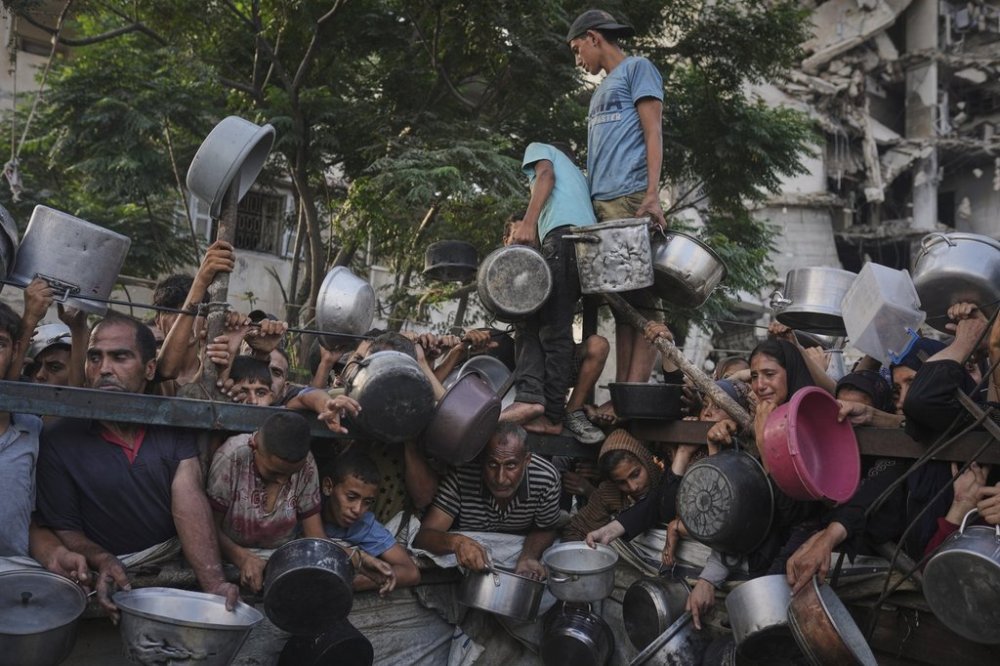
People in Gaza rely almost entirely on outside aid to survive because Israel’s military offensive has wiped out most capacity to produce food inside the territory.
“I am speechless that in 2025, we are facing starvation on the planet,” said Dr. Mark Manary at Washington University in St. Louis, an expert on childhood malnutrition. “It’s got to be a wake-up call.”
Manary said if food were made widely available, it would take around two or three months for the region to recover from the famine.
Here’s a look at what famine means and how the world finds out when one exists.
What is famine?
“Famine is, in plain language, not having enough to eat,” Manary said.
IPC, the leading international authority on hunger crises, considers an area to be in famine when three things occur: 20% of households have an extreme lack of food, or essentially are starving; at least 30% of children suffer from acute malnutrition or wasting, meaning they’re too thin for their height; and two adults or four children per every 10,000 people are dying daily of hunger and its complications.
Famine can appear in pockets — sometimes small ones — and a formal classification requires caution.
Last year, experts said a famine was ongoing in parts of North Darfur in Sudan. Somalia, in 2011, and South Sudan, in 2017, also saw famines in which tens of thousands of people were affected.
Who declares a famine?
The short answer is, there’s no set rule.
While the IPC says it is the “primary mechanism” used by the international community to analyze data and conclude whether a famine is happening or projected, it typically doesn’t make such a declaration itself.
Often, U.N. officials or governments will make a formal statement, based on an analysis from the IPC.
In Gaza, the World Health Organization said malnutrition among children “is accelerating at a catastrophic pace,” with more than 12,000 children identified as acutely malnourished in July alone. That’s the highest monthly figure ever recorded.
What happens to people trapped in a famine?
When people don’t have enough to eat, Manary said, the first thing that happens is the body uses up its reserves.
“So we have about three days’ worth of carbohydrates … and sometimes even months’ worth of fat that we can keep in our body in storage,” he said. “These are used up. And then the body still needs to keep working. So it starts breaking down less essential parts of the body. So you see, like, people become very thin.”
In a sense, he said, people’s muscles are being eaten by their own bodies to keep them going.
“The body is eating all of itself up in order to try to survive,” he said.
At some point, he said, that process breaks down and a stressor like an infection can kill the person.
How do starving people recover?

If they start eating, Manary said, their risk of dying drops quite a bit in just a week. But it sometimes takes a couple of months for someone to recover completely.
When a famine is declared, governments and the international aid community, including the U.N., can potentially unlock aid and funding to help feed people en masse.
Because this famine is human-caused, “it can be halted and reversed,” the IPC report said. “The time for debate and hesitation has passed, starvation is present and is rapidly spreading.”
___
The Associated Press Health and Science Department receives support from the Howard Hughes Medical Institute’s Department of Science Education and the Robert Wood Johnson Foundation. The AP is solely responsible for all content.