AI could help manufacturers offset tariff costs, depending on implementation: experts
Advertisement
Read this article for free:
or
Already have an account? Log in here »
To continue reading, please subscribe:
Digital Subscription
One year of digital access for only $1.44 a week*
- Enjoy unlimited reading on winnipegfreepress.com
- Read the E-Edition, our digital replica newspaper
- Access News Break, our award-winning app
- Play interactive puzzles
*Billed as $5.77 plus GST every four weeks. After 52 weeks, price increases to the regular rate of $19.95 plus GST every four weeks. Offer available to new and qualified returning subscribers only. Cancel any time.
To continue reading, please subscribe:
Add Free Press access to your Brandon Sun subscription for only an additional
$1 for the first 4 weeks*
- Enjoy unlimited reading on winnipegfreepress.com
- Read the E-Edition, our digital replica newspaper
- Access News Break, our award-winning app
- Play interactive puzzles
*Your next Brandon Sun subscription payment will increase by $1.00 and you will be charged $17.95 plus GST for four weeks. After four weeks, your payment will increase to $24.95 plus GST every four weeks.
Read unlimited articles for free today:
or
Already have an account? Log in here »
Hey there, time traveller!
This article was published 10/09/2025 (411 days ago), so information in it may no longer be current.
Manufacturing experts say there are specific ways integrating AI into the sector can help reduce costs and improve margins in the face of trade tensions, but note it won’t be a silver bullet.
“When the U.S. charges a 25 per cent tariff, if you can drop the supply price by, let’s say 20 per cent … then we can neutralize the additional cost due to the tariff,” said Chi-Guhn Lee, a University of Toronto professor and director of the AI in Manufacturing centre.
Currently, he said AI adoption in Canadian manufacturing is “widespread” and interest is high across the board but implementation is at very different stages for different companies. Some firms made investments years ago and are now “quite advanced,” he said.
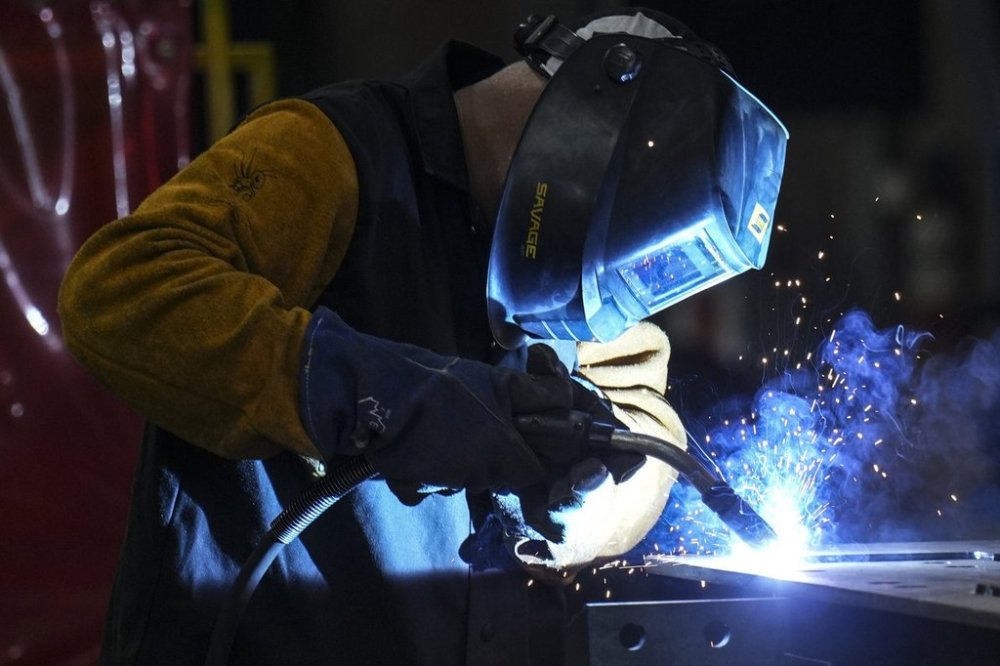
There are also stark differences between the U.S. and Canadian industries, said Jayson Myers, CEO of Next Generation Manufacturing Canada. He said that on average, Canadian firms have a “huge advantage” over their U.S. counterparts because “we don’t rely on volume of product out the door.”
“We rely on being able to specialize products, being able to specialize services for customers. And that’s where AI can really come in to help.”
He said one of the major advantages of AI in manufacturing will play out on factory floors, where equipment can benefit from things like predictive and prescriptive maintenance.
Another advantage AI can bring to the table is in supply chain management.
Myers said the technology can help “analyze supply chain capabilities and supply chain risks” while automating certain processes.
What AI can offer the industry, Myers said, is the development of “systems of prediction” and rapid data identification that highlight risks or defects. One example, he said, is in the development of new materials for industrial uses. Other areas include autonomous robotics or vehicles on factory floors, as well as analyzing equipment data to predict and avoid failures.
But without proper implementation, AI can’t deliver on its potential.
“The biggest thing for any company using AI is to really understand what you’re trying to achieve as a company, and to look at how AI can be implemented to improve whatever processes are really critical for your business plan,” Myers said.
Yi Li, the co-founder and executive vice-president of robotics software company Maple Advanced Robotics Inc., says his firm developed an autonomous robotics system that uses AI and 3D vision to perform skilled tasks like sanding, welding, spraying and more.
For example, Li said his company works with a Toronto-based small business that uses the system to have a robot sand kitchen cabinets — a task that is typically hard to automate.
“Each door is a different size, so if you use robots in a traditional way, it’s going to take a lot of programming time,” Li said.
With his company’s approach, it can take about four seconds to generate a panel using a scan, “which in production is nearly real time,” he said.
He said the robot can reach a maximum daily output of about 350 panels per day over an eight-hour production period, equivalent to the output of around three or four workers doing the task by hand.
One other specific use case for AI in manufacturing is quality inspections, according to Lee.
“I think the machine learning based image processing is way above the level of performance that humans can achieve,” he said.
Myers said it’s important to keep in mind that AI doesn’t operate on its own in a manufacturing environment. Instead, he said it needs to be integrated alongside tools like sensors and be able to read data from equipment.
“AI is only as good as the data that you’re feeding into it. So data quality is by far the biggest problem that any AI implementation faces,” he said.
While some firms have successfully implemented the technology into their production processes, others face barriers.
Lee said that for small firms, the cost can become an onerous investment.
He added that some tasks can be challenging to address using AI, especially if data is limited.

Myers said there could also be a skills gap for manufacturers adopting AI into their operations, where people with data analysis skills will be vital to the implementation.
He also highlighted cybersecurity as a potential issue.
“The more digital you become, the more you open yourself up to cyber risk,” he said.
Comments about AI integration in the manufacturing sector come ahead of an industry event taking place later this month, called the Canadian Manufacturing Technology Show, featuring professionals across the automotive, aerospace, and energy industries, among others.
This report by The Canadian Press was first published Sept. 10, 2025.