U.S. tariffs ‘greatest intentional destruction of income ever’: Stephen Poloz
Advertisement
Read this article for free:
or
Already have an account? Log in here »
To continue reading, please subscribe:

Digital Subscription
One year of digital access for only $205*
- Enjoy unlimited reading on winnipegfreepress.com
- Read the E-Edition, our digital replica newspaper
- Access News Break, our award-winning app
- Play interactive puzzles
*First annual payment billed as $205.00 + GST for one year. This annual subscription will automatically renew at $233.00 + GST every 52 weeks (10% off the regular annual price of $259.35). Offer available to new and qualified returning subscribers only. Cancel any time.
To continue reading, please subscribe:
Add Free Press access to your Brandon Sun subscription for only an additional
$1 for the first 4 weeks*
- Enjoy unlimited reading on winnipegfreepress.com
- Read the E-Edition, our digital replica newspaper
- Access News Break, our award-winning app
- Play interactive puzzles
*Your next Brandon Sun subscription payment will increase by $1.00 and you will be charged $17.95 plus GST for four weeks. After four weeks, your payment will increase to $24.95 plus GST every four weeks.
Read unlimited articles for free today:
or
Already have an account? Log in here »
Hey there, time traveller!
This article was published 18/09/2025 (354 days ago), so information in it may no longer be current.
TORONTO – A former Bank of Canada governor says the tariffs being imposed by the U.S. will be the “greatest intentional destruction of income ever.”
Stephen Poloz estimates that if U.S. tariffs land somewhere in the vicinity of 10 per cent, they would reduce global income by close to or around two percentage points.
While that might not sound like a lot, he said Thursday that it would equate to $2 trillion in income this year alone and $40 trillion over the next 10 years.
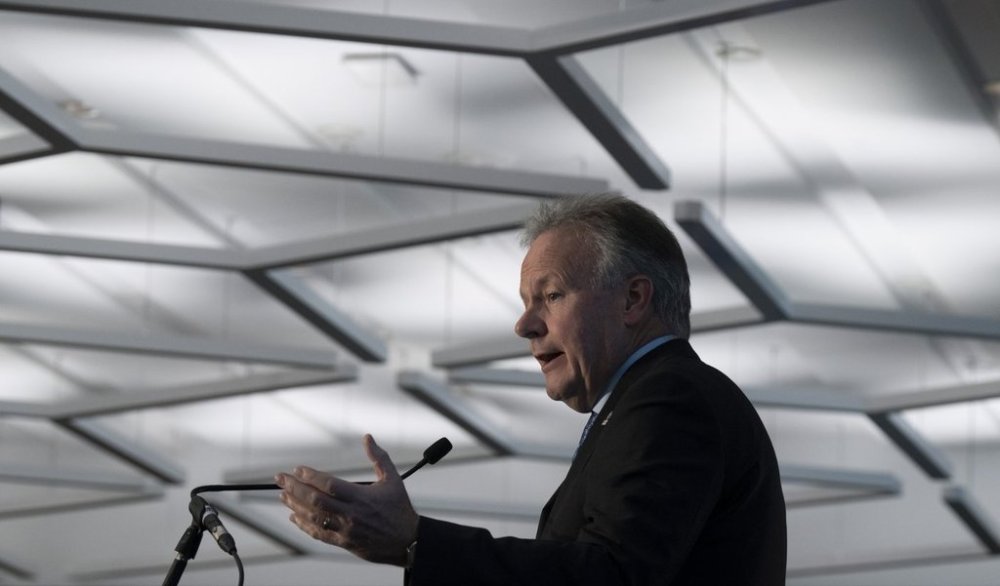
The impacts of the imposing tariffs is “a lot like throwing sand into the gas tank of a finely tuned Camaro,” said Poloz, who reminded the crowd that his arithmetic assumes no retaliatory measures from other countries.
“Like in any war, if you retaliate, you can easily double your losses.”
Poloz’s remarks opened an artificial intelligence symposium in Toronto organized by the Ivey Business School of Western University.
The symposium comes in the latter half of a year where trade tensions have dominated the worlds of economics and politics, weighing on business decisions, international relationships and consumer spending.
The trends have some people discussing the possibility of a recession and others predicting an irrevocable change in the world order.
“It’s tempting to blame that seismic throughline on one individual, but I believe that the root cause is actually the economic, not political,” Poloz said, alluding to U.S. President Donald Trump.
“We shouldn’t forget that history often repeats itself, or at least it rhymes, and that actually, you’ve been here before.”
Poloz’s understanding of the cyclical nature of economics and politics informs his views as the world enters the fourth Industrial Revolution, which is being spurred by the digitalization of every aspect of our lives and the increasing integration of artificial intelligence.
The first revolution came in the 1800s with the introduction of steam engines and was followed by another in the early 1900s, when electricity emerged. A third revolution triggered by the personal computer began in the 1980s and lasted to the 2010s.
“Each of these episodes was associated with major stock market crashes. Each was associated with major economic cataclysms, major points of disruption,” Poloz said.
“Each industrial revolution also spawned an era of rising income disparity because people were displaced by new technology.”
The revolutions formed a K-shaped economy, where some portions of the population and economy rebound quicker than others.
This creates a divergence that grows over time and according to Poloz, leads to rising political polarization, trade protectionism, nationalism, isolationism, and often, opportunism or war.
“I believe we need to assume we are in for more of the same — emphasis on more,” he said.
“If anything, Trump is just accelerating trends that were already in vogue.”
When tariff threats from the U.S. first emerged, Poloz and other economists hoped “damage would show up fast and cause them to change their minds,” but now they’ve seen Trump’s tactic is to blame the country’s central bank, the Federal Reserve.
“We have to accept the cards we have been dealt and seek a new path forward,” Poloz said.
He believes that path should include reducing interprovincial trade barriers.
Earlier this year, the federal Liberal government started tackling legislation aimed at cutting down barriers. By June, it estimated that it removed almost 70 per cent of the exceptions it has imposed on the Canadian Free Trade Agreement.
Also on Poloz’s list was embracing AI — a technology Julian Birkinshaw, dean of the Ivey Business School, cast doubt on.

Birkinshaw feels generative AI will be a “sustaining technology” but not a completely disruptive one and not one that will trigger some of the immense productivity gains people are predicting.
While AI will change businesses and is already shaking up the work of translators, Birkinshaw is more skeptical that it will upend most industries and kill off established companies.
“Does that mean established businesses should ignore it? Of course not,” Birkinshaw said.
“You have to have a certain level of paranoia … while being completely pragmatic about the likelihood that it’s not going to be quite as disruptive as people say.”
This report by The Canadian Press was first published Sept. 18, 2025.