As Amazon’s ‘flying rivers’ weaken with tree loss, scientists warn of worsening droughts
Advertisement
Read this article for free:
or
Already have an account? Log in here »
To continue reading, please subscribe:
Digital Subscription
One year of digital access for only $1.44 a week*
- Enjoy unlimited reading on winnipegfreepress.com
- Read the E-Edition, our digital replica newspaper
- Access News Break, our award-winning app
- Play interactive puzzles
*Billed as $5.77 plus GST every four weeks. After 52 weeks, price increases to the regular rate of $19.95 plus GST every four weeks. Offer available to new and qualified returning subscribers only. Cancel any time.
To continue reading, please subscribe:
Add Free Press access to your Brandon Sun subscription for only an additional
$1 for the first 4 weeks*
- Enjoy unlimited reading on winnipegfreepress.com
- Read the E-Edition, our digital replica newspaper
- Access News Break, our award-winning app
- Play interactive puzzles
*Your next Brandon Sun subscription payment will increase by $1.00 and you will be charged $17.95 plus GST for four weeks. After four weeks, your payment will increase to $24.95 plus GST every four weeks.
Read unlimited articles for free today:
or
Already have an account? Log in here »
Hey there, time traveller!
This article was published 30/09/2025 (388 days ago), so information in it may no longer be current.
BOGOTA, Colombia (AP) — Droughts have withered crops in Peru, fires have scorched the Amazon and hydroelectric dams in Ecuador have struggled to keep the lights on as rivers dry up. Scientists say the cause may lie high above the rainforest, where invisible “flying rivers” carry rain from the Atlantic Ocean across South America.
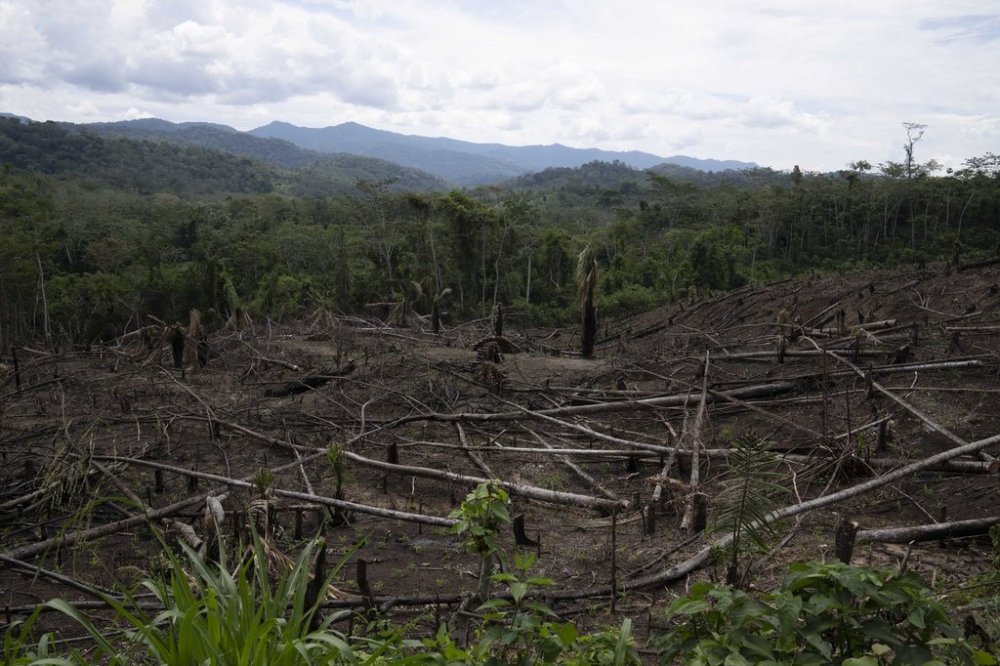
New analysis warns that relentless deforestation is disrupting that water flow and suggests that continuing tree loss will worsen droughts in the southwestern Amazon and could eventually trigger those regions to shift from rainforest to drier savanna — grassland with far fewer trees.
“These are the forces that actually create and sustain the Amazon rainforest,” said Matt Finer, a senior researcher with Amazon Conservation’s Monitoring of the Andean Amazon Project (MAAP), which tracks deforestation and climate threats across the basin and carried out the analysis.
“If you break that pump by cutting down too much forest, the rains stop reaching where they need to go.”
What are flying rivers and how do they work?
Most of the Amazon’s rainfall starts over the Atlantic Ocean. Moist air is pushed inland by steady winds that blow west along the equator, known as the trade winds. The forest then acts like a pump, effectively relaying the water thousands of miles westward as the trees absorb water, then release it back into the air.
Brazilian climate scientist Carlos Nobre was among the early researchers who calculated how much of the water vapor from the Atlantic would move through and eventually out of the Amazon basin. He and colleagues coined the “flying rivers” term at a 2006 scientific meeting, and interest grew as scientists warned that a weakening of the rivers could push the Amazon into a tipping point where rainforest would turn to savanna.
That’s important because the Amazon rainforest is a vast storehouse for the carbon dioxide that largely drives the world’s warming. Such a shift would devastate wildlife and Indigenous communities and threaten farming, water supplies and weather stability far beyond the region.
Warning signs in Peru and Bolivia
The analysis by Finer’s group found that southern Peru and northern Bolivia are especially vulnerable. During the dry season, flying rivers sweep across southern Brazil before reaching the Andes — precisely where deforestation is most intense. The loss of trees means less water vapor is carried westward, raising the risk of drought in iconic protected areas such as Peru’s Manu National Park.
“Peru can do everything right to protect a place like Manu,” Finer said. “But if deforestation keeps cutting into the pump in Brazil, the rains that sustain it may never arrive.”
Nobre said as much as 50% of rainfall in the western Amazon near the Andes depends on the flying rivers.
Corine Vriesendorp, director of science at Conservacion Amazonica, based in Cusco, Peru, said the changes are already visible.
“The last two years have brought the driest conditions the Amazon has ever seen,” Vriesendorp said. “Ecological calendars that Indigenous communities use — when to plant, when to fish, when animals reproduce — are increasingly out of sync. Having less and more unpredictable rain will have an even bigger impact on their lives than climate change is already having.”
Farmers face failed harvests, Indigenous families struggle with disrupted fishing and hunting seasons and cities that rely on hydroelectric power see outages as the rivers that provide the power dry up.
Forest makes a fragile pump
MAAP researchers found that rainfall patterns depend on when and where the flying rivers cross the basin. In the wet season, their northern route flows mostly over intact forests in Guyana, Suriname and northern Brazil, keeping the system strong.
But in the dry season — when forests are already stressed by heat — the aerial rivers cut across southern Brazil, where deforestation fronts spread along highways and farms and there simply are fewer trees to help move the moisture along.
“It’s during the dry months, when the forest most needs water, that the flying rivers are most disrupted,” Finer said.
Finer pointed to roads that can accelerate deforestation, noting that the controversial BR-319 highway in Brazil — a project to pave a road through one of the last intact parts of the southern Amazon — could create an entirely new deforestation front.
The tipping point debate
For years, scientists have warned about the Amazon tipping toward savannah. Finer said the new study complicates that picture.
“It’s not a single, all-at-once collapse,” he said. “Certain areas, like the southwest Amazon, are more vulnerable and will feel the impacts first. And we’re already seeing early signs of rainfall reduction downwind of deforested areas.”
Nobre said the risks are stark. Amazon forests have already lost about 17% of their cover, mostly to cattle and soy. Those ecosystems recycle far less water.
“The dry season is now five weeks longer than it was 45 years ago, with 20 to 30% less rainfall,” he said. “If deforestation exceeds 20 to 25% and warming reaches 2 degrees Celsius, there’s no way to prevent the Amazon from reaching the tipping point.”
What can be done?
Protecting intact forests, supporting Indigenous land rights and restoring deforested areas are the clearest paths forward, researchers say.

“To avoid collapse we need zero deforestation, degradation and fires — immediately,” Nobre said. “And we must begin large-scale forest restoration, not less than half a million square kilometers. If we do that, and keep global warming below 2 degrees, we can still save the Amazon.”
Finer said governments should consider new conservation categories specifically designed to protect flying rivers — safeguarding not just land but the atmospheric flows that make the rainforest possible.
For Vriesendorp, that means regional cooperation. She praised Peru for creating vast parks and Indigenous reserves in the southeast, including Manu National Park. But, she said, “this can’t be solved by one country alone. Peru depends on Brazil, and Brazil depends on its neighbors. We need basin-wide solutions.”
___
The Associated Press’ climate and environmental coverage receives financial support from multiple private foundations. AP is solely responsible for all content. Find AP’s standards for working with philanthropies, a list of supporters and funded coverage areas at AP.org.