Polytechnique engineers design low-cost, Japanese kirigami-inspired parachute

Advertisement

Advertise with us

MONTREAL - Researchers at Polytechnique Montreal have created a concept for a parachute inspired by the Japanese art of kirigami, one that engineers hope could be used in everything from humanitarian airdrops to scientific exploration.

Read this article for free:

or

Already have an account? Log in here »

To continue reading, please subscribe:

Subscribe and receive a limited-edition Free Press branded hat or tote.

Digital Subscription

One year of digital access for only $205*

  • Enjoy unlimited reading on winnipegfreepress.com
  • Read the E-Edition, our digital replica newspaper
  • Access News Break, our award-winning app
  • Play interactive puzzles

*First annual payment billed as $205.00 + GST for one year. This annual subscription will automatically renew at $233.00 + GST every 52 weeks (10% off the regular annual price of $259.35). Offer available to new and qualified returning subscribers only. Cancel any time.

To continue reading, please subscribe:

Add Free Press access to your Brandon Sun subscription for only an additional

$1 for the first 4 weeks*

  • Enjoy unlimited reading on winnipegfreepress.com
  • Read the E-Edition, our digital replica newspaper
  • Access News Break, our award-winning app
  • Play interactive puzzles
Start now

*Your next Brandon Sun subscription payment will increase by $1.00 and you will be charged $17.95 plus GST for four weeks. After four weeks, your payment will increase to $24.95 plus GST every four weeks.

Hey there, time traveller!
This article was published 02/10/2025 (302 days ago), so information in it may no longer be current.

MONTREAL – Researchers at Polytechnique Montreal have created a concept for a parachute inspired by the Japanese art of kirigami, one that engineers hope could be used in everything from humanitarian airdrops to scientific exploration.

The innovative project, which earned the researchers an article in the science journal “Nature,” published this week, demonstrates the new possibilities of a traditional art form, said Frédérick Gosselin, who alongside colleague David Mélançon led the work.

Kirigami is a Japanese art of folding and cutting paper to create three-dimensional designs. 
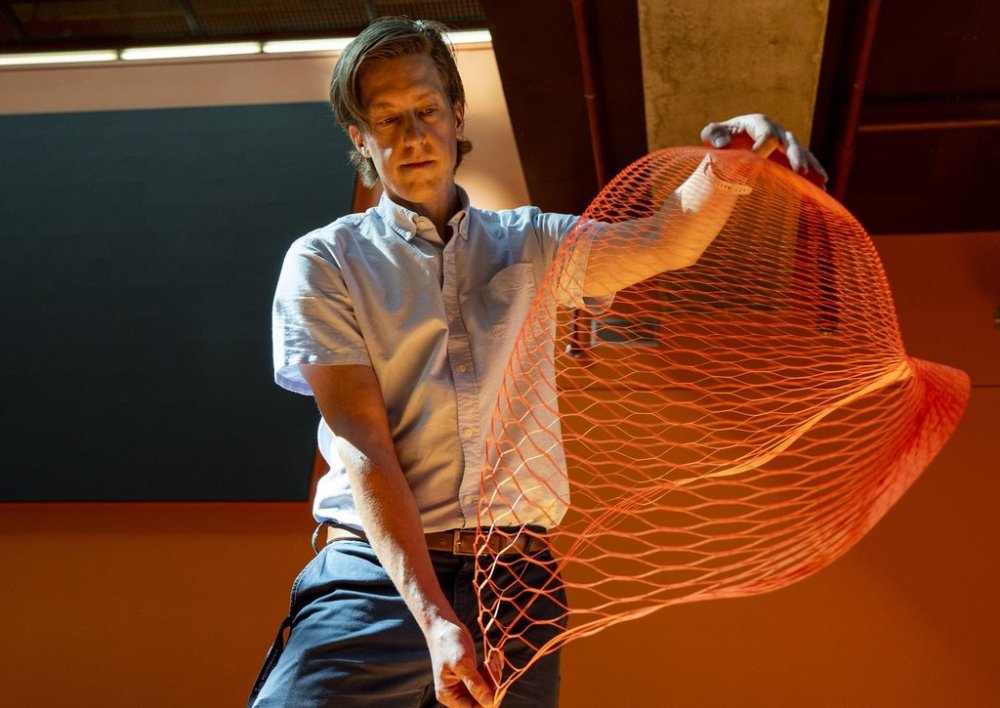
Frédérick Gosselin, professor at Polytechnique Montréal’s demonstrates the elasticity of a parachute in Montreal on Tuesday, Sept. 30, 2025. A project led by professors David Mélançon and Frédérick Gosselin in Polytechnique Montréal’s Mechanical Engineering Department has developed a parachute made from a plastic sheet cut in a “closed-loop” kirigami pattern. THE CANADIAN PRESS/Christinne Muschi

“So you probably made snowflakes with your kids around Christmas — you fold paper, you cut it, and when you unfold it, you get this pattern,” said Gosselin, a professor of mechanical engineering at Polytechnique and one of the authors of the study.

The prototype developed by Polytechnique engineers is a flat sheet of material, cut into a pattern that unfolds into a parachute as it drops to the ground.

“We were able to make a parachute for very little cost and simple materials like a sheet of paper, plastic, cardboard,” Gosselin said. “So we can make parachutes that are cheap to make but also they could be recyclable, reusable or even biodegradable.”

However, the current prototype is cut with a laser that costs tens of thousands of dollars, with each parachute taking about 25 minutes to produce. The size of the parachute is limited by the laser machine’s two-by-three-foot dimensions.

During a demonstration at Polytechnique this week, Gosselin used a bristol board from a dollar store.

A key challenge was determining which of the infinite possible cutting patterns would be effective, Gosselin said. What they created, he said, is an exceptionally stable parachute that falls to the ground in a straight line with little drift.

“These kinds of parachutes could limit material losses during airdropping as well as decrease manufacturing costs and complexity,” researchers wrote in the article.

The parachute’s behaviour doesn’t change as its size changes, which suggests it could be scaled up, Gosselin added.

Gosselin believes the parachutes could be used for multiple purposes, everything from drone delivery, humanitarian airdrops, or perhaps even to carry sensors during hurricanes that can measure properties of a storm at different altitudes.

“And so these Kirigami parachutes could be made very cheap to achieve these kind of applications,” Gosselin said.

The project took two years to develop and was the focus of Danick Lamoureux’s master’s thesis, which won the award for the best master’s dissertation at Polytechnique for 2024. A federal grant from the Natural Sciences and Engineering Research Council of Canada paid for Lamoureux to travel to École polytechnique in Paris to test parachute designs.

Gosselin says his plan is to continue researching the best kirigami patterns to achieve more functionality in the parachutes, including to improve their descent, to make them rotate and allow a camera to scan the surroundings.

Other logistical hurdles include how to manufacture them in large quantities and at scale.

“We’re still at the stage of fundamental research,” Gosselin said. “The novelty was to bring this new idea of kirigami parachutes forward and show that it’s possible.”

While space is a potential long-term goal, there are significant challenges, Gosselin noted.

A parachute for Mars, for example, would need to function in an atmosphere that is only about one per cent as dense as Earth’s and at supersonic speeds, a completely different environment to the one the chute has been tested in so far.

This report by The Canadian Press was first published Oct. 2, 2025.

Note to readers:This is a corrected story. A previous version misspelled the name of Danick Lamoureux.

Report Error Submit a Tip

More Stories

Wild weather uproots trees across city, leaves thousands in Manitoba without power

Chris Kitching 8 minute read Preview

Wild weather uproots trees across city, leaves thousands in Manitoba without power

Chris Kitching 8 minute read Updated: Yesterday at 5:06 PM CDT

This summer’s latest barrage of severe thunderstorms caused widespread property damage and power outages for more than 30,000 Manitoba Hydro customers, mostly in Winnipeg, as winds of up to 133 km/h wreaked havoc.

Charleswood resident Ian Glover’s house had minor damage compared with a neighbour’s home, where a large, uprooted poplar tree crashed through the roof while the storm pummelled Winnipeg late Wednesday night and early Thursday.

“I opened the window after I woke up (around 6 a.m.) and the tree — oh my God,” Glover said. “I got my wife up and she couldn’t believe it. I was totally blown away. (Our neighbour) said the branch went right through the house into their living room.”

Glover was thankful his neighbours were not injured. Some of the tree’s outer branches clipped the corner of his home.

Read
Updated: Yesterday at 5:06 PM CDT

Giant Tiger to close downtown, area residents bemoan dwindling grocery options

Nicole Buffie 4 minute read Preview

Giant Tiger to close downtown, area residents bemoan dwindling grocery options

Nicole Buffie 4 minute read Yesterday at 6:34 PM CDT

One of the only remaining grocery-store options for people living downtown and in the Exchange District is closing its doors.

Red notices on the windows at Giant Tiger’s Donald Street and Ellice Avenue location advised passersby the store will close on Nov. 7.

Chain spokesperson Jessica Charbonneau said in an email the decision to shutter stores is “not taken lightly and is made with careful consideration and thorough analysis.”

The store was busy Thursday afternoon.

Read
Yesterday at 6:34 PM CDT

Health Sciences Centre hit with 12-hour power outage

2 minute read Preview

Health Sciences Centre hit with 12-hour power outage

2 minute read Yesterday at 5:48 PM CDT

The cause of a power outage that affected several areas of Health Sciences Centre is under investigation.

Read
Yesterday at 5:48 PM CDT

IG Wealth Management to sell longtime Portage Avenue HQ

Gabrielle Piché 4 minute read Preview

IG Wealth Management to sell longtime Portage Avenue HQ

Gabrielle Piché 4 minute read Updated: Yesterday at 10:05 AM CDT

The downtown IG Wealth Management building will soon be up for sale.

The Winnipeg-based financial services company is moving its headquarters after nearly 40 years at 447 Portage Ave., across from the former Hudson’s Bay flagship store.

By current timelines, staff will move into a newer downtown tower — 360 Main St. — in 2028.

Roughly 1,100 employees will make the transition, according to Nancy McCuaig, executive vice-president of IGM Financial, IG Wealth Management’s parent company.

Read
Updated: Yesterday at 10:05 AM CDT

Manitobans will feel pinch of feds' early retirement plan: union leader

Carol Sanders 5 minute read Preview

Manitobans will feel pinch of feds' early retirement plan: union leader

Carol Sanders 5 minute read Wednesday, Jul. 29, 2026

About 10,000 federal public servants have applied for the government’s early retirement program, launched as part of a plan to cut the number of bureaucrats.

The cuts will impact services to Manitobans, with increasing workloads for those who remain, says the union representing federal employees here.

“It’s going to be increased workloads, maybe delays in services — issues getting your passport or seeking in-person support for (employment insurance),” said Krysty Thomas, Public Service Alliance of Canada regional vice-president for the Prairies.

“Those will all be affected with these early incentive retirement packages.”

Read
Wednesday, Jul. 29, 2026

We’re giving, they’re taking — where’s the win?

Editorial 4 minute read Preview

We’re giving, they’re taking — where’s the win?

Editorial 4 minute read 2:00 AM CDT

In the give-and-take of negotiations so far, Canada seems to be doing all the giving, while the United States does all the taking.

In the last few days, the Canadian government said it was backing away from a five per cent levy to be paid by American streaming services such as Amazon and Netflix after, earlier, dropping the three per cent digital services tax. Then, there was what now appears to be succumbing to American President Donald Trump over the Gordie Howe International Bridge, where Canada agreed to let the U.S. share the net revenues from the bridge, even though Canada paid for the entire construction.

Now, Prime Minister Mark Carney is signalling he won’t use energy exports to the United States as a bargaining chip in the current talks on the Canada-U.S.-Mexico free trade agreement, saying he didn’t “see the value” of using Canada’s energy exports to the U.S. as a trade bargaining chip.

“Canadians are reliable,” Carney said Wednesday in Red Deer, Alta. “One of the biggest commodities, arguably the best, is trust. People trust us, and so, when you’re a supplier of a key commodity, key service, you’ve got to think really hard about not supplying.”

Read
2:00 AM CDT