Archaeological site in Alaska that casts light on early Yup’ik life ravaged by ex-Typhoon Halong

Advertisement

Advertise with us

JUNEAU, Alaska (AP) — A fragment of a mask that was preserved for hundreds of years in permafrost sat in the muck of a low tide in the western Alaska community of Quinhagak. Wooden spoons, toys, a fishing lure and other artifacts were strewn, in some cases for miles, along the beach.

Read this article for free:


or

Already have an account? Log in here »

To continue reading, please subscribe:

Subscribe and receive a limited-edition Free Press branded hat or tote.

Digital Subscription

One year of digital access for only $205*

  • Enjoy unlimited reading on winnipegfreepress.com
  • Read the E-Edition, our digital replica newspaper
  • Access News Break, our award-winning app
  • Play interactive puzzles

*First annual payment billed as $205.00 + GST for one year. This annual subscription will automatically renew at $233.00 + GST every 52 weeks (10% off the regular annual price of $259.35). Offer available to new and qualified returning subscribers only. Cancel any time.

To continue reading, please subscribe:

Add Free Press access to your Brandon Sun subscription for only an additional

$1 for the first 4 weeks*

  • Enjoy unlimited reading on winnipegfreepress.com
  • Read the E-Edition, our digital replica newspaper
  • Access News Break, our award-winning app
  • Play interactive puzzles
Start now

*Your next Brandon Sun subscription payment will increase by $1.00 and you will be charged $17.95 plus GST for four weeks. After four weeks, your payment will increase to $24.95 plus GST every four weeks.

Hey there, time traveller!
This article was published 29/10/2025 (351 days ago), so information in it may no longer be current.

JUNEAU, Alaska (AP) — A fragment of a mask that was preserved for hundreds of years in permafrost sat in the muck of a low tide in the western Alaska community of Quinhagak. Wooden spoons, toys, a fishing lure and other artifacts were strewn, in some cases for miles, along the beach.

The Yup’ik community near the edge of the Bering Sea was spared the widespread devastation wrought by the remnants of Typhoon Halong on its neighbors further west earlier this month. But it suffered a different kind of blow: The lashing winds and storm surge devoured dozens of feet of shoreline, disrupting a culturally significant archaeological site and washing away possibly thousands of unearthed artifacts.

About 1,000 pieces, including wooden masks and tools, were recovered in Quinhagak after the storm ravaged parts of southwest Alaska on Oct. 11 and 12. But many more pieces — perhaps up to 100,000 — were left scattered, said Rick Knecht, an archaeologist who has worked on the Nunalleq, or old village, project for 17 years. That’s roughly the number of pieces previously recovered from the archaeological site.
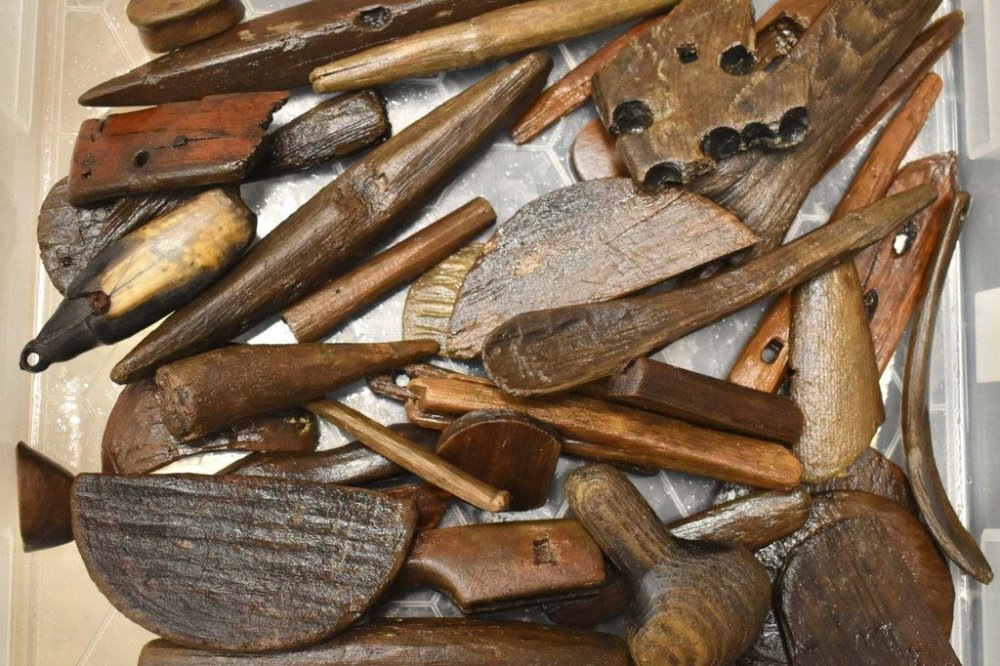
This photo provided by Richard Arden Knecht shows various tools, utensils and other artifacts that were recovered after the Typhoon Halong scattered them from a significant Yup'ik archaeological site, known as the Nunalleq site, in Quinhagak, Alaska, Oct. 2025. (Richard Arden Knecht via AP)

Meanwhile, freezing temperatures and ice have settled into the region, stalling immediate efforts to find and recover more displaced artifacts on searches done by four-wheeler and foot.

Knecht called what happened a major loss. The site has yielded the world’s largest collection of pre-contact Yup’ik artifacts. Much of what’s known about Yup’ik life before outsiders arrived stems from the project, said Knecht, an emeritus senior lecturer in archaeology at the University of Aberdeen in Scotland.

“When there are holes or disturbances in the site, it’s like trying to read a book with holes in the pages. You’re going to miss a few things,” he said. “And the bigger those holes are, the weaker the story gets. There’s a few holes in the book right now.”

While the name of the original village isn’t known, it was attacked by another village and burned around 1650, he said. Knecht has worked with elders and others in Quinhagak to combine their traditional knowledge with the technology and techniques used by the archaeology teams to study the past together.

Quinhagak has about 800 residents, and subsistence food gathering is critically important to them.

The storm dispersed artifacts from a site long preserved by permafrost, Knecht said. A longstanding concern has been the threat that climate change — melting permafrost, coastal erosion, the potential for more frequent or stronger storms — has posed to the site, he said.

It poses risks to the community itself. Erosion threatens major infrastructure in Quinhagak, including a sewage lagoon, homes and fish camps. Thawing permafrost is also unsettling and undermining buildings, according to a 2024 report from the Alaska Native Tribal Health Consortium.

The excavation project itself began after artifacts began appearing on the beach around 2007. Part of the site that washed out had been excavated previously.

“There was a big chunk where we’d only gone about halfway down and left it for later because we prioritized parts of the site that were most at risk from marine erosion,” Knecht said.

When he left in July, there was a roughly 30-foot buffer to the sea. The storm took out the buffer and another 30 feet of the site, he said. It also left what Knecht described as piano-sized clumps of tundra on the tidal flats.

Knecht didn’t recognize the site at first after Halong.

“I just drove right by it because all the landmarks I’m used to on the beach and at the site were gone or changed,” he said.

Work to preserve the rescued artifacts has included soaking the marine salts from the wood and placing the pieces in special chemicals that will help them hold together when they dry out, he said. If one were to just take one of the wooden artifacts off the beach and let them dry, they’d “crack to pieces, sometimes in a matter of hours.”

There is a lab at the museum in Quinhagak where the artifacts are kept.

Archaeologists hope to return to the site next spring for a “rescue excavation” of layers exposed by the storm, he said. In some ways, it feels like when teams saw the site in 2009: “We’ve got this raw site with artifacts popping off in every way,” he said. “So we’re starting from scratch again.”


Report Error Submit a Tip

More Stories

MPI not sleeping on ride-share fraud

Editorial 4 minute read Preview

MPI not sleeping on ride-share fraud

Editorial 4 minute read Yesterday at 2:00 AM CDT

Rust never sleeps. You may remember those words as the title of a Neil Young and Crazy Horse album from 1979. You might even recognize an even older use of the words as an advertising slogan for anti-rust paint Rust-Oleum.

Read
Yesterday at 2:00 AM CDT

Man pleads guilty to manslaughter for chasing, stabbing man downtown

Erik Pindera 3 minute read Preview

Man pleads guilty to manslaughter for chasing, stabbing man downtown

Erik Pindera 3 minute read Updated: 6:28 AM CDT

An intellectually disabled man who drunkenly chased down a man he had been arguing with and fatally stabbed him in broad daylight admitted to manslaughter on Wednesday.

Matthew Gerald Tomack Pelletier, now 38, chased Ricky Dwayne Mancheese, 49, down Kennedy Street before stabbing him six times in front of his wife on the sidewalk between Sargent and Cumberland avenues, at about 11:50 a.m. on June 11, 2024.

Pelletier, who police arrested the next day, was charged with second-degree murder, but instead pleaded guilty to the lesser offence of manslaughter in front of Court of King’s Bench Justice Joan McKelvey on Wednesday.

“This type of incident on Winnipeg streets is all too common and must be strongly deterred,” said McKelvey.

Read
Updated: 6:28 AM CDT

‘We know we’re not going to beat Mother Nature’: Ice prep begins at Princess Auto Stadium for Heritage Classic

Mike McIntyre 6 minute read Preview

‘We know we’re not going to beat Mother Nature’: Ice prep begins at Princess Auto Stadium for Heritage Classic

Mike McIntyre 6 minute read Tuesday, Oct. 13, 2026

Derek King typically has ice in his veins.

But the Manitoban admits there may be a few more butterflies than usual as he prepares for the ultimate home game — the 2026 Heritage Classic between the Winnipeg Jets and Montreal Canadiens.

“This is so exciting to be back,” King, the NHL’s vice-president of hockey operations and facilities operations, said Tuesday afternoon.

“It’s definitely going to be a fun event to be part of.”

Read
Tuesday, Oct. 13, 2026

Jets top line powers win over Wild

Ken Wiebe 7 minute read Preview

Jets top line powers win over Wild

Ken Wiebe 7 minute read Tuesday, Oct. 13, 2026

Cole Perfetti has made it clear he doesn’t want to get ahead of himself.

The Winnipeg Jets winger has first-hand knowledge on how humbling the NHL can be, coming off a quiet campaign as he worked his way back from a high ankle sprain.

But with the benefit of a full summer of training and a return to health, Perfetti has taken advantage of his promotion to the top line and quickly shown he belongs.

The latest proof came Tuesday, with Perfetti scoring a pair of goals — including the game-winner — in a 5-2 victory over the Minnesota Wild at Canada Life Centre.

Read
Tuesday, Oct. 13, 2026

White-supremacist highway sign casts pall on Steinbach city council campaign

Matthew Frank 4 minute read Preview

White-supremacist highway sign casts pall on Steinbach city council campaign

Matthew Frank 4 minute read Tuesday, Oct. 13, 2026

The RCMP is investigating a white-nationalist sign near Steinbach with racist messaging and alleged links to a known Canadian far-right group.

Read
Tuesday, Oct. 13, 2026

What's Up: Clara Hughes, Moving / Still: Animation, Rumble in the Burt, Send+Receive, Lotai as Chappell Roan, Scream & Halloween

7 minute read Preview

What's Up: Clara Hughes, Moving / Still: Animation, Rumble in the Burt, Send+Receive, Lotai as Chappell Roan, Scream & Halloween

7 minute read 6:00 AM CDT

Clara Hughes book launchMcNally Robinson Booksellers, Grant Park (1120 Grant Ave.)Tonight, 7 p.m.FreeOne of Canada’s most decorated Olympians returns to her hometown tonight to launch a new memoir about her healing journey, the roadblocks along the way and the search for new beginnings.Clara Hughes, who was born in Winnipeg and now lives on Vancouver Island, launches her new memoir Learning to Breathe at 7 p.m., when she’ll be joined in conversation by Shelagh Rogers, the former host of CBC Radio’s The Next Chapter.

Learning to Breathe is Hughes’s second memoir, following the publication of 2017’s Open Heart, Open Mind. Her latest sees the six-time Olympic medallist detail her use of psychedelic-assisted therapy to deal with physical and emotional ailments, navigating menopause, forging new relationships and more.

Hughes is the only athlete to win multiple medals in both the Summer and Winter Games (in cycling and speed skating, respectively), and is a member of both the Order of Manitoba and the Order of Canada. She’ll discuss Learning to Breathe with Rogers before signing copies at the store. The free event is also available to stream on McNally Robinson’s YouTube page.

— Ben Sigurdson

Read
6:00 AM CDT