Norway transport firm steps up controls after tests show Chinese-made buses can be halted remotely

Advertisement

Advertise with us

OSLO, Norway (AP) — A leading Norwegian public transport operator has said it will introduce stricter security requirements and step up anti-hacking measures after a test on new Chinese-made electric buses showed the manufacturer could remotely turn them off.

Read this article for free:


or

Already have an account? Log in here »

To continue reading, please subscribe:

Subscribe and receive a limited-edition Free Press branded hat or tote.

Digital Subscription

One year of digital access for only $205*

  • Enjoy unlimited reading on winnipegfreepress.com
  • Read the E-Edition, our digital replica newspaper
  • Access News Break, our award-winning app
  • Play interactive puzzles

*First annual payment billed as $205.00 + GST for one year. This annual subscription will automatically renew at $233.00 + GST every 52 weeks (10% off the regular annual price of $259.35). Offer available to new and qualified returning subscribers only. Cancel any time.

To continue reading, please subscribe:

Add Free Press access to your Brandon Sun subscription for only an additional

$1 for the first 4 weeks*

  • Enjoy unlimited reading on winnipegfreepress.com
  • Read the E-Edition, our digital replica newspaper
  • Access News Break, our award-winning app
  • Play interactive puzzles
Start now

*Your next Brandon Sun subscription payment will increase by $1.00 and you will be charged $17.95 plus GST for four weeks. After four weeks, your payment will increase to $24.95 plus GST every four weeks.

Hey there, time traveller!
This article was published 05/11/2025 (316 days ago), so information in it may no longer be current.

OSLO, Norway (AP) — A leading Norwegian public transport operator has said it will introduce stricter security requirements and step up anti-hacking measures after a test on new Chinese-made electric buses showed the manufacturer could remotely turn them off.

Transport operator Ruter said test results published last week showed that Chinese bus maker Yutong Group had access to their control systems for software updates and diagnostics. “In theory, this could be exploited to affect the bus,” it said.

The tests — with buses driven in underground mines to strip away external signals — were conducted both on brand-new Yutong buses and on three-year old vehicles from Dutch bus manufacturer VDL, the company said. It said the tests showed that the Dutch buses didn’t have the ability to conduct over-the-air software updates, while the Chinese-made buses did.
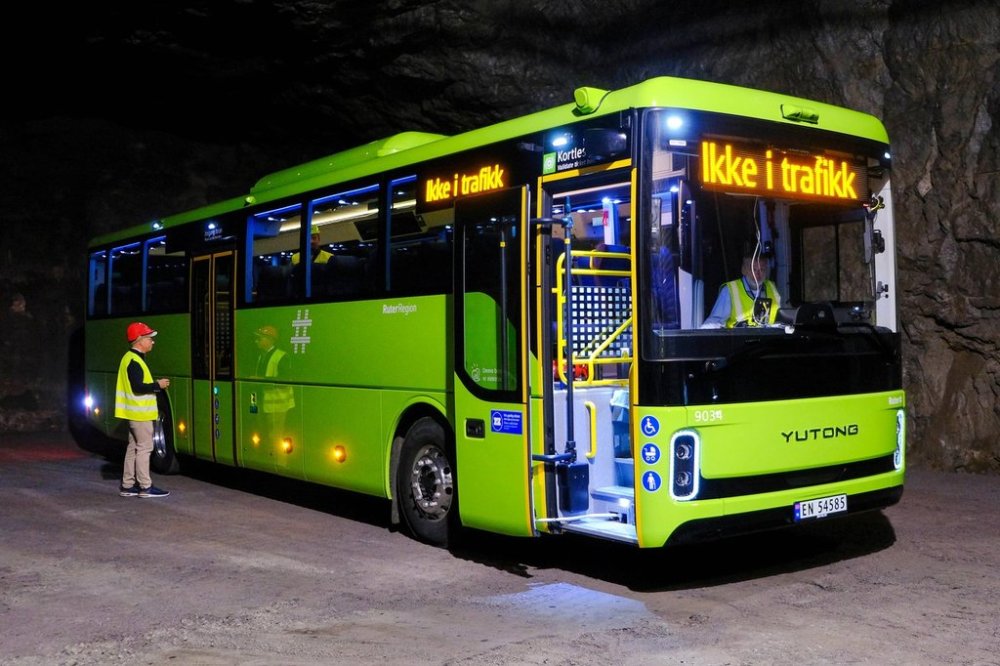
This photo provided by Ruter AS show a Yutong bus, owned by Norwegian public transport operator, Ruter, during a test of the vehicle's communication system on Aug. 14, 2025, in Sandvika, Norway. (Eilif Swensen/Ruter AS via AP)

Yutong did not immediately respond to requests from The Associated Press on Wednesday seeking comment.

The Guardian newspaper, which reported on the issue, cited a statement from the Chinese company that said it “strictly complies” with the laws and rules of places where its vehicles operate. The statement said data about its buses was stored in Germany.

The newspaper cited an unidentified Yutong spokesperson saying the data is encrypted and is “used solely for vehicle-related maintenance, optimization and improvement to meet customers’ after-sales service needs.”

According to Yutong’s website, the company has sold tens of thousands of vehicles across Europe, Africa, Latin America and the Asia-Pacific region in recent decades.

The study was initiated in part over concerns about surveillance, at a time when many countries in Europe, North America and beyond have been taking steps to protect data about consumers and remote operations.

Broader worries about remote control of EVs

The findings showed that “the manufacturer has direct digital access to each individual bus for software updates and diagnostics,” said Ruter, which says it runs half of Norway’s public transport and operates in Oslo and the eastern Akershus region.

Concerns about remote control of electric vehicles are not new: U.S. regulators in January opened a probe into Teslas after reports of crashes involving the use of company technology that allows drivers to remotely command their vehicle to return to them, or move to another location, using a phone app.

The Yutong buses are operated by people — they are not driverless vehicles like taxis and shuttles in places like California and China.

“Following this testing, Ruter moves from concern to concrete knowledge about how we can implement security systems that protect us against unwanted activity or hacking of the bus’s data systems,” Ruter CEO Bernt Reitan Jenssen said in a statement.

‘All types of vehicles’ of this type at risk

In nearby Denmark, transport company Movia said it was reviewing risk assessments when it comes to cybersecurity and espionage on scheduled buses, and possible measures to prevent hacking, misuse of data and risks of disabling the bus.

Movia said Danish authorities had not signaled any cases of buses being deactivated, but it was looking for ways to eliminate vulnerabilities.

The new findings, it said, were presented at the InformNorden traffic conference by advisers from the University of South-Eastern Norway and showed that neither a hacker nor the supplier could take control of the bus.

“It is also important to emphasize that the Norwegian senior advisers stated that this is not a Chinese bus concern, it is a problem for all types of vehicles and devices with these kind of electronics built in,” Movia said in an email.

Tougher security rules

Cameras in the buses are not connected to the internet, so “there is no risk of image or video transmission from the buses,” said Ruter, which has more than 100 Yutong buses in its fleet. The buses cannot be operated remotely, it said.

Still, Ruters said the manufacturer can access the control system for battery and power supply via mobile network. It said that means that in theory, buses “can be stopped or rendered inoperable by the manufacturer.”

The Norwegian company said it’s responding by imposing tougher security rules in future procurement, developing firewalls that ensure local control and prevent hacking, and working with authorities on “clear cybersecurity requirements.”

It’s also taking steps to delay inbound signals, “so that we can gain insight into the updates being sent before they reach the bus.”


Report Error Submit a Tip

More Stories

We’re not falling back, springing forward anymore; Manitoba staying on daylight time

Carol Sanders 3 minute read Preview

We’re not falling back, springing forward anymore; Manitoba staying on daylight time

Carol Sanders 3 minute read Updated: 9:55 AM CDT

Time’s up for the time change in Manitoba.

Manitobans won’t be setting their clocks back an hour when daylight time comes to an end elsewhere on Nov. 1.

After surveying residents on the twice annual clock adjustment, the province announced Thursday that it will no longer spring forward and fall back, as has been the case for the majority of the past 110 or so years.

“We heard from Manitobans loud and clear — no more changing the clocks in Manitoba,” Premier Wab Kinew said in a news release Thursday. “Permanent daylight saving time is good for our health, good for business and good for parents… This change means one less adjustment families have to deal with each spring and fall. That’s why this November, your clocks won’t be changing.”

Read
Updated: 9:55 AM CDT

Winnipeg, police and downtown crime

Editorial 4 minute read Preview

Winnipeg, police and downtown crime

Editorial 4 minute read Yesterday at 2:01 AM CDT

A safer downtown is not much use if people are still afraid to walk there.

That is the uncomfortable message from Winnipeg’s latest police citizen survey, and one city council should take seriously.

Downtown crime has fallen this year, according to the most recent police statistics. Violent crime is down even more. But for most Winnipeggers, the downtown still feels like a place to avoid, particularly after dark.

Only 44 per cent of survey respondents said they feel very or reasonably safe walking alone downtown during the day. At night, that number plunges to just eight per cent. Among women, it is an appalling three per cent, compared with 14 per cent of men.

Read
Yesterday at 2:01 AM CDT

A community brought the Trident Press home

Stephen Borys 6 minute read Preview

A community brought the Trident Press home

Stephen Borys 6 minute read 2:00 AM CDT

A truck pulled up outside Oseredok a few weeks ago carrying more than an exhibition. Inside were the panels of Ukrainian Voice: A Legacy Mosaic, a monumental artwork built from the printing blocks once used to reproduce the photographs and illustrations in one of Canada’s longest-running Ukrainian newspapers.

Read
2:00 AM CDT

Gas turbine peaker plants are a mistake

Don Scott 7 minute read 2:00 AM CDT

Technology respecting electricity generation, storage and grid management is rapidly advancing and displacing gas-fired peaker plants. New battery storage systems are more efficient and less costly, smooth grid flow and are non-polluting. Texas, California and Australia are replacing gas turbine peaker plants with more effective storage batteries.

Solar and wind energy generation combined with battery storage at both the grid and home/business level is the most efficient way to meet peak demand. Building expensive, outdated, polluting American gas turbines, as Manitoba Hydro is proposing, is not in Manitoba’s interest.

Premier Wab Kinew noted that a final decision to build a new turbine power plant in Brandon has not been made. I hope he’s correct, for if Manitoba Hydro already made the decision and entered binding financial obligations with GE Vernova, the PUB’s role was superfluous.

In 2025/26 Nova Scotia Power installed 3 x 50 MW Lithium-ion grid batteries with the storage capacity of over 600 MWh. Installed by Kitchener/Waterloo based Canadian Solar’s subsidiary e-Storage who have operations around the world, they accomplished this in less than two years from the approval date in June 2024. Two were operational within 18 months, the third in 24. The cost was $237 million. At Nova Scotia’s cost per MW, a 750 MW battery peaker facility would cost Hydro $1.185 billion, just 40 per cent of the proposed $3 billion gas peaker plant.

Man gets 18 year sentence for sex assault that impregnated teen girl

Tessa Adamski 4 minute read Yesterday at 2:01 AM CDT

BRANDON — A 29-year-old man has been sentenced to 18 years in prison for sexually abusing and impregnating a 14-year-old girl in 2024.

“Sexual abuse of a child is inherently a grave violation of the child’s bodily integrity, dignity, and security, and in this case, the consequences were compounded by the victim’s pregnancy and the need to undergo a termination,” Brandon provincial court Judge Patrick Sullivan said on Tuesday.

The accused had pleaded guilty to two counts of sexual interference and two counts of breaching a court order banning him from contacting anyone under 18.

A publication ban prohibits the publication of information that could identify the 14-year-old, who is from a western Manitoba First Nation, and two other minors with whom he communicated.

Food literacy curriculum on the menu

Maggie Macintosh 5 minute read Preview

Food literacy curriculum on the menu

Maggie Macintosh 5 minute read Yesterday at 2:01 AM CDT

Manitoba has a new recipe for health class and “food literacy” is a key ingredient.

The in-class portion of phys-ed has historically involved lessons about puberty, the risks of consuming drugs and dissecting Canada’s food guide.

A new pilot program asks teachers to expand their nutrition units and include in-depth discussions about how everything from diet culture to food insecurity affects eating habits.

“This is really moving beyond a conception of food as only fuel, where you just boil down food to its calories, its vitamins,” said Sarah Elvins, a food historian at the University of Manitoba who researches popular culture and marketing.

Read
Yesterday at 2:01 AM CDT