Talking cows? N.S. researchers think they are getting closer to understanding moos
Advertisement
Read this article for free:
or
Already have an account? Log in here »
To continue reading, please subscribe:
Digital Subscription
One year of digital access for only $1.44 a week*
- Enjoy unlimited reading on winnipegfreepress.com
- Read the E-Edition, our digital replica newspaper
- Access News Break, our award-winning app
- Play interactive puzzles
*Billed as $5.77 plus GST every four weeks. After 52 weeks, price increases to the regular rate of $19.95 plus GST every four weeks. Offer available to new and qualified returning subscribers only. Cancel any time.
To continue reading, please subscribe:
Add Free Press access to your Brandon Sun subscription for only an additional
$1 for the first 4 weeks*
- Enjoy unlimited reading on winnipegfreepress.com
- Read the E-Edition, our digital replica newspaper
- Access News Break, our award-winning app
- Play interactive puzzles
*Your next Brandon Sun subscription payment will increase by $1.00 and you will be charged $17.95 plus GST for four weeks. After four weeks, your payment will increase to $24.95 plus GST every four weeks.
Read unlimited articles for free today:
or
Already have an account? Log in here »
Hey there, time traveller!
This article was published 02/01/2026 (298 days ago), so information in it may no longer be current.
HALIFAX – If a cow moos in a barn and no one is around to hear it, could you still understand what it’s trying to say?
Researchers at Dalhousie University are hoping to answer that question.
Led by Dr. Ghader Manafiazar, the team at Dalhousie’s agricultural campus in Truro, N.S., has been recording and analyzing cow noises to see whether the animals have different vocal patterns.
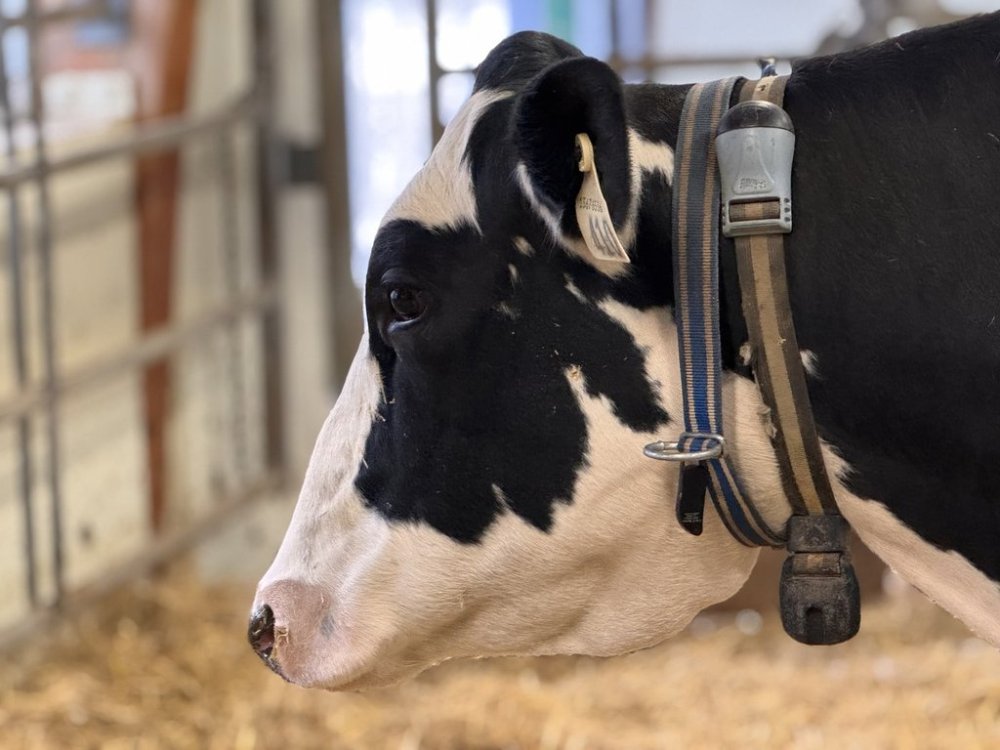
Humans can utter words using various inflections and meanings, said Manafiazar, a professor in the faculty of agriculture. His research is trying to determine whether the same holds true for animals. “When they say ‘moo,’ is it different from saying ‘moooooo’?”
Manafiazar and his student Hassan Miraei recorded more than 8,400 hours of audio of cows, concentrating on the week before and after calving to determine whether the researchers could detect stress in the animals.
Miraei fed the audio into an artificial intelligence algorithm tasked with logging the sounds and matching them with other data collected by researchers — such as the time of day or the behaviour of the cow before and after it made a noise. For instance, if a cow made a specific kind of moo, then gave birth the next day, the team would input that data into the AI model.
“If there is some time that we see high rise in their pitch, this could be associated with something particular. Even sunsets, down time. We don’t know,” Manafiazar said.
From there, Miraei says, the team is working on getting the algorithm to analyze vocal patterns and offer suggestions on whether the cow may be hungry, tired, in pain, or just enjoying a sunset.
Manafiazar likens the research to a parent learning to decode a baby’s cries. Over time, parents can figure out what a particular cry means.
That’s much harder to do with a herd of cattle. “The challenge is having 10,000 babies at a time,” Manafiazar said.

The goal for the team is to move from what Miraei calls a supervised algorithm to an unsupervised algorithm. Currently, the algorithm’s suggestions are cross-checked with notes from the team about what the cows were doing and when.
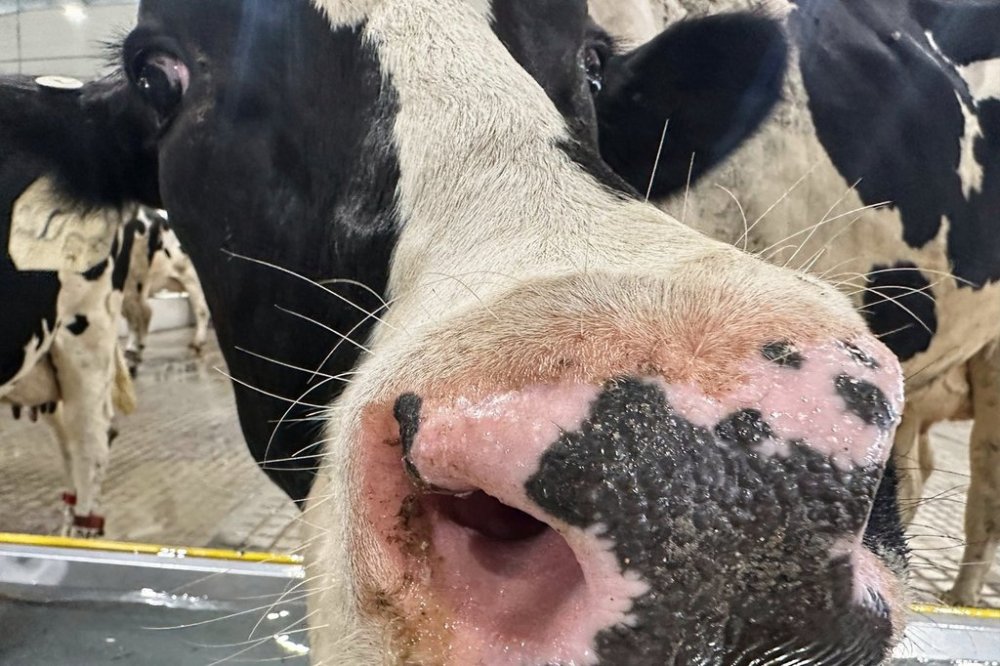
Eventually, they hope to move to an unsupervised algorithm, in which a recorder in the barn will send audio directly to the AI model, which will respond with an interpretation of the cow’s vocalizations.
It could be a real-time way of decoding what the cows are trying to say.
The research is still in early stages, but Manafiazar and Miraei are optimistic. They hope this research will one day help farmers understand and anticipate changes in cows’ moods, health and behaviour.
This report by The Canadian Press was first published Jan. 2, 2026.