Microsoft’s Brad Smith pushes Big Tech to ‘pay our way’ for AI data centers amid rising opposition
Advertisement
Read this article for free:
or
Already have an account? Log in here »
To continue reading, please subscribe:

Digital Subscription
One year of digital access for only $205*
- Enjoy unlimited reading on winnipegfreepress.com
- Read the E-Edition, our digital replica newspaper
- Access News Break, our award-winning app
- Play interactive puzzles
*First annual payment billed as $205.00 + GST for one year. This annual subscription will automatically renew at $233.00 + GST every 52 weeks (10% off the regular annual price of $259.35). Offer available to new and qualified returning subscribers only. Cancel any time.
To continue reading, please subscribe:
Add Free Press access to your Brandon Sun subscription for only an additional
$1 for the first 4 weeks*
- Enjoy unlimited reading on winnipegfreepress.com
- Read the E-Edition, our digital replica newspaper
- Access News Break, our award-winning app
- Play interactive puzzles
*Your next Brandon Sun subscription payment will increase by $1.00 and you will be charged $17.95 plus GST for four weeks. After four weeks, your payment will increase to $24.95 plus GST every four weeks.
Read unlimited articles for free today:
or
Already have an account? Log in here »
Hey there, time traveller!
This article was published 13/01/2026 (275 days ago), so information in it may no longer be current.
It won’t be easy for Big Tech companies to win the hearts and minds of Americans who are angered about massive artificial intelligence data centers sprouting up in their neighborhoods, straining electricity grids and drawing on local reservoirs.
Microsoft is trying anyway.
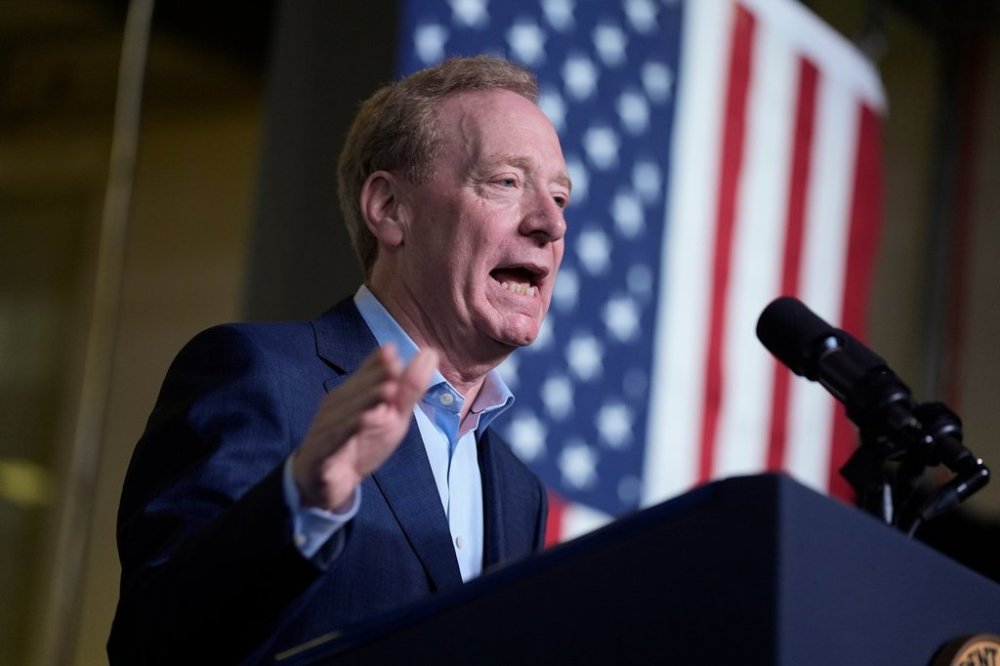
The software giant’s president, Brad Smith, is meeting with federal lawmakers Tuesday to push forward an approach that calls for the industry, not taxpayers, to pay the full costs of the vast network of computing warehouses needed to power AI chatbots like ChatGPT, Google’s Gemini and Microsoft’s own Copilot.
President Donald Trump gave Microsoft’s effort a nod in a Truth Social post Monday evening, where he stated that he does not want Americans to “pick up the tab” for these data centers and pay higher utility costs.
“Local communities naturally want to see new jobs but not at the expense of higher electricity prices or the diversion of their water,” Smith said in an interview with The Associated Press.
Smith’s campaign comes as data center developers are increasingly running into hostility in towns where they want to build and meeting defeat at municipal boards that must approve zoning applications or construction permits.
Rising electric prices are one problem. Heavy water usage by data centers to cool electronic equipment has also elicited concerns from local residents that they’ll see their wells run dry or their water utility bills spike.
The defeats have spread alarm among data center allies and spurred efforts to ramp up the amount of money that operators are willing to offer communities in exchange for approval.
“People are asking not just pointed questions but completely reasonable questions and it’s our job, I think, to acknowledge them and address them head on and show that we can do this and pursue this expansion in a way that fully meets their needs,” said Smith, who is also Microsoft’s vice chair and has spent decades leading its legal and political work.
In the mid-Atlantic region grid that encompasses all or parts of 13 states, ratepayers have been paying higher prices on their bills since at least June because of data centers, according to utilities and analysts.
Electricity bills are expected to keep rising as payments to power plant owners grow to entice the construction of new power sources to meet demand from new and yet-to-be-built data centers in hot spots like Virginia, Ohio and Pennsylvania.
Another source of friction is that big data center developers can strike bulk power deals with local electric utilities that are profitable for utilities, but also kept confidential. That means it may never be clear whether data center operators really are paying for their electricity — or foisting the cost onto the rest of the utility’s ratepayers, consumer advocates say.
Data center projects have also met objections in communities where people are worried about losing open space, farmland, forest or rural character, or are concerned about the damage to quality of life, property values, environment or their health.
In Hobart, Indiana, last week, the City Council approved a tax-abatement package for a multibillion-dollar Amazon data center planned there. In turn, the deal promises Amazon will make two payments of $5 million each for issuing a pair of building permits, plus another series of payments totaling $175 million over three years at various project milestones.
Opponents say the money unduly influences the decision-making of city officials.
In Wisconsin, where Smith grew up and the home of what Microsoft has called “the world’s most powerful AI datacenter,” the company has encountered hurdles in expanding its construction projects near the shores of Lake Michigan. The company has promised the centers will employ hundreds of people when they’re finished. Democratic Gov. Tony Evers has touted the projects he says will put Wisconsin “on the very cutting edge of AI power.”
But environmentalists and consumer groups have warned that the centers will consume unprecedented amounts of electricity, driving up rates across the Midwestern power grid, and could use hundreds of thousands of gallons of Lake Michigan water daily. Company officials have pledged that the centers’ impact will be minimal and will contribute carbon-free energy to the power grid.
Environmental group Clean Wisconsin has called for government officials to pause data center approvals until the state develops a comprehensive plan to regulate them. Francesca Hong, one of several Democratic candidates for governor — Evers is not seeking re-election in November — has developed a proposal she calls CONTROL ALT DELETE that calls for a moratorium on data center construction until “we know how to protect ourselves from their environmental and energy costs.”
In the interview with AP, Smith talked about data center projects in Wisconsin and elsewhere. This interview has been edited for clarity and length.
What’s the heaviest lift for Microsoft in terms of what you are contributing to ameliorate data center opposition?
Smith: We don’t use nearly as much water as we do electricity. Electricity is a heavier lift. It’s a larger investment. And it comes after several decades where electricity production in the United States was basically flat. If you look at the approach that we’re taking in terms of partnering with utilities, paying our own way, I think we can address this problem to the satisfaction of local communities. At the end of the day, it requires the approval of the utilities commissions.
Who are you talking about when you say you disagree with those who say AI is so beneficial that the public should help pay for the electricity the technology needs?
Smith: I shouldn’t name names. First of all, we wholeheartedly agree with the positive impact that AI is going to create for the future. But we don’t think that the public should be devoting tax dollars to pay for the improvements in the electricity grid that are needed to serve data centers. Private companies can incorporate that into their financial planning, especially when you look at things like improvements on the transmission side or improvements in substations.
Clean energy is not a priority for the current presidential administration. Are you still pushing for the electricity to power your data centers to be clean?
Smith: We set a goal for ourselves in 2020 of being what we call carbon-negative by 2030. That requires that we reduce the amount of carbon emissions that we create, and that we then remove from the environment each year, beginning in 2030, more carbon than we emit. We have not changed course on that. There are times when the power that is coming to our data centers is generated by something like natural gas. We can work with a utility to ensure that it’s cleaner natural gas, but beyond that, we also invest in bringing to the regional grid new sources of carbon-free energy as well, whether it’s nuclear, solar, hydro or others.
To what extent are you on track for the 2020 commitments?
Smith: On the carbon commitment, we have a clear path to reach our goal in 2030. As we often say, progress is lumpy, not linear. A lot of what we’re doing in the middle of the decade is making the investments that will benefit us at the end of the decade. It’s not like walking upstairs, where every step is the same length. But overall, I continue to be confident in our ability to meet our goals at the end of the decade.
What’s your position on groups calling for Wisconsin to pause AI data center approvals until there’s a plan to ensure these projects won’t harm communities?
Smith: We are supportive of Wisconsin developing a comprehensive electricity plan. I don’t think our project should be paused to wait for that. We’re partnering to build out and improve the electricity grid in southeastern Wisconsin. A rate tariff that we have proposed to the public utility commission would impose on Microsoft additional costs that we would help pay for in the state. And because of other investments we’re making, including a 150-megawatt solar farm.
——
AP writer Todd Richmond in Madison, Wisconsin, contributed to this report.