Why a turtle die-off has this Ottawa researcher worried about warming winters

Advertisement

Advertise with us

Grégory Bulté was snorkelling in the cold waters of Ontario's Opinicon Lake when he noticed the first dead turtle. 

Read this article for free:


or

Already have an account? Log in here »

To continue reading, please subscribe:

Subscribe and receive a limited-edition Free Press branded hat or tote.

Digital Subscription

One year of digital access for only $205*

  • Enjoy unlimited reading on winnipegfreepress.com
  • Read the E-Edition, our digital replica newspaper
  • Access News Break, our award-winning app
  • Play interactive puzzles

*First annual payment billed as $205.00 + GST for one year. This annual subscription will automatically renew at $233.00 + GST every 52 weeks (10% off the regular annual price of $259.35). Offer available to new and qualified returning subscribers only. Cancel any time.

To continue reading, please subscribe:

Add Free Press access to your Brandon Sun subscription for only an additional

$1 for the first 4 weeks*

  • Enjoy unlimited reading on winnipegfreepress.com
  • Read the E-Edition, our digital replica newspaper
  • Access News Break, our award-winning app
  • Play interactive puzzles
Start now

*Your next Brandon Sun subscription payment will increase by $1.00 and you will be charged $17.95 plus GST for four weeks. After four weeks, your payment will increase to $24.95 plus GST every four weeks.

Hey there, time traveller!
This article was published 04/02/2026 (200 days ago), so information in it may no longer be current.

Grégory Bulté was snorkelling in the cold waters of Ontario’s Opinicon Lake when he noticed the first dead turtle. 

The lake ice had just melted, and the northern map turtles stirred from their hibernation. The turtles, named for their topographical-looking shell marks, spend the winter at the bottom of the lake beneath what should be a protective layer of ice. 

Bulté’s monitoring of the lake dates back to 2003 and has offered long-term insights into the turtle. The Carleton University biology professor just recently confirmed what he believes is the oldest turtle of its kind documented in the wild, at 57 years old. 
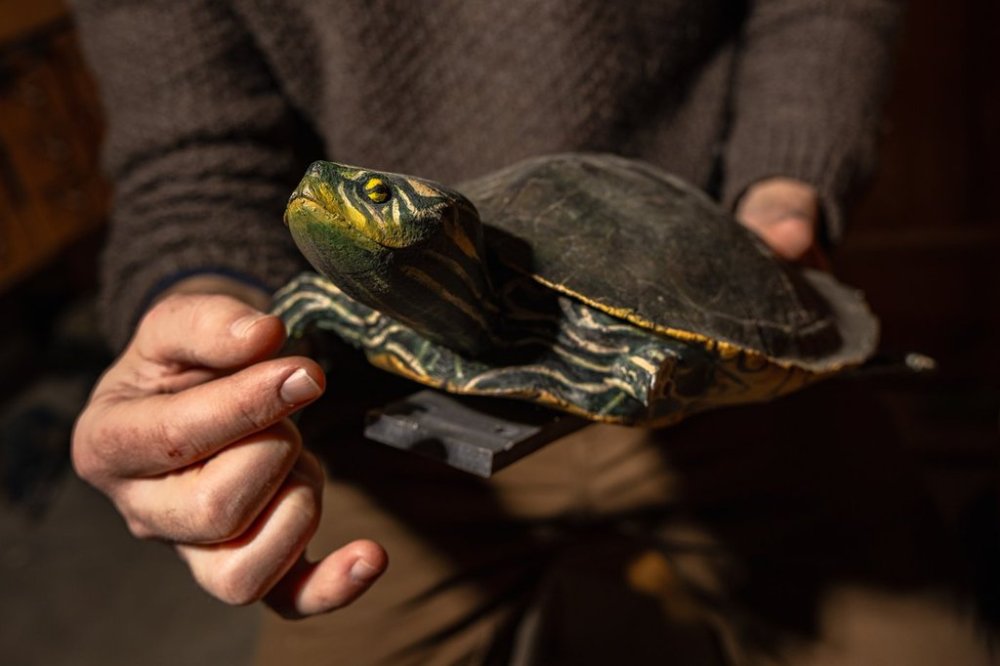
A 3D-printed northern map turtle made by Dr. Gregory Bulte to study map turtle behaviour is shown in this undated handout photo. THE CANADIAN PRESS/Handout - Michael O. Snyder / National Geographic Society / Preserving Legacies (Mandatory Credit)

What he found that day in April 2022 was unlike anything he, or maybe even that old turtle, had seen before. 

It wasn’t just one dead turtle. Broken shells and dismembered bodies riddled the bottom of the lake. In all, Bulté and his team found about 142 dead turtles. 

Almost 10 per cent of the lake’s turtles had been wiped out. 

“After looking into it in more details, this really seems to be … what we call a mass mortality event,” he said. 

Like any good scientist, or detective, he had questions: “Why did it happen that year? Is it something that we should be worried that might happen in the future?” 

Years later, the first question remains a mystery to Bulté. On the second question, he now suggests there may be cause for concern. 

A warming climate may prove to be an abettor to the perpetrators of the turtle die-off at Opinicon Lake. 

To understand why, Bulté first pinned down the suspect. In this area northeast of Kingston, Ont., there are only two predators who could inflict this type of damage during a turtle’s winter hibernation: the American mink and the river otter. 

The evidence piled up against the otter. It’s heavier than the mink, with a history of wreaking turtle havoc, and a bite more likely to break shell.

“It really seemed to point toward the river otter,” Bulté said. 

Climate change, driven by the burning of fossil fuels, is reshaping Canada’s winters. The season’s average temperature is up by 3.7 degrees since the mid-20th century. Studies have consistently shown a warmer world is producing thinner lake ice for shorter stretches of the year. 

It’s thought that northern map turtles depend on the ice to protect themselves from predators in the winter, Bulté said. 

“If we have less reliable ice covers, then we might expect more mortality like this,” he said.

“So, at this point it is a concern, but it’s not something that we know is happening.”

Climate change poses some other questions for the turtle. It may influence the population’s male-female ratio, according to a 2019 federal species management plan. 

The sex of the turtles is temperature dependent and takes place while the eggs are incubating in their nests. Some research suggests temperatures around 25 degrees will produce more males, while those of 30 degrees or warmer will produce the much larger females, who grow to be about the size of a dinner plate or twice as large as males.

Climate change is by no means the only, or even the most significant, threat to the turtle, which is listed as a special concern under wildlife protection laws. The 2019 assessment suggests their main threat comes from habitat loss and degradation from shoreline development, along with boat crashes and fishing bycatch. 

Bulté says another possible accomplice to future winter turtle mortality is the growing use of devices to keep docks and boats ice-free during the winters. There’s no evidence the devices, called bubblers, played any part in the 2022 die-off but Bulté said he’s concerned by their growing use. 

“Eventually we might see more of these kinds of events,” he said. 

Despite some warm winters in recent years, there have been no more turtle die-offs recorded at Opinicon Lake, Bulté said. His team is currently crunching the numbers on how long it may take for the local population to recover. 

This report by The Canadian Press was first published Feb. 4, 2026. 
Report Error Submit a Tip

More Stories

Roadside giants towering symbols of Canada’s quirkiness

Jen Zoratti 4 minute read Preview

Roadside giants towering symbols of Canada’s quirkiness

Jen Zoratti 4 minute read 2:01 AM CDT

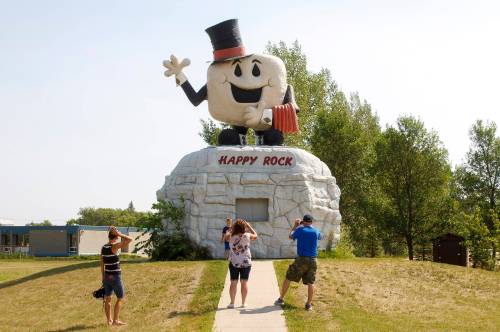
Could you imagine a Canada without Mr. PG repping Prince George, B.C.? Or the Big Nickel in Sudbury? Or, my personal favourite, Happy Rock in Gladstone?

Earlier this summer, CBC’s Cost of Living looked at the economics of these giant roadside attractions — of which there are more than 1,500 in Canada — and the cost of keeping them.

Some are falling into disrepair — this is why public art funding is necessary, by the way, not just for construction, but maintenance — and some towns are weighing whether or not that money is better spent elsewhere.

The main character of the story: Tyra the Tyrannosaurus, the rather literal symbol of Drumheller, Alta., a.k.a. the Dinosaur Capital of the World since 2000, who could be facing extinction after the lease agreement between the town and the Drumheller and District Chamber of Commerce ends in 2029.

Read
2:01 AM CDT

Provincial teacher watchdog releases names, details in three disciplinary matters

Maggie Macintosh 6 minute read Preview

Provincial teacher watchdog releases names, details in three disciplinary matters

Maggie Macintosh 6 minute read Updated: Yesterday at 11:19 AM CDT

An Interlake teacher with a history of “intimidating” outbursts has been ordered to participate in counselling and study anger-management strategies after he made a child cry.

Read
Updated: Yesterday at 11:19 AM CDT

The good, bad and record setting performance in Bombers loss to Elks

Joshua Frey-Sam 7 minute read Preview

The good, bad and record setting performance in Bombers loss to Elks

Joshua Frey-Sam 7 minute read 6:50 PM CDT

The Winnipeg Blue Bombers’ 22-19 defeat at the hands of the Edmonton Elks at Commonwealth Stadium in Alberta on Friday was fitting for all the wrong reasons.

The Bombers looked reinvigorated as they jumped out to a 16-point lead in the first half. Then some bad habits reared their ugly head, as the Elks roared back with 19 straight points before kicker Vincent Blanchard walked it off with a 40-yard field goal.

A night that began with so much promise left many fans to wonder what the ceiling actually is for this team in 2026.

On offence, Zach Collaros completed 19 of 30 passes for 219 yards, one touchdown and an interception; Brady Oliveira amassed 118 yards on 16 carries and added a pair of catches for 11 yards; and Nic Demski secured five grabs for 80 yards.

Read
6:50 PM CDT

Wooed by wood, Cedarella founder takes pride in handcrafted designs

David Sanderson 7 minute read Preview

Wooed by wood, Cedarella founder takes pride in handcrafted designs

David Sanderson 7 minute read 6:00 AM CDT

Marina Bulan is the founder of Cedarella, a two-year-old venture that turns out eye-catching wood products such as jewelry, kitchen decor, children’s toys and, most recently, metre-high outdoor planters that double as home street-number indicators.

Ahead of immigrating to Winnipeg a decade ago from their native Russia, Bulan and her partner thought it would be prudent to conduct some research on their soon-to-be new home, a city they knew next to nothing about.

Imagine their surprise as they were viewing the 2007 surrealist film My Winnipeg, which comically blends historical facts about our burg with what Winnipeg-born writer/director Guy Maddin has termed “mystical hypothesizing.”

(For instance, there is no proof that, as reported in the award-winning flick, Winnipeg is the sleepwalking capital of the world, and that residents keep keys to their former abodes on their person in the event they turn up there during a bout of somnambulism.)

Read
6:00 AM CDT

The trolls inside the Conservative tent

David McLaughlin 5 minute read Preview

The trolls inside the Conservative tent

David McLaughlin 5 minute read 2:00 AM CDT

The Conservative Party of Canada has a troll problem. And it’s coming from inside the tent.

Once, trolls existed only in imagination. They were figures of mythical proportion, big and small. They lived solitary lives under bridges, in caves, or forests. They were considered dim-witted and mean. Best avoided.

Today, they are real, unavoidable, and ubiquitous on social media. They are anything but solitary. There are tribes of them out there and tribal is how they think and post. As for dim-witted and mean, others can opine but they are uniformly mean and dismissive.

Mean to anyone who disagrees with their views. Dismissive of any view but their own. They distribute questionable, at best, facts and opinions grounded in hostility towards anything or anyone deemed disagreeable or heretical to their world view.

Read
2:00 AM CDT

‘We got attacked’: Carney says retaliatory tariffs on U.S. to take effect next month

Catherine Morrison and David Baxter, The Canadian Press 7 minute read Preview

‘We got attacked’: Carney says retaliatory tariffs on U.S. to take effect next month

Catherine Morrison and David Baxter, The Canadian Press 7 minute read Updated: 3:46 PM CDT

OTTAWA - Prime Minister Mark Carney says retaliatory tariffs will hit the U.S. starting next month after Canada walked away from what he called a "bad deal."

The U.S. introduced new 50 per cent tariffs on billions of dollars in Canadian exports on Saturday after trade talks failed.

"We got attacked," Carney told reporters on Parliament Hill Saturday when asked about the escalating trade war.

Carney suspended talks with the United States late Friday and summoned his negotiators back to Ottawa.

Read
Updated: 3:46 PM CDT