By The Numbers: A look at European rocket Ariane 64’s maiden launch

Advertisement

Advertise with us

PARIS (AP) — Europe’s Ariane 6 rocket is scheduled to make a powerful debut with a new equipment configuration Thursday, flying with four boosters to carry Amazon’s internet satellites.

Read this article for free:


or

Already have an account? Log in here »

To continue reading, please subscribe:

Subscribe and receive a limited-edition Free Press branded hat or tote.

Digital Subscription

One year of digital access for only $205*

  • Enjoy unlimited reading on winnipegfreepress.com
  • Read the E-Edition, our digital replica newspaper
  • Access News Break, our award-winning app
  • Play interactive puzzles

*First annual payment billed as $205.00 + GST for one year. This annual subscription will automatically renew at $233.00 + GST every 52 weeks (10% off the regular annual price of $259.35). Offer available to new and qualified returning subscribers only. Cancel any time.

To continue reading, please subscribe:

Add Free Press access to your Brandon Sun subscription for only an additional

$1 for the first 4 weeks*

  • Enjoy unlimited reading on winnipegfreepress.com
  • Read the E-Edition, our digital replica newspaper
  • Access News Break, our award-winning app
  • Play interactive puzzles
Start now

*Your next Brandon Sun subscription payment will increase by $1.00 and you will be charged $17.95 plus GST for four weeks. After four weeks, your payment will increase to $24.95 plus GST every four weeks.

Hey there, time traveller!
This article was published 12/02/2026 (215 days ago), so information in it may no longer be current.

PARIS (AP) — Europe’s Ariane 6 rocket is scheduled to make a powerful debut with a new equipment configuration Thursday, flying with four boosters to carry Amazon’s internet satellites.

The launch will take place at Europe’s Spaceport in Kourou, French Guiana.

The flagship of Europe’s rocket industry is competing in a highly competitive global market against heavyweight players, including Elon Musk’s market leader SpaceX.
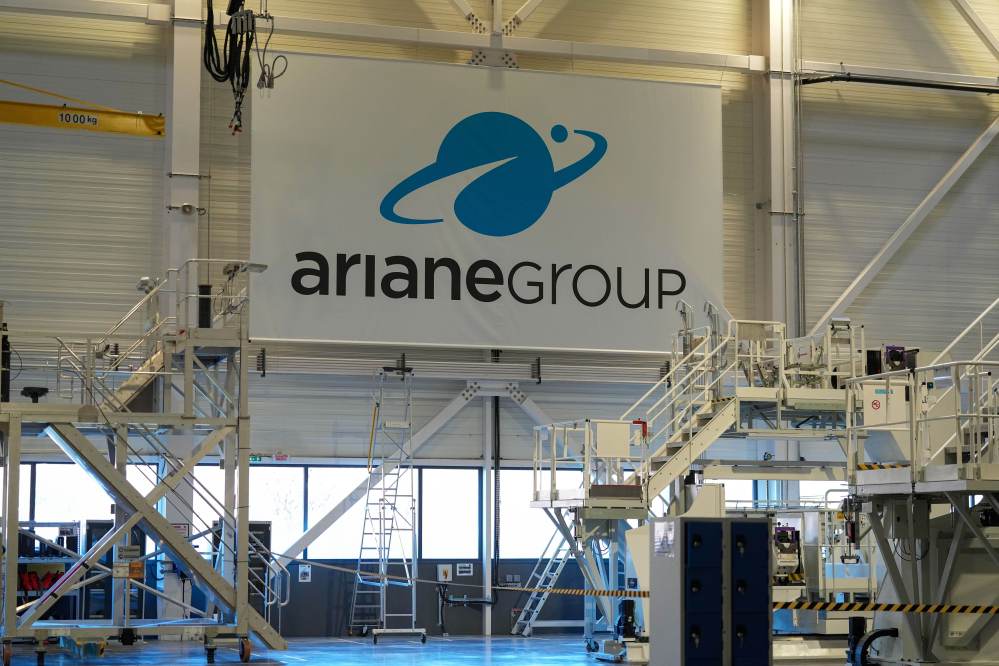
Partial view of assembly line of the Ariane 64 rocket, in Les Mureaux, west of Paris, Wednesday, Feb. 4, 2026. (AP Photo/Thibault Camus)

Here’s a look at the Ariane 6 rocket’s technology by the numbers:

4

For the first time, the rocket is equipped with four boosters around its core stage, giving it the name Ariane 64.

Their role is to provide extra thrust, allowing the rocket to carry about 21.6 metric tons (23.8 tons) into low Earth orbit, which is more than double what it can lift with just two boosters.

The boosters consume 142,000 kilograms (313,056 pounds) of solid propellant in just over two minutes before burning out.

5

Ariane 6 has completed five flights using two boosters — all successful — including its maiden launch in July 2024. Thursday’s launch will be the sixth and the first with a commercial customer.

Last year, the European rocket focused on institutional missions, placing into orbit a French military reconnaissance satellite, a French weather satellite and European Union-sponsored Earth observation radar and navigation satellites.

13

The Ariane 6 programme is backed by 13 nations, all members of the European Space Agency.

Building the rocket requires the expertise and coordination of about 600 subcontractors led by ArianeGroup. The core stage is assembled in Les Mureaux, west of Paris, while the upper stage is built in a factory in Bremen, Germany. There are roughly 300,000 pieces in one rocket.

The core stage, the upper stage and the boosters cross the Atlantic to French Guiana on a cargo ship equipped with sails to reduce emissions and save fuel.

Ariane 64 is 62 meters (203 feet) high with a core stage of 5.4 meters (17.7 feet) wide.

32

Thursday’s mission is set to place 32 Amazon Leo satellites into orbit.

Amazon launched its first internet satellites in 2025 as the company seeks to become a key player in the mega-constellation market currently dominated by SpaceX’s thousands of Starlink satellites.

Founded by Jeff Bezos, who runs his own rocket company, Blue Origin, Amazon aims to deploy more than 3,200 of the satellites to provide fast, affordable broadband service around the globe.

1 hour and 54 minutes

The mission is expected to last 1 hour, 54 minutes, from liftoff to separation of all satellites.

In addition to its boosters, Ariane 6 is powered by one main engine at the base of its core stage that uses supercooled hydrogen and oxygen as fuel.

A second engine ignites once the upper stage escapes Earth’s gravity, placing the satellites into their precise orbits. It can re-ignite up to four times in flight.
Report Error Submit a Tip

More Stories

Letters, Sept 15

7 minute read 2:00 AM CDT

Building for the future

It’s hard to argue with Tom Brodbeck’s column Carney cashes in standing to U.S. bully, Free Press, Sept. 12, because everything in the article makes sense.

But I think Canada is cashing in as well.

The rather depressing environment created by Trump has given impetus to an aggressive slate of policies promulgated by Prime Minister Mark Carney that with a little luck (that’s code for preparation, opportunity and hard work) will position Canada for a much brighter future once the tin-pot dictator is gone.

A rural Manitoba physician is warning that Ste. Rose du Lac could face significant emergency department closures after its doctors were stretched thin helping absorb the fallout from the flooding and prolonged shutdown of Dauphin Regional Health Centre.

When Dauphin was evacuated July 1, Ste. Rose expanded its emergency department to 24-7 service and nearly doubled its in-patient load. But with Dauphin’s ER reopening last week and staff that had been temporarily working in Ste. Rose returning to their regular posts, Dr. Ashley Blais says her hospital, located about 50 kilometres southeast of Dauphin, has been left without enough physicians to maintain reliable emergency coverage.

“We answered the call when Manitoba’s health-care system needed us,” Blais said Monday. “Now we are asking the Manitoba health-care system to answer ours.”

Blais, who penned an open letter to Manitoba Health Minister Uzoma Asagwara, is calling on the province, Shared Health and Prairie Mountain Health to urgently develop a sustainable staffing plan for Ste. Rose, with direct input from physicians working there.

Puzzles Palace

1 minute read Monday, Jul. 27, 2026

To solve our puzzles, please subscribe with this special offer: |

Letters, Sept. 14

7 minute read Preview

Letters, Sept. 14

7 minute read Updated: Yesterday at 8:14 AM CDT

Worth it for who? Our transit system has been undergoing growing pains for the past year, ever since city staff completely messed up the system with their redesign.

Read
Updated: Yesterday at 8:14 AM CDT

Rogers, Telus deny blame for June twister alert barrage

Malak Abas 3 minute read Preview

Rogers, Telus deny blame for June twister alert barrage

Malak Abas 3 minute read 2:01 AM CDT

Telecom companies say they aren’t to blame for the barrage of tornado alerts Manitobans received during severe thunderstorms in early June.

The Canadian Radio-television and Telecommunications Commission announced in August it would investigate the unusually high number of alerts, and called on the Pelmorex Corp., which operates the national Alert Ready system, along with telecom companies Bell, Rogers and Telus to respond to a number of questions.

They were given until last Friday to describe their possible roles in the creation, receipt, processing or distribution of alerts issued from Environment and Climate Change Canada in the midst of the June 9 storm.

Telus said in its response that it received 133 alert requests targeted to Manitoba created by Environment Canada and forwarded by Pelmorex between 2:35 p.m. June 9 and 3:29 a.m. the following day. While the majority of those messages contained identical information and were automatically suppressed, 17 were ultimately sent out as alerts in Winnipeg.

Read
2:01 AM CDT

Transit safety drives first mayoral debate

Morgan Modjeski 4 minute read Preview

Transit safety drives first mayoral debate

Morgan Modjeski 4 minute read 2:01 AM CDT

The safety of Winnipeg Transit drivers was front and centre Monday as the first mayoral debate of the 2026 election focused on public transit.

Kevin Klein, the most experienced of the 10 candidates at the Amalgamated Transit Union 1505-hosted debate, said the time for partial safety shields has passed.

“The partial shields have failed drivers. That’s why we need change,” the former PC MLA and city councillor said, adding driver safety is not a staffing issue, but a “protection failure.”

If elected, Klein said he will bring in full-shield implementation across the city within two years and start a nine-bus pilot project immediately.

Read
2:01 AM CDT