Scientists change how El Nino is labeled to keep up with spike in temperature
Advertisement
Read this article for free:
or
Already have an account? Log in here »
To continue reading, please subscribe:

Digital Subscription
One year of digital access for only $205*
- Enjoy unlimited reading on winnipegfreepress.com
- Read the E-Edition, our digital replica newspaper
- Access News Break, our award-winning app
- Play interactive puzzles
*First annual payment billed as $205.00 + GST for one year. This annual subscription will automatically renew at $233.00 + GST every 52 weeks (10% off the regular annual price of $259.35). Offer available to new and qualified returning subscribers only. Cancel any time.
To continue reading, please subscribe:
Add Free Press access to your Brandon Sun subscription for only an additional
$1 for the first 4 weeks*
- Enjoy unlimited reading on winnipegfreepress.com
- Read the E-Edition, our digital replica newspaper
- Access News Break, our award-winning app
- Play interactive puzzles
*Your next Brandon Sun subscription payment will increase by $1.00 and you will be charged $17.95 plus GST for four weeks. After four weeks, your payment will increase to $24.95 plus GST every four weeks.
Read unlimited articles for free today:
or
Already have an account? Log in here »
Hey there, time traveller!
This article was published 20/02/2026 (183 days ago), so information in it may no longer be current.
WASHINGTON (AP) — The natural El Nino cycle, which warps weather worldwide, is both adding to and shaped by a warming world, meteorologists said.
A new study calculated that an unusual recent twist in the warming and cooling cycle that includes El Nino and its counterpart La Nina can help explain the scientific mystery of why Earth’s already rising temperature spiked to a new level over the past three years.
Separately, scientists have had to update how they label El Nino and La Nina because of rapid weather changes cause by global warming. Increasingly hot waters globally have caused the U.S. National Oceanic and Atmospheric Administration this month to alter how it calculates when the weather pattern has flipped into a new cycle. It’s likely to mean that more events will be considered La Nina and fewer qualify as an El Nino for warming tropical waters.
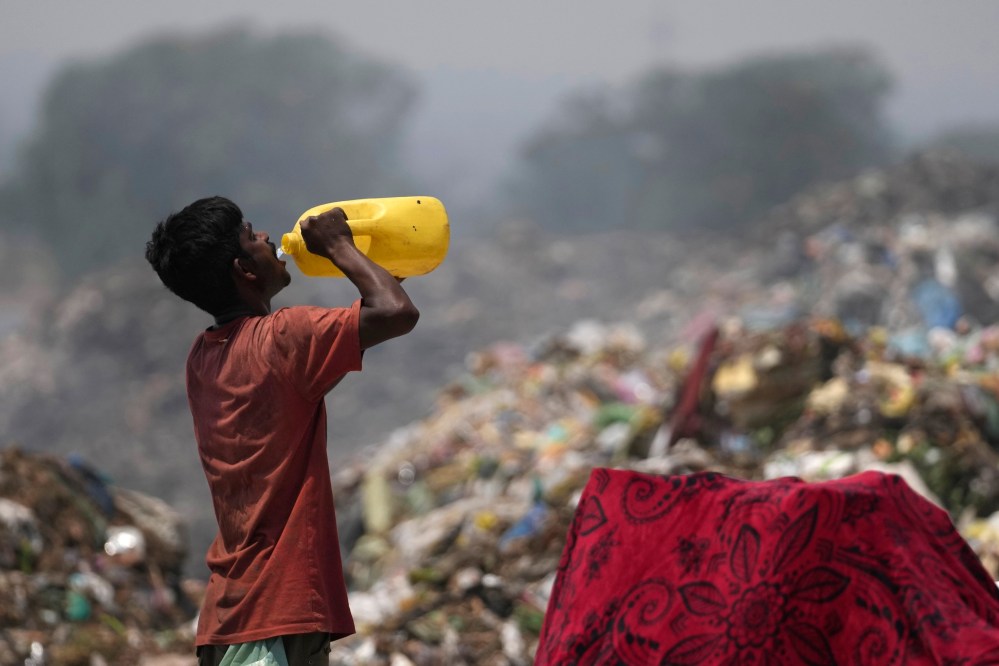
Earth’s average monthly temperature took a noticeable jump up from the long-term upward trend connected to human-caused climate change in early 2023, and that increase continued through 2025. Scientists have many theories about what’s happening, including an acceleration of greenhouse gas warming, a reduction in particle pollution from ships, an underwater volcano eruption and increased solar output.
In a new study in Nature Geoscience this month, Japanese researchers look at how the difference in energy coming to and leaving the planet — called Earth’s energy imbalance — increased in 2022. An increased imbalance, or more trapped heat, then leads to warmer temperatures, scientists said. The researchers calculate that about three-quarters of the change in Earth’s energy imbalance can be attributed to the combination of long-term human-caused climate change and a shift from a three-year cooling La Nina cycle to a warm El Nino one.
What’s El Nino vs. La Nina
El Nino is a cyclical and natural warming of patches of the equatorial Pacific that then alters the world’s weather patterns, while La Nina is marked by cooler than average waters.
Both shift precipitation and temperature patterns, but in different ways. El Ninos tend to increase global temperatures and La Ninas depress the long-term rise.
La Ninas tend to cause more damage in the United States because of increased hurricane activity and drought, studies have shown.
Why weather cycles switch from warm to cool
From 2020 to 2023, Earth had an unusual “triple dip” La Nina without an El Nino in between. In a La Nina, warm water sticks to a deeper depth, resulting in a cooler surface. And that reduces how much energy goes out into space, said study co-author Yu Kosaka, a climate scientist at the University of Tokyo.
She compared it to what happens when people have fevers.
“If our body’s temperature is high then it tends to emit its energy out, and the Earth has the same situation happening. And as the temperatures increase, it acts to emit more energy outward. And for three-year La Nina, it’s opposite,” Kosaka said.
So more energy — which becomes heat — is trapped on Earth, she said. La Ninas more typically correspond to a one- or two-year buildup of extra energy imbalance, but this time it was longer so the difference was more noticeable and included hotter temperatures, Kosaka said.
“When there is a transition from La Nina to El Nino, it’s like the lid is popped off,” releasing the heat, explained former NOAA meteorologist Tom Di Liberto, who’s now with Climate Central.
About 23% of the energy imbalance driving the recent higher temperatures comes from this unusually long La Nina pattern, with slightly more than half coming from gases from the burning of coal, oil and gas, the study authors said. The rest can be other factors.
Scientist Jennifer Francis of the Woodwell Climate Research Center, which wasn’t involved in the study, said the research makes sense and explains an increase in energy imbalance that some scientists were attributing to accelerated warming.
Changing how El Ninos and La Ninas are labeled
For 75 years when meteorologists calculated El Ninos and La Ninas, it was based on the difference in temperature in three tropical Pacific regions compared to normal. An El Nino was 0.5 degrees Celsius (0.9 degrees Fahrenheit) warmer than normal and La Nina was cooler than normal by the same amount.
The trouble in a warming world is what’s considered normal keeps shifting.
Until now, NOAA used the 30-year average as normal. It updated the 30-year average every decade, which is how often it updates most climate and weather measurements. Then the water warmed so much for El Ninos and La Ninas that NOAA updated its definition of normal every five years, but that wasn’t enough either, said Nat Johnson, a meteorologist at NOAA’s Geophysical Fluid Dynamics Lab.
So NOAA came up with an El Nino index that’s relative, starting this month. This new index compares temperatures to the rest of Earth’s tropics. Recently that difference between the old and new methods has been as much as half a degree Celsius (0.9 degrees Fahrenheit), and “that’s enough to have an impact,” Johnson said.
That’s because what really matters with El Ninos and La Ninas is the way the waters interact with the atmosphere. And recently the interactions didn’t match the old labeling, but they do match the new method, Johnson said.
This will likely mean a bit more La Ninas and fewer El Ninos than in the old system, Johnson said.

Here comes another El Nino
NOAA’s forecast is for an El Nino to develop later this year in the late summer or fall. If it comes early enough, it could dampen Atlantic hurricane activity. But it would also mean warmer global temperatures in 2027.
“When El Nino develops, we’re likely to set a new global temperature record,” Woodwell’s Francis said in an email. “’Normal’ was left in the dust decades ago. And with this much heat in the system, everyone should buckle up for the extreme weather it will fuel.”
___
The Associated Press’ climate and environmental coverage receives financial support from multiple private foundations. AP is solely responsible for all content. Find AP’s standards for working with philanthropies, a list of supporters and funded coverage areas at AP.org.