New studies of old dogs help scientists understand where they came from

Advertisement

Advertise with us

NEW YORK (AP) — Using the oldest dog genes studied so far, scientists are finding more evidence that our furry friends have been our companions for thousands of years.

Read this article for free:


or

Already have an account? Log in here »

To continue reading, please subscribe:

Subscribe and receive a limited-edition Free Press branded hat or tote.

Digital Subscription

One year of digital access for only $205*

  • Enjoy unlimited reading on winnipegfreepress.com
  • Read the E-Edition, our digital replica newspaper
  • Access News Break, our award-winning app
  • Play interactive puzzles

*First annual payment billed as $205.00 + GST for one year. This annual subscription will automatically renew at $233.00 + GST every 52 weeks (10% off the regular annual price of $259.35). Offer available to new and qualified returning subscribers only. Cancel any time.

To continue reading, please subscribe:

Add Free Press access to your Brandon Sun subscription for only an additional

$1 for the first 4 weeks*

  • Enjoy unlimited reading on winnipegfreepress.com
  • Read the E-Edition, our digital replica newspaper
  • Access News Break, our award-winning app
  • Play interactive puzzles
Start now

*Your next Brandon Sun subscription payment will increase by $1.00 and you will be charged $17.95 plus GST for four weeks. After four weeks, your payment will increase to $24.95 plus GST every four weeks.

NEW YORK (AP) — Using the oldest dog genes studied so far, scientists are finding more evidence that our furry friends have been our companions for thousands of years.

Scientists think dogs descended from an ancient population of gray wolves somewhere in Europe or Asia. Tens of thousands of years ago, those wolves got used to living with people and became less aggressive. As they became domesticated, their genes shifted along with their behavior, giving rise to the pups we know today.

But exactly when and where this happened remains a mystery. Scientists are studying bits of DNA found in ancient dog and wolf remains to figure out what the earliest dogs may have looked like and where they came from.

In two separate studies published Wednesday in the journal Nature, researchers pushed the timeline back. They established a new way to study ancient canine DNA — which is often contaminated and tough to extract — by isolating just the doggy bits.

They examined ancient genes from the remains of over 200 dogs and wolves. The oldest dated back to about 15,800 years ago, moving the origin of dogs back by at least 5,000 years.

“This unique relationship between people and dogs has existed for such a long time and is continuing on today,” said University of Michigan dog genomics expert Jeffrey Kidd, who was not involved with the new research.

The genes showed that dogs were already spread out across Western Europe and Asia 14,200 years ago, at a time before agriculture and farming. These dogs lived with hunter-gatherer humans who were constantly on the move.

The dawn of agriculture — a major shift in human history — brought new people to Europe from southwest Asia. They mixed and mingled with Europeans, leaving a lasting and varied imprint on their genes.

But the dog genes studied by the scientists, stretching from the United Kingdom all the way to Turkey, stayed more consistent. They were less impacted by the arrival of new humans during the development of agriculture, and more by interactions between different hunter-gatherer groups and their dogs thousands of years before.

That’s different from dogs in Asia and the Americas, whose genes more closely reflect the movement patterns of their owners.

Scientists don’t know exactly what the first dogs looked like, but they have some ideas.

“We’re suspecting they would have resembled smaller wolves,” said study co-author Lachie Scarsbrook with the Ludwig Maximilian University of Munich.
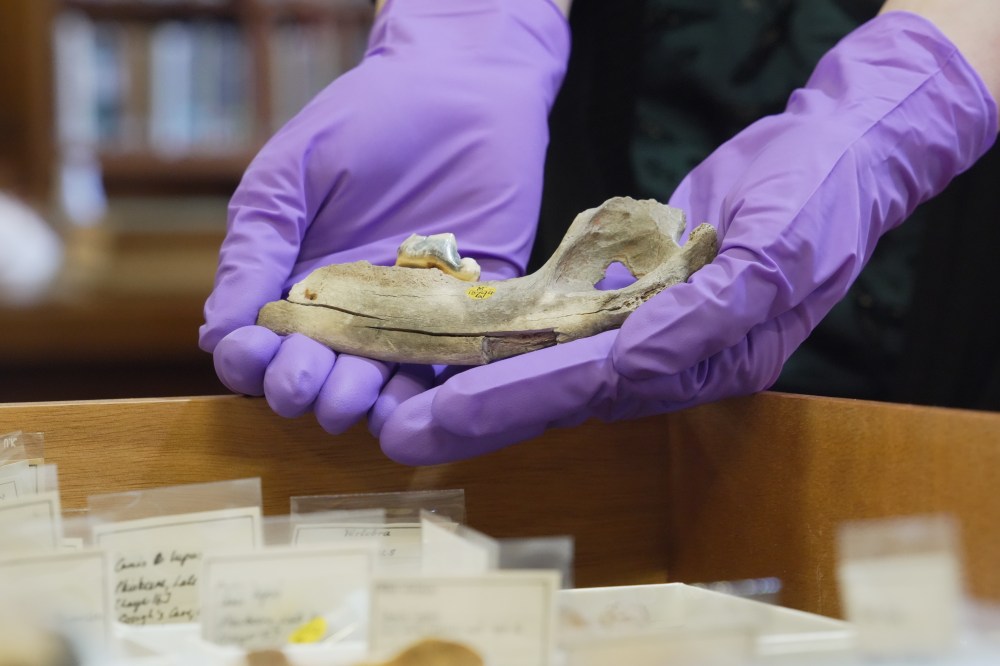
A researcher holds a 14,300 year-old dog jawbone found at Gough's Cave in the United Kingdom, on Tuesday, March 24, 2026, in London. (AP Photo/Mustakim Hasnath)

It’s also not clear how these ancient dogs lived alongside their humans. They could have stood guard or helped them hunt, but probably also played with young children.

There’s still more work to go to pinpoint exactly when dogs emerged — the first few pages of a storied relationship that’s still going strong.

“They are humanity’s best friend, alongside our societies for the last 16,000 years and will continue to in the future,” Scarsbrook said.

___

The Associated Press Health and Science Department receives support from the Howard Hughes Medical Institute’s Department of Science Education and the Robert Wood Johnson Foundation. The AP is solely responsible for all content.


 

Report Error Submit a Tip

More Stories

Controlling pace of response path to success

Tim Kist 5 minute read Yesterday at 2:01 AM CDT

WITH the recent collapse of Canada-U.S. trade talks, the economic, political and social changes are coming at business leaders on a daily basis.

While you cannot control the pace of these changes, you can control the pace of response and timing of actions your organization takes. This is a time for thoughtful analysis and careful action, not chasing the latest trends.

Artificial intelligence, for example, can write articles, create images, draft emails and perform seemingly countless other tasks. But is this new tool solving a current business problem?

Successful companies know they must develop a strategy before launching any tactics. Otherwise, the strategy is based on “hope” — and we all know hope is not a strategy.

Canada’s first drive-thru-only McDonald’s opens in Winnipeg

Aaron Epp 4 minute read Preview

Canada’s first drive-thru-only McDonald’s opens in Winnipeg

Aaron Epp 4 minute read Wednesday, Sep. 2, 2026

One Grimace and dozens of smiles were on display Wednesday as McDonald’s staff and supporters celebrated the grand opening of the fast-food chain’s first drive-thru-only restaurant in Canada.

Read
Wednesday, Sep. 2, 2026

Puzzles Palace

1 minute read Monday, Jul. 27, 2026

To solve our puzzles, please subscribe with this special offer: |

Woman died while getting wisdom teeth out; case raises questions about transparency of dental association

Nicole Buffie 5 minute read Preview

Woman died while getting wisdom teeth out; case raises questions about transparency of dental association

Nicole Buffie 5 minute read Friday, Sep. 4, 2026

The parents of a 23-year-old southwestern Manitoba woman who died after receiving a local anesthetic during a wisdom tooth extraction say they are in the dark about the investigation into their daughter’s death.

Dulaney and Victoria Blatz say the Manitoba Dental Association has been unwilling to give them information about the probe into their daughter’s death, saying the self-governing regulatory body must be more transparent with the public.

“We have pushed through various channels trying to get information, but it’s nothing but stalling and sidelining,” Victoria said Friday. “This has crashed our world to pieces and we just want answers.”

Virginia Blatz went to Boundary Trails Dental Centre in Morden on Nov. 27, 2024, to have her wisdom teeth removed, but never returned home.

Read
Friday, Sep. 4, 2026

Politicians who harp on Klein’s history with Nygard do so at their own peril

Tom Brodbeck 5 minute read Preview

Politicians who harp on Klein’s history with Nygard do so at their own peril

Tom Brodbeck 5 minute read Friday, Sep. 4, 2026

It was probably the easiest prediction to make in Winnipeg politics this week: the moment Kevin Klein officially entered the mayoral race, someone would bring up Peter Nygard.

Sure enough, they did.

And it was led by Klein’s chief political opponent in this race, Mayor Scott Gillingham, who called Klein a “fixer” for the convicted sex offender.

None of this is particularly surprising.

Read
Friday, Sep. 4, 2026

‘Soapy disco’ for your ride

Aaron Epp 4 minute read Preview

‘Soapy disco’ for your ride

Aaron Epp 4 minute read Friday, Sep. 4, 2026

For Kyle Thompson, foam is where the heart is.

As a high school student at Winnipeg’s Transcona Collegiate, one of his classes required him to create a business plan. He was cleaning vehicles part-time at the Chamois Car Wash and Detail Centre, so he used the assignment to envision a car wash of his own — one with a Regent Avenue address.

Fast forward some 25 years later and that dream is a reality. Thompson is the co-owner and general manager at Flamingo Express Car Wash.

Located at 868 Regent Ave. West — east of the row of car dealerships that call the thoroughfare home and across the street from an Amazon distribution hub — Flamingo opened last month.

Read
Friday, Sep. 4, 2026