Shaky ceasefire unlikely to stop cyberattacks from Iran-linked hackers for long

Advertisement

Advertise with us

WASHINGTON (AP) — Hackers backing Tehran say an uncertain ceasefire between Iran and the United States and Israel won't end their retaliatory cyberattacks, a warning that American cybersecurity experts say potential targets in the U.S. and Israel should take seriously.

Read this article for free:


or

Already have an account? Log in here »

To continue reading, please subscribe:

Subscribe and receive a limited-edition Free Press branded hat or tote.

Digital Subscription

One year of digital access for only $205*

  • Enjoy unlimited reading on winnipegfreepress.com
  • Read the E-Edition, our digital replica newspaper
  • Access News Break, our award-winning app
  • Play interactive puzzles

*First annual payment billed as $205.00 + GST for one year. This annual subscription will automatically renew at $233.00 + GST every 52 weeks (10% off the regular annual price of $259.35). Offer available to new and qualified returning subscribers only. Cancel any time.

To continue reading, please subscribe:

Add Free Press access to your Brandon Sun subscription for only an additional

$1 for the first 4 weeks*

  • Enjoy unlimited reading on winnipegfreepress.com
  • Read the E-Edition, our digital replica newspaper
  • Access News Break, our award-winning app
  • Play interactive puzzles
Start now

*Your next Brandon Sun subscription payment will increase by $1.00 and you will be charged $17.95 plus GST for four weeks. After four weeks, your payment will increase to $24.95 plus GST every four weeks.

WASHINGTON (AP) — Hackers backing Tehran say an uncertain ceasefire between Iran and the United States and Israel won’t end their retaliatory cyberattacks, a warning that American cybersecurity experts say potential targets in the U.S. and Israel should take seriously.

One leading hacking group known as Handala said after the ceasefire announcement that it was temporarily postponing attacks on the U.S. but would continue to target Israel. It vowed to revive its efforts against America when the time was right — demonstrating again how digital warfare has become ingrained in military conflict. Already, the two-week ceasefire appears at risk of fraying over significant disagreements between the parties, which each are claiming victory in the war.

A pro-Palestinian, pro-Iranian network that operates independently of Tehran, Handala has claimed credit for disrupting the operations of the U.S. medical manufacturer Stryker and hacking into FBI Director Kash Patel’s personal email account, among other cyberattacks. The group is just one of several proxy hacking networks allied with Iran.
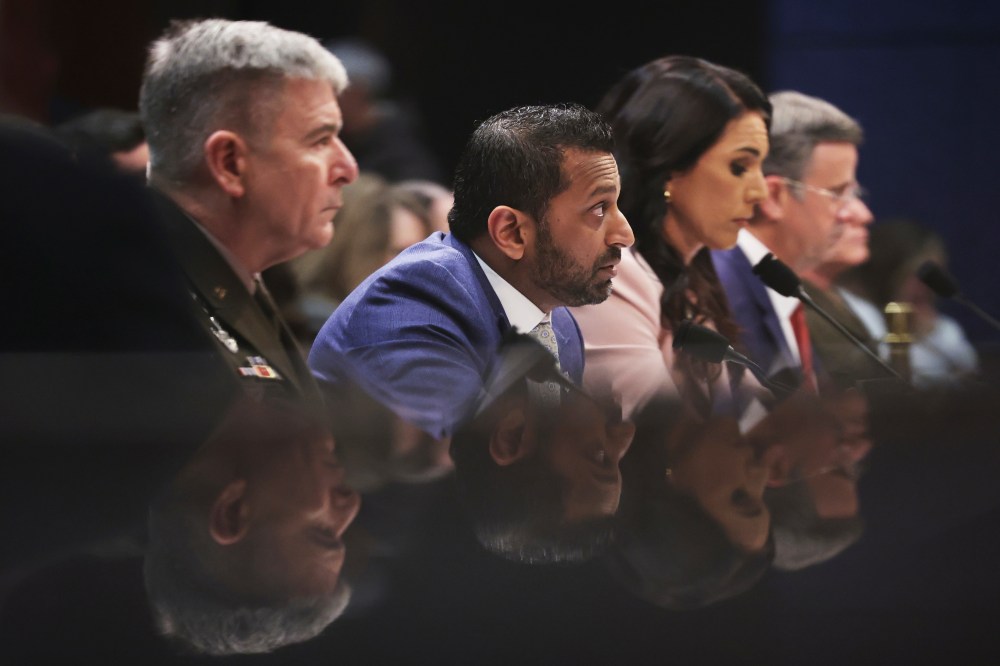
From left, Acting Commander of the U.S. Cyber Command William Hartman, FBI Director Kash Patel, Director of National Intelligence Tulsi Gabbard and CIA Director John Ratcliffe, listen during a House Permanent Select Committee on Intelligence hearing to examine worldwide threats, Thursday, March 19, 2026, on Capitol Hill in Washington. (AP Photo/Tom Brenner)

“We did not begin this war, but we will be the ones to finish it,” Handala wrote on its X account. “And let it be clear: The cyber war did not begin with the military conflict, and it will not end with any military ceasefire.”

U.S. authorities warned on Tuesday that hackers supporting Iran had burrowed into internet-connected computers used to automate and control technology in a variety of important industrial sectors. The computers, known as programmable logic controllers, are used in ports, power plants and water plants — key targets for foreign hackers looking to disrupt everyday life in the U.S.

In a joint advisory from the FBI, National Security Agency and Cybersecurity and Infrastructure Security Agency, officials urged organizations that use the technology to ensure their security precautions were up-to-date. CISA did not immediately respond to questions Wednesday about the impact that the ceasefire would have on cybersecurity.

Cybersecurity experts say the warning should be taken seriously by potential targets regardless of the sides announcing a temporary truce.

Markus Mueller, a cybersecurity executive at Nozomi Networks, said he anticipates an increase in cyberattacks on American organizations following the ceasefire, not a decrease. That’s because any lull in hostilities would allow hackers to shift from regional targets directly involved in the conflict to efforts to infiltrate U.S. organizations that participated in the war effort in some way, a list that includes data centers, tech companies and defense contractors.

He also predicted that some groups based in Iran or Russia may seek to circumvent the truce by launching a significant cyberattack on a U.S. target that is designed to attract the attention of the American public.

“With a ceasefire, we will likely see an expansion of cyber activity both in scale and scope,” Mueller said. “These groups will likely try to execute a high-profile attack such as what we saw with Stryker.”

So far, the attacks attributed to pro-Iranian hackers have been high in volume but low in impact, designed to boost morale among Iran’s supporters while reminding its opponents of continued vulnerabilities despite their military advantages.

Handala claimed responsibility last month for hacking Stryker, a major medical equipment supply company based in Michigan. Handala claimed the hack was in retaliation for strikes that killed Iranian schoolchildren.

The FBI responded by seizing four internet web addresses used by the group to spread its message. Handala then leaked several old photos of Patel after saying it had hacked into the FBI director’s personal email account.

Other pro-Iranian hackers have been linked to efforts to install malware on the phones of Israelis, penetrate cameras in Middle Eastern countries to improve Iran’s missile targeting, and target data centers and industrial facilities in Israel, Saudi Arabia and Kuwait.

Report Error Submit a Tip

More Stories

Neighbours relieved after fire strikes Quickie Mart

Morgan Modjeski 4 minute read Preview

Neighbours relieved after fire strikes Quickie Mart

Morgan Modjeski 4 minute read Wednesday, Sep. 2, 2026

As Janina McNaughton watched the Quickie Mart on River Avenue go up in flames on Tuesday, she felt relieved.

“The first thing I see is flames, like a fireball of flames inside,” McNaughton said about watching the blaze from her bedroom across the street.

On Wednesday, the bright green building, at 292 River Ave., was boarded up and charred on the outside.

Crews from the Winnipeg Fire Paramedic Service responded at 8:13 p.m. Tuesday to battle the blaze, said the city in a news release. It was under control within the hour.

Read
Wednesday, Sep. 2, 2026

Loon design wins for next Manitoba specialty licence plate, province says

The Canadian Press 1 minute read Preview

Loon design wins for next Manitoba specialty licence plate, province says

The Canadian Press 1 minute read Updated: Yesterday at 6:28 PM CDT

WINNIPEG - Manitoba says a loon design has won out in a public survey about a new specialty licence plate that pays homage to provincial parks.

The government says 62,605 people responded to the July survey.

Manitobans had five options, with a portion of the proceeds of every plate sold going to an endowment fund for park improvements.

Along with the loon on a lake, there was also a campsite at night, someone canoeing on a waterway, a replication of a map and a pure black one to represent a park at night.

Read
Updated: Yesterday at 6:28 PM CDT

St. Malo’s summer hot spot relies on dedicated community to make sure park-goers can kick back and relax

Melissa Martin 16 minute read Preview

St. Malo’s summer hot spot relies on dedicated community to make sure park-goers can kick back and relax

Melissa Martin 16 minute read Yesterday at 6:00 AM CDT

It’s shaping up to be a hot late-August Friday in southern Manitoba; the forecast warns of a thunderstorm in the late afternoon, but that won’t stop Manitobans from flocking to savour one of the last great beach days of the summer.

Read
Yesterday at 6:00 AM CDT

Smith’s pretzel logic confuses

Editorial 4 minute read Preview

Smith’s pretzel logic confuses

Editorial 4 minute read 2:01 AM CDT

Alberta Premier Danielle Smith had both sides of her mouth working overtime on Aug. 30, when she spoke at an event in Calgary to commemorate Alberta Day, the annual celebration of the province’s entry into Confederation in 1905 (officially Sept. 1, it was celebrated on the weekend).

Smith’s comments — and the things she did not say — revealed a lot about the political tightrope the premier is trying to walk over the challenges currently faced by her province. At the top of that list of challenges is a persistent campaign to separate Alberta from the aforementioned Confederation. A campaign that Smith appears to both support and oppose, depending on which day of the week it is.

Her Alberta Day remarks were an excellent case in point.

Smith has decided that on Oct. 19, Albertans will vote on a series of non-binding propositions in a province referendum. One of those questions will ask Albertans whether they want to hold a referendum on separation, thus making this fall’s vote a “referendum on whether to hold a referendum,” as some observers have dubbed it.

Read
2:01 AM CDT

Controlling pace of response path to success

Tim Kist 5 minute read 2:01 AM CDT

WITH the recent collapse of Canada-U.S. trade talks, the economic, political and social changes are coming at business leaders on a daily basis.

While you cannot control the pace of these changes, you can control the pace of response and timing of actions your organization takes. This is a time for thoughtful analysis and careful action, not chasing the latest trends.

Artificial intelligence, for example, can write articles, create images, draft emails and perform seemingly countless other tasks. But is this new tool solving a current business problem?

Successful companies know they must develop a strategy before launching any tactics. Otherwise, the strategy is based on “hope” — and we all know hope is not a strategy.

Art piece connects viewers to broader national landscape

Allison Gillmor 4 minute read Preview

Art piece connects viewers to broader national landscape

Allison Gillmor 4 minute read 2:01 AM CDT

WHAT IT IS: Copy Paperis a 2014 textile-based piece by Ontario-born, Winnipeg-based artist Kristin Nelson, currently on view at WAG-Qaumajuq as part of the exhibition Terra Cognita/Incognita.

Of the 125 works in the show — which uses historical and contemporary pieces from WAG-Qaumajuq’s permanent collection to explore how artists have represented the landscape over time and across cultures —probably the most attention-getting are the beautiful paintings of Canada’s lakes, plains, forests and mountains.

So, how does this seemingly modest, somewhat enigmatic work connect to Terra Cognita/Incognita’s larger themes?

WHAT IT’S ABOUT: In the middle of the exhibition, an antique desk holds several objects of beauty and utility, and this is where Copy Paper sneaks in, as something both “cognita and incognita,” known and unknown.

Read
2:01 AM CDT