A robot is beating human pros at table tennis. Its maker calls it a milestone for machines
Advertisement
Read this article for free:
or
Already have an account? Log in here »
To continue reading, please subscribe:

Digital Subscription
One year of digital access for only $205*
- Enjoy unlimited reading on winnipegfreepress.com
- Read the E-Edition, our digital replica newspaper
- Access News Break, our award-winning app
- Play interactive puzzles
*First annual payment billed as $205.00 + GST for one year. This annual subscription will automatically renew at $233.00 + GST every 52 weeks (10% off the regular annual price of $259.35). Offer available to new and qualified returning subscribers only. Cancel any time.
To continue reading, please subscribe:
Add Free Press access to your Brandon Sun subscription for only an additional
$1 for the first 4 weeks*
- Enjoy unlimited reading on winnipegfreepress.com
- Read the E-Edition, our digital replica newspaper
- Access News Break, our award-winning app
- Play interactive puzzles
*Your next Brandon Sun subscription payment will increase by $1.00 and you will be charged $17.95 plus GST for four weeks. After four weeks, your payment will increase to $24.95 plus GST every four weeks.
Read unlimited articles for free today:
or
Already have an account? Log in here »
A paddle-wielding robot is so adept at playing table tennis that it is posing a tough challenge to elite human players and sometimes defeating them, according to a new study that shows how advances in artificial intelligence are making robots more agile.
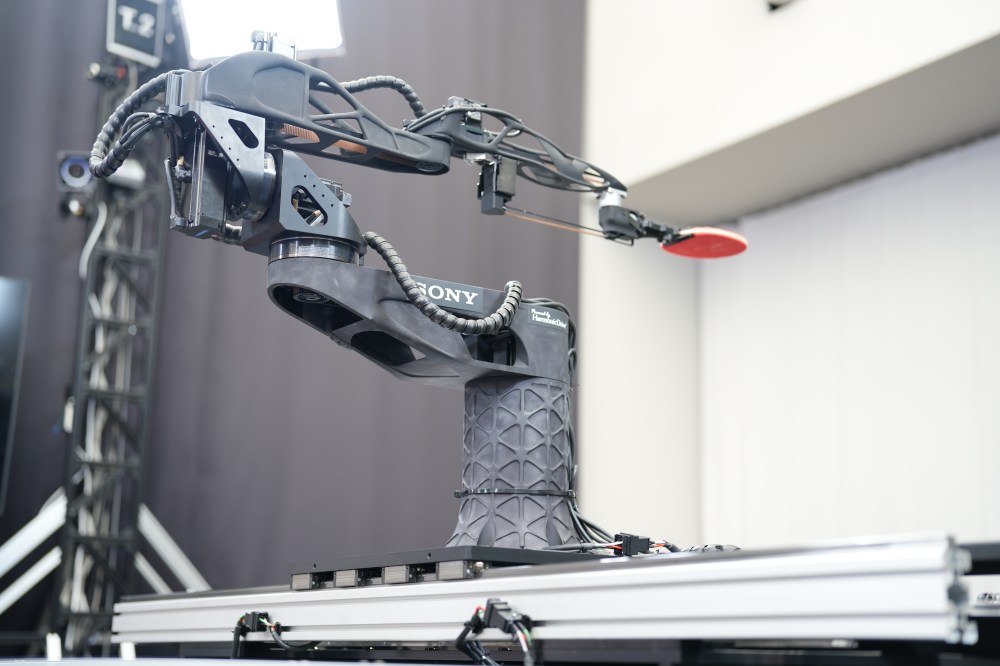
Japanese electronics giant Sony built the robotic arm it calls Ace and pitted it against professional athletes. Ace proved a worthy adversary, though one with some non-human attributes: nine camera eyes positioned around the court and an uncanny ability to follow the ball’s logo to measure its spin.
The robot learned how to play the sport using the AI method known as reinforcement learning.
“There’s no way to program a robot by hand to play table tennis. You have to learn how to play from experience,” said Sony AI researcher Peter Dürr, co-author of the study published Wednesday in the science journal Nature.
To conduct the experiments, Sony built an Olympic-sized table tennis court at its headquarters in Tokyo to give professional and other highly skilled athletes a “level playing field” with the robot, Dürr said in an interview with The Associated Press. Some of the athletes said they were surprised by Ace’s prowess.
Sony calls it a first for a common competitive sport
Sony says it is the “first time a robot has achieved human, expert-level play in a commonly played competitive sport in the physical world — a longstanding milestone for AI and robotics research.”
The custom-built robot has eight joints that direct its movements, or degrees of freedom, enabling it to position the racket, execute shots and swiftly respond to its opponent’s rallies.
“Speed is really one of the fundamental issues in robotics today, especially in scenarios or environments that are not fixed,” said Michael Spranger, president of Sony AI, in an interview.
“We see a lot of robots that are in factories that are very, very fast,” Spranger said. “But they’re doing the same trajectory over and over again. With this technology, we show that it’s actually possible to train robots to be very adaptive and competitive and fast in uncertain environments that constantly change.”
Spranger said such technology could play a role in manufacturing and other industries. It’s also not hard to imagine how such high-speed and highly perceptive hardware could be used in war.
Building parity with humans is a challenge
A humanoid robot ran faster than the human world record in a half-marathon race for robots in Beijing on Sunday, but getting a machine to interact and compete at split-second speeds with skilled human athletes is in some ways a more difficult challenge.
Spranger said it was important for researchers to not give the robot too unfair of an advantage and make its speed, arm’s reach and performance comparable to a skilled athlete who trains at least 20 hours a week. It plays by official table tennis rules on a typically sized court.
“It’s very easy to build a superhuman table tennis robot,” Spranger said. “You build a machine that sucks in the ball and shoots it out much faster than a human can return it. But that’s not the goal here. The goal is to have some level of comparability, some level of fairness to the human, and win really at the level of AI and the level of decision-making and tactics and, to some extent, skill.”
That means, he said, that “the robot cannot just win by hitting the ball faster than any human ever could, but it has to win by actually playing the game.″
AI researchers have long used board games like chess as benchmarks for a computer’s capabilities. They later moved into more open-ended video game worlds. But moving AI from simulated environments to the physical world has long been the gold standard for robot makers.
The past year has marked a ″kind of ChatGPT moment for robotics,” Spranger said, with new, AI-driven approaches to teach robots about their real-world environments and task them with physically demanding activities, like backflips.
‘Ace’ pulled off shots pros thought were impossible
Sony is hardly the first to tackle robots in table tennis. John Billingsley helped pioneer such contests in 1983 in a paper titled “Robot Ping-Pong.” More recently, Google’s AI research division DeepMind has also tackled the sport.
And while impressive, Billingsley said Sony’s all-seeing computer vision and motion detection capabilities make it hard for a two-eyed human to stand a chance.
“I would not want to belittle the achievement, but they have gone at the task mob-handed, and used sledgehammer techniques,” Billingsley, a retired mechatronics professor at the University of Southern Queensland in Australia, said in an email to the AP.
He added, however, that it adds to the lesson that “true progress comes out of contests, whether they involve hitting a ball or setting foot on Mars.”
Japanese professional players Minami Ando and Kakeru Sone were among those who competed against Sony’s robot. Two umpires from the Japanese Table Tennis Association judged the games.

After submitting the paper to peer review ahead of its publication in Nature, Sony researchers kept experimenting and said Ace accelerated its shot speeds and rallies and played even more aggressively and closer to the table edge. Competing against four high-skill players, Sony said Ace defeated all but one of them in December.
Another expert player, Kinjiro Nakamura, who competed in the 1992 Barcelona Olympics, told researchers after observing Ace play a shot that “no one else would have been able to do that. I didn’t think it was possible.”
But the robot now having done it “means that there is a possibility that a human could do it too,” he said, in remarks published in the Nature paper.
___
AP journalists Yuri Kageyama and Javier Arciga contributed to this report.