Four female premiers on whether Christine Fréchette can avoid the ‘glass cliff’
Advertisement
Read this article for free:
or
Already have an account? Log in here »
To continue reading, please subscribe:

Digital Subscription
One year of digital access for only $205*
- Enjoy unlimited reading on winnipegfreepress.com
- Read the E-Edition, our digital replica newspaper
- Access News Break, our award-winning app
- Play interactive puzzles
*First annual payment billed as $205.00 + GST for one year. This annual subscription will automatically renew at $233.00 + GST every 52 weeks (10% off the regular annual price of $259.35). Offer available to new and qualified returning subscribers only. Cancel any time.
To continue reading, please subscribe:
Add Free Press access to your Brandon Sun subscription for only an additional
$1 for the first 4 weeks*
- Enjoy unlimited reading on winnipegfreepress.com
- Read the E-Edition, our digital replica newspaper
- Access News Break, our award-winning app
- Play interactive puzzles
*Your next Brandon Sun subscription payment will increase by $1.00 and you will be charged $17.95 plus GST for four weeks. After four weeks, your payment will increase to $24.95 plus GST every four weeks.
Read unlimited articles for free today:
or
Already have an account? Log in here »
MONTREAL – Kathleen Wynne, Ontario’s first female premier, remembers meeting a businessman who shook hands with the male staffer standing next to her and addressed him as “premier.”
It’s hard to shake the notion among the public of what a premier looks like, Wynne, premier between 2013 and 2018, said in a recent interview.
“A five-foot-four-woman is not who people think of as a leader.”
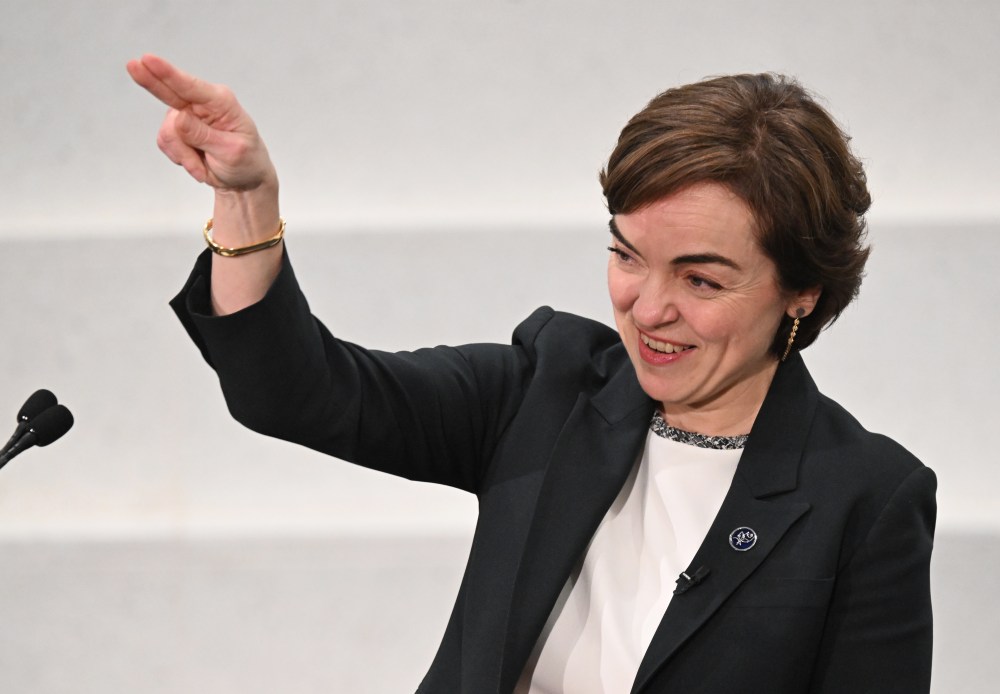
Wynne is one of four former or current female premiers who spoke to The Canadian Press following last week’s swearing in ceremony of Christine Fréchette, Quebec’s 33rd premier and the second woman in the role after the Parti Québécois’s Pauline Marois between 2012-14.
All four said Fréchette has been handed the reins of a party in crisis and faces a “glass cliff”: a situation when a woman is put in a leadership role when risk of failure is high. However, neither Wynne, Marois, former B.C. premier Christy Clark nor New Brunswick Premier Susan Holt are ready to write Fréchette off just yet.
“I certainly wouldn’t underestimate Christine Fréchette. She’s an extremely determined and smart woman,” Holt, who led her Liberals to a majority in 2024, becoming New Brunswick’s first female premier, said over the phone.
Of more than 340 Canadian prime ministers and premiers since Confederation, 17 have been women. Several — such as Wynne, Marois and Clark — were named leader at a difficult time for their parties, but all three led them to victory.
It remains to be seen whether Fréchette will do the same. She has less than six months to make her mark before October’s general election, and poll aggregator Qc125 predicts her party — Coalition Avenir Québec — is on track to be reduced to zero seats.
Clark, B.C.’s second female premier, took over as Liberal leader from Gordon Campbell in 2011. His approval rating had dropped to nine per cent and the party was 22 points behind in the polls, but she wound up winning a surprise majority in the 2013 general election.
“When you’re really low in the polls, people are looking for a big, obvious change. And so I think women fit that bill because it’s so strange still to elect women to be leader of your party,” Clark said in a recent interview.
Wynne inherited Ontario’s top job in 2013 from Dalton McGuinty, whose Liberals were unpopular after a slew of scandals. She says she remembers seeing a newspaper comic depicting her driving a beat-up car the day after she was sworn in.
“Sometimes a party will say, ‘Well we’ve tried everything else, let’s try a girl,’ you know? And it can either work or not,” said Wynne, who led the Liberals to a majority victory in 2014. She lost the following election to Doug Ford’s Progressive Conservatives.
Clark, meanwhile, is the only female premier elected to a second term in office, but her party was downgraded to a minority government in May 2017. She quickly lost a confidence vote and resigned in June of that year.
While Clark says some losses can be chalked up to poor campaigning, she adds people sour on women in leadership roles quicker than men. Politics and press galleries tend to be “boy’s clubs,” she says, that judge women more harshly.
“We still live in a sexist society,” she said.
Kate Graham, a political-science professor at Huron University College, says it’s too soon to say whether Fréchette will be pushed off the glass cliff. In her podcast series, “No Second Chance,” Graham dissects the rise and fall of women in Canada’s most senior political roles.
With Fréchette, she says comparisons to both Kim Campbell and Wynne come to mind.
Campbell, Canada’s only female prime minister, won the 1993 Progressive Conservative leadership race following Brian Mulroney’s retirement. She was in office for 132 days before the party lost to Jean Chrétien’s Liberals in what is considered the worst defeat for a federal governing party.
“These are two possible scenarios (for Fréchette),” says Graham. “I think that the difference between those paths is if the incumbent will show voters that something is different (within the party).”
New Brunswick’s Holt is optimistic about the future of women in politics, though she sees the glass cliff pattern repeating with Fréchette. “The bar is higher and often women are put into those kind of unwinnable situations,” she said.
Holt — who started off as opposition leader — says she faced her own set of challenges. She says the gender wage gap still exists, leaving women with less disposable income than men to support political candidates. She also says she experienced online harassment and threats.
Marois was named PQ leader after the storied party lost official Opposition status to the now-defunct Action démocratique in 2007. But she rallied the embattled party and led the PQ to a minority government, defeating the Liberals. On election night 2012, a gunman forced his way into the Montreal venue where she was delivering her victory speech. He killed a lighting technician and injured another person.

Marois called an election in 2014 and lost to the Liberals. During her time in office, she remembers constantly fighting against sexist stereotypes. She recalls holding a news conference after one of her morning strolls — she walks about 7,000 steps per day — and being told by journalists that she “looked tired.”
“I thought to myself, ‘No, this can’t be happening; we’re not going to go through this again,'” she said in an interview. She invited the reporters to join her for a walk up Montreal’s Mount Royal at 6 a.m. the next day, and many “stayed on the campaign bus.”
Marois said she felt “deep pride” seeing Fréchette become premier, saying it’s “a win for all women.” When Marois first joined the Quebec legislature in 1981, she says about 24 per cent of elected officials were women compared to 46 per cent today.
“It’s wonderful, all the barriers we’ve broken down,” said Marois. “But there’s still work to do.”
This report by The Canadian Press was first published April, 23, 2026.