Telus and feds announce AI data cluster in B.C. to boost ‘sovereign’ computing power

Advertisement

Advertise with us

VANCOUVER - Canada's artificial intelligence minister says the Liberal government is aware of risks involved in a major investment in AI data centres in British Columbia, but taking such chances are necessary for the country to remain competitive globally.

Read this article for free:


or

Already have an account? Log in here »

To continue reading, please subscribe:

Subscribe and receive a limited-edition Free Press branded hat or tote.

Digital Subscription

One year of digital access for only $205*

  • Enjoy unlimited reading on winnipegfreepress.com
  • Read the E-Edition, our digital replica newspaper
  • Access News Break, our award-winning app
  • Play interactive puzzles

*First annual payment billed as $205.00 + GST for one year. This annual subscription will automatically renew at $233.00 + GST every 52 weeks (10% off the regular annual price of $259.35). Offer available to new and qualified returning subscribers only. Cancel any time.

To continue reading, please subscribe:

Add Free Press access to your Brandon Sun subscription for only an additional

$1 for the first 4 weeks*

  • Enjoy unlimited reading on winnipegfreepress.com
  • Read the E-Edition, our digital replica newspaper
  • Access News Break, our award-winning app
  • Play interactive puzzles
Start now

*Your next Brandon Sun subscription payment will increase by $1.00 and you will be charged $17.95 plus GST for four weeks. After four weeks, your payment will increase to $24.95 plus GST every four weeks.

VANCOUVER – Canada’s artificial intelligence minister says the Liberal government is aware of risks involved in a major investment in AI data centres in British Columbia, but taking such chances are necessary for the country to remain competitive globally.

Evan Solomon and Vancouver-based telecom giant Telus announced the plans for three B.C. facilities on Monday in what’s described as a bid to boost Canada’s sovereign computing and artificial-intelligence infrastructure.

The two in Vancouver and one in the Interior city of Kamloops represent an attempt to create what Telus calls “one of the world’s most powerful and sustainable AI infrastructure clusters.”
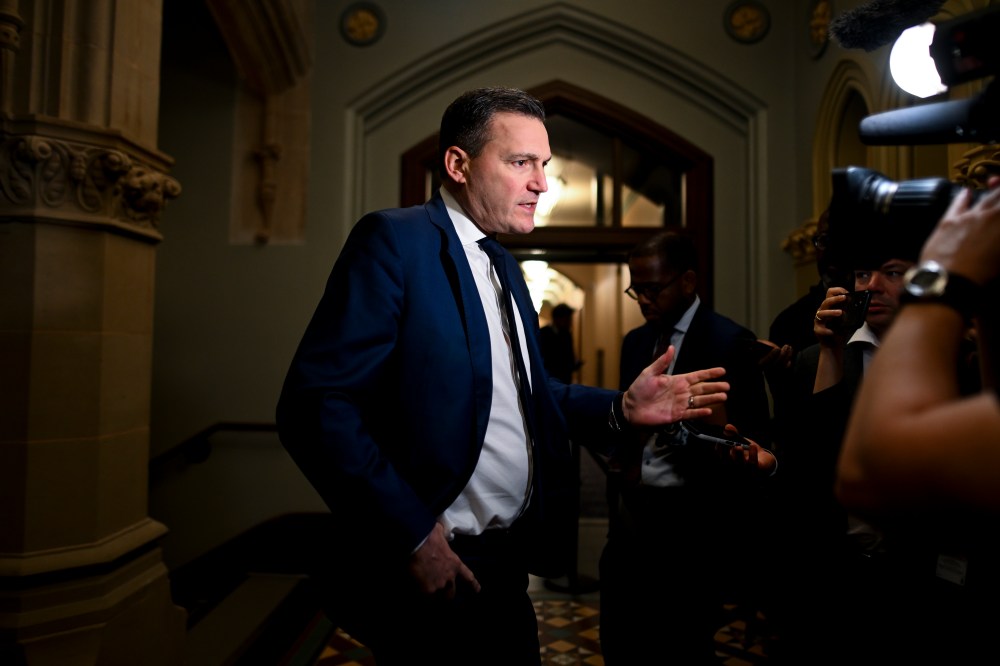
Minister of Artificial Intelligence and Digital Innovation and Minister responsible for the Federal Economic Development Agency for Southern Ontario Evan Solomon speaks to reporters ahead of a federal cabinet meeting on Parliament Hill in Ottawa on Thursday, May 7, 2026. THE CANADIAN PRESS/Spencer Colby

“We shouldn’t sugar-coat it,” Solomon said at a news conference in Vancouver. “Of course there’s financial risks when people are investing billions of dollars.

“Building is risk, which is why the Prime Minister said we cannot be risk averse in this moment. We’re going to take on an element of risk, but you also have to do that boldly and responsibly. Risk cannot come at the expense of our values, sustainability.

“In this moment, do we want a country that is not taking risk to bet on Canada? Do we want country that’s not taking a risk to bet our own innovation, our own energy systems, our own cities, our workforce? Absolutely not.”

No costings for the project have been released. However, the federal government has committed $2 billion over five years, starting in 2024—25, under an initiative to identify and boost large-scale sovereign data centres. 

Telus said the project would see the expansion of its existing Kamloops data centre, as well as the development of two new Vancouver facilities in the Mount Pleasant neighbourhood and in the city’s downtown.

The Kamloops expansion and the Mount Pleasant facility will open later this year, while the downtown facility will come online in 2029.

Outgoing Telus chief executive Darren Entwistle, who is retiring at the end of June after 26 years in the post, called the project a “seminal announcement” for Canada’s economic future and added he “cannot wait to cheer this one on — even if it’s from the sidelines.”

“To do a comparative to understand the magnitude of what is being achieved here, this is enough processing power to run the world’s most advanced AI models,” Entwistle said.

“And every single computation will happen right here on Canadian soil, with infrastructure that is owned and infrastructure that it’s controlled by Canadians.”

The project announcement comes after a call for proposals by the federal government on large-scale AI clusters ran from Jan. 15 to Feb. 15 earlier this year.

In a statement, federal Conservative shadow AI minister Ben Lobb called the announcement “photo ops” unnecessary for driving tech development in Canada.

“Canada should already be a hub for AI data centres,” Lobb said. “They don’t need government involvement or tax dollars, they just need the Liberal government to get out of the way.
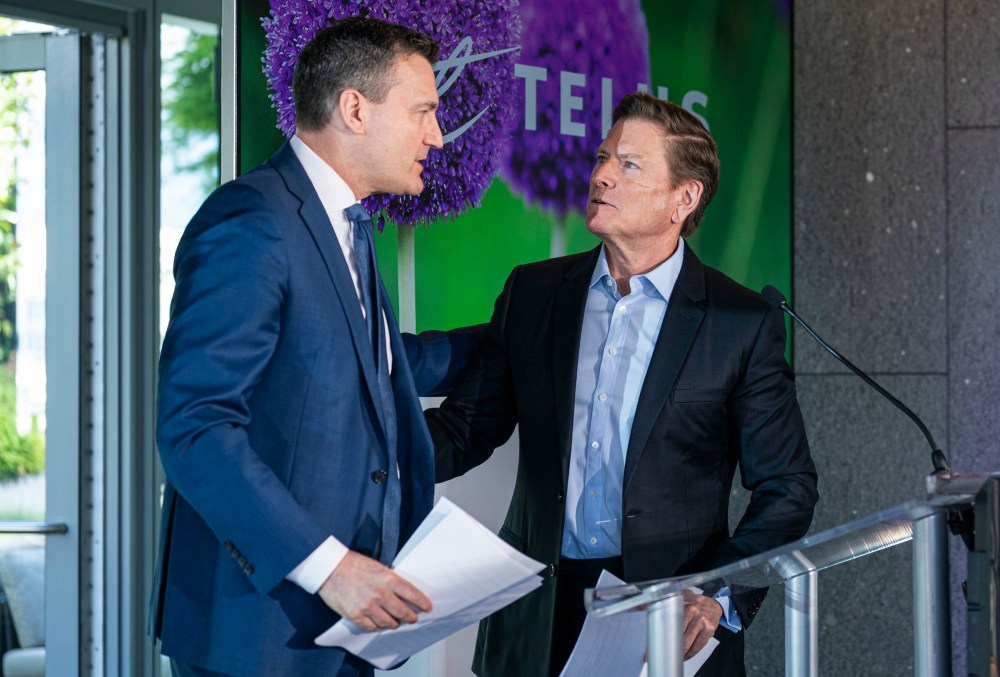
Evan Solomon, Minister of Artificial Intelligence and Digital Innovation, greets Darren Entwistle, President and CEO of Telus at the podium after announcing plans for three large-scale AI data centre projects in British Columbia during a press event in Vancouver on Monday, May 11, 2026. THE CANADIAN PRESS/Rich Lam

“The Liberal government has not repealed their anti-development laws, regulations, and taxes that block projects. They should scrap them and get out of the way so we can use the advantages we have to build our future.”

The federal government said the project would support domestic innovation involving both academia and industry.

Telus said the three new data centres would get more than 98 per cent of their electricity from renewable sources, and waste heat from the two Vancouver facilities would be used to help heat homes.

Artificial intelligence has been under federal scrutiny in recent months, after February’s mass shootings in Tumbler Ridge, B.C., where shooter Jesse Van Rootselaar had troubling interactions with the ChatGPT chatbot that were flagged by OpenAI — but not forwarded to police.

Solomon said Monday that he would not “relate that to what we’re doing here,” while adding that an examination of AI safety protocols was ongoing and “all options are on the table.”

But he said Canada could shy away from AI, and building Canadian data centres was part of an overall modernization process and not an attempt to close off the country from tech from other countries.

“We are building sovereign AI under Canadian law, but we are still going to have Canadians use technologies from around the world, including things like ChatGPT,” Solomon said.

“We can’t stop people. We don’t want to. Sovereignty is not solitude, but we have an obligation to protect Canadians, to protect children, and that means making sure it’s safe, reliable, transparent, and subject to Canadian law as we’ve talked about.”

This report by The Canadian Press was first published May 11, 2026.

Report Error Submit a Tip

More Stories

Could renewed interest in strategically critical rare earth elements finally make sub-sector profitable?

Joel Schlesinger 6 minute read Preview

Could renewed interest in strategically critical rare earth elements finally make sub-sector profitable?

Joel Schlesinger 6 minute read Yesterday at 3:00 AM CDT

Rare earth elements are among the most critical of mined resources for modern economies.

They’re essential in manufacturing specialized magnets used in a host of technologies from wind turbines and electric vehicles to hard drives, smartphones, television screens, and fibre optics. Most notably, however, rare earth minerals are increasingly vital to the defence industry.

These 17 elements — closely related chemically and usually found all together in mineral deposits — have indeed been growing in geopolitical importance as the United States, Canada and other Western nations recognize their dependence on production from China.

It is the world’s largest producer and processor of rare earths, including the most in-demand elements neodymium and praseodymium used to manufacture very light and powerful magnets for an array of technologies, including the most advanced weapons of modern warfare.

Read
Yesterday at 3:00 AM CDT

Don’t be a big loser — check out Real Love Summer Fest ReunionBig Loser takes the stage at 8:20 p.m. tonight as part of the Real Love Summer Fest Reunion, a one-day event put on by the indie promotion company, which ran the festival in the Interlake area for a decade until last summer’s final edition near Teulon.

Bookers Gil Carroll and Adam Soloway have programmed a full day of music at Blue Note Park (220 Main St.), the outdoor venue adjacent to Times Change(d) High and Lonesome Club.

First up at 4 p.m. is folk-rock songwriter tofusmell, followed at 5 p.m. with a rare performance by indie-songwriting darlings Animal Teeth, a group with several summer fest bills under its belt. Up-and-coming pop-rockers Synthetic Friend take the stage at 6, followed at 7 by the fun electronic dance pop of French Class.

After playing with his full band at last month’s Winnipeg Folk Festival, Amos the Kid will perform a solo set at 8 p.m. Sans band, the performer shows off his affable roots as a Gord Downie acolyte with catchy earworms to match.

WRHA directs three care homes to accommodate surge of hospital patients

Malak Abas 5 minute read Preview

WRHA directs three care homes to accommodate surge of hospital patients

Malak Abas 5 minute read Friday, Aug. 14, 2026

The Winnipeg Regional Health Authority has directed three long-term care centres to make space for hospital patients, citing “exceptionally high demand for care across the health-care system.”

Read
Friday, Aug. 14, 2026

Rainbow Stage’s Legally Blonde a lovely legal musical

Holly Harris 6 minute read Preview

Rainbow Stage’s Legally Blonde a lovely legal musical

Holly Harris 6 minute read Friday, Aug. 14, 2026

Omigod, you guys! Rainbow Stage kicked off its penultimate summer production Thursday with a high-octane joy machine bathed in a sea of pink.

Inspired by the 2001 Hollywood film starring Reese Witherspoon, and Amanda Brown’s same-titled novel, the award-winning Legally Blonde: The Musical — featuring a book by Heather Hach, with music/lyrics by Laurence O’Keefe and Nell Benjamin — opened on Broadway in April 2007, followed by a subsequent West End run.

The tale — equal parts cheesy rom-com and potent siren call for female autonomy and empowerment — focuses on quintessential Cali-girl Elle Woods (a pitch-perfect Claire Mac Master). A proud daughter and president of Delta Nu sorority house, she enrols at Harvard Law School to win back her upwardly mobile ex-boyfriend, Warner Huntington III (Duncan Cox).

Laser-focused on marrying a “Jackie, not a Marilyn,” Warner dreams of becoming an American senator, latching onto uber-preppy fellow pupil Vivienne Kensington (Julie Davis), who becomes Elle’s arch nemesis.

Read
Friday, Aug. 14, 2026

Poilievre’s lips moving, but Canadians aren’t interested in what he’s saying

Tom Brodbeck 5 minute read Preview

Poilievre’s lips moving, but Canadians aren’t interested in what he’s saying

Tom Brodbeck 5 minute read Thursday, Aug. 6, 2026

Pierre Poilievre’s biggest political challenge right now isn’t Prime Minister Mark Carney’s popularity.

It’s the fact that he still seems to be campaigning against a political landscape that no longer exists.

More than a year after the 2025 federal election, the Conservative leader is still relying on the same message, the same themes and the same attacks that defined his party’s campaign before voters went to the polls.

And Canadians appear to be tuning it out.

Read
Thursday, Aug. 6, 2026

Corroded Arlington overpass yields way for new hope of spanning urban chasm

Melissa Martin 6 minute read Preview

Corroded Arlington overpass yields way for new hope of spanning urban chasm

Melissa Martin 6 minute read Yesterday at 2:00 AM CDT

It’s an interesting quirk of timing, perhaps, that the end of two of Winnipeg’s most unlovely features are coming into view in the same few weeks. The rail lines that split the city in half, and the bridge that was built to tie it back together. The original problem, and the solution.

And in the confluence of those two ends, we have an opportunity to dream of what a better Winnipeg can be.

At a news conference on Wednesday, former federal transport minister Lloyd Axworthy laid out a vision for a rail line bypass that would remove more than 120 railway crossings from Winnipeg, route them through Crown and Manitoba Hydro corridor land south of the city, and reclaim 250 acres in the urban core for greenspace and development.

The next step is to focus on how to make it happen. Nothing of this scope comes easy. This new bypass plan emerged from a two-year feasibility study that Premier Wab Kinew had tasked Axworthy with back in 2024. Now, Axworthy will helm a new 90-day feasibility study zooming in on that route specifically.

Read
Yesterday at 2:00 AM CDT