One of the largest modern US infrastructure projects will soon burrow toward New York City

Advertisement

Advertise with us

NORTH BERGEN, N.J. (AP) — When the original train tunnel beneath the Hudson River connecting Manhattan to New Jersey was built more than a century ago, workers toiled with picks and shovels from each side until eventually meeting in the middle.

Read this article for free:


or

Already have an account? Log in here »

To continue reading, please subscribe:

Subscribe and receive a limited-edition Free Press branded hat or tote.

Digital Subscription

One year of digital access for only $205*

  • Enjoy unlimited reading on winnipegfreepress.com
  • Read the E-Edition, our digital replica newspaper
  • Access News Break, our award-winning app
  • Play interactive puzzles

*First annual payment billed as $205.00 + GST for one year. This annual subscription will automatically renew at $233.00 + GST every 52 weeks (10% off the regular annual price of $259.35). Offer available to new and qualified returning subscribers only. Cancel any time.

To continue reading, please subscribe:

Add Free Press access to your Brandon Sun subscription for only an additional

$1 for the first 4 weeks*

  • Enjoy unlimited reading on winnipegfreepress.com
  • Read the E-Edition, our digital replica newspaper
  • Access News Break, our award-winning app
  • Play interactive puzzles
Start now

*Your next Brandon Sun subscription payment will increase by $1.00 and you will be charged $17.95 plus GST for four weeks. After four weeks, your payment will increase to $24.95 plus GST every four weeks.

NORTH BERGEN, N.J. (AP) — When the original train tunnel beneath the Hudson River connecting Manhattan to New Jersey was built more than a century ago, workers toiled with picks and shovels from each side until eventually meeting in the middle.

A new tunnel, one of the largest U.S. mass transit projects in generations and which is expected to cost $16 billion, will take a decidedly modern approach.

Giant drilling machines nearly the length of two football fields armed with cutters harder than diamonds will chew through dense rock. A crew of about 40 will oversee a conveyor system hauling out debris as well as equipment to install the tunnel’s curved concrete lining.
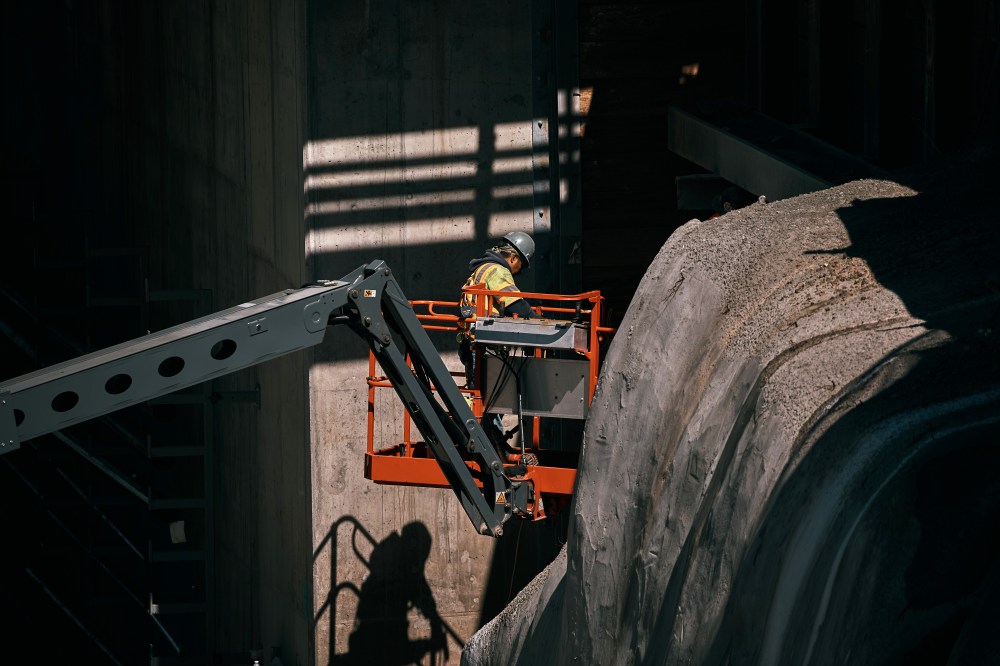
A worker stands on a crane while securing exposed rock along a wall at the Palisades Tunnel Project, part of the Gateway Program, on Tuesday, May 12, 2026, in North Bergen, N.J. (AP Photo/Andres Kudacki)

“This is a fully automated, underground factory,” said James Starace, chief of program delivery for the Gateway Development Commission, a public agency formed by New York and New Jersey that’s undertaking the tunnel project.

Wearing a hardhat and yellow safety vest, Starace stood Tuesday in a trench cut into the hills across the river from New York City. Behind him rose a two-story wall of solid rock where, if all goes as planned, by 2035 trains will speed in and out of the tunnel, easing a bottleneck on the busiest passenger rail corridor in the nation.

The tunnel-boring machines arrived “like Lego pieces” from Germany in nearly 100 different components, said Hamed Nejad, the project’s chief engineer. Outside the tunnel’s future entrance, sparks flew as a team of welders fused pieces of the massive cutterheads.

Danny Pearlstein, a spokesperson for the transit advocacy group Riders Alliance, said America has grown unaccustomed to building megaprojects at this scale, which has contributed to the cost.

“What’s astonishing about Gateway isn’t the size and scope of the project,” Pearlstein said, “but that it’s taken this long to get only so far.”

The machines are expected to take about a year to grind through the first section in the New Jersey Palisades, which is made of tough volcanic rock, once digging starts later this year, according to Starace. That’s about 30 feet of tunnel a day. Other machines will dig under the riverbed.

In full, the new tunnel with two train tracks inside will run almost 2.5 miles (4 kilometers). The original two-tracked tunnel, damaged by saltwater during Superstorm Sandy, will be renovated.

The ambitious project received key approvals and funding under the Biden administration, but nearly ground to a halt a few months ago.

The Trump administration froze funding during the recent federal government shutdown, citing concerns that the project was allocating funds based on diversity, equity and inclusion principles.

As funding neared depletion in February, a federal judge ordered the administration to release the funds. Money has continued flowing as a lawsuit brought by New York and New Jersey against the federal government plays out.

___

Follow Philip Marcelo at https://x.com/philmarcelo

Report Error Submit a Tip

More Stories

Sean Burns and company head to Sidestage to celebrate album

Sheldon Birnie 6 minute read Preview

Sean Burns and company head to Sidestage to celebrate album

Sheldon Birnie 6 minute read 2:00 AM CDT

Like so many country musicians before him, local troubadour Sean Burns just can’t wait to get on the road again, playing to listeners far and wide.

But for now, hot off 10 dates out west, Burns and his band Lost Country will celebrate the official release of the group’s latest record, Better Off in Time & Other Songs for the Dance Floor, with a gig at Sidestage Friday.

“I like to work with the band as much as I can,” Burns says. “There aren’t many bands that play the kind of country music we play. It’s the most rewarding gig.”

Burns, who sings and plays upright bass, tic-tac and acoustic guitars on the new record, laid down the tracks last October at Winnipeg’s No Fun Club, mostly live off the floor with Lost Country.

Read
2:00 AM CDT

Jets mailbag: storylines to watch as countdown to 16th season begins

Mike McIntyre and Ken Wiebe 19 minute read Preview

Jets mailbag: storylines to watch as countdown to 16th season begins

Mike McIntyre and Ken Wiebe 19 minute read Yesterday at 12:00 PM CDT

There’s a chill in the air, which must mean hockey is right around the corner.

Sure enough, the Winnipeg Jets open training camp this week, full of excitement and hope for the upcoming campaign.

However, there are a few other emotions surrounding the club right now, which were evident when we opened up the monthly Free Press mailbag. Specifically when it comes to a certain goaltender who isn’t expected to show his face  while waiting news on a trade he’s demanded.

Among them: Angst. Apathy. Anger.

Read
Yesterday at 12:00 PM CDT

Jets suspend goaltender Hellebuyck for failure to report to training camp

The Canadian Press 2 minute read Preview

Jets suspend goaltender Hellebuyck for failure to report to training camp

The Canadian Press 2 minute read Updated: Yesterday at 10:02 PM CDT

WINNIPEG - The Winnipeg Jets suspended goaltender Connor Hellebuyck on Wednesday night for failing to report to training camp.

The team said general manager Kevin Cheveldayoff would address the media Thursday morning. It did not specify the length of the suspension for the U.S. Olympic star.

Hellebuyck, a three-time Vezina Trophy winner and 2025 Hart Trophy winner as NHL MVP, publicly requested a trade from the team on Aug. 27.

In a statement posted on X by his agent, Ray Petkau, Hellebuyck said he had privately requested a trade “several months ago” and that he gave the organization time to address it “quietly and respectfully.”

Read
Updated: Yesterday at 10:02 PM CDT

Puzzles Palace

1 minute read Monday, Jul. 27, 2026

To solve our puzzles, please subscribe with this special offer: |

Wind and batteries the best bet

James Wilt 5 minute read Preview

Wind and batteries the best bet

James Wilt 5 minute read Yesterday at 2:01 AM CDT

For years, Manitoba Hydro has claimed that we can’t rely on wind turbines during multi-day or even multi-week cold snaps.

Read
Yesterday at 2:01 AM CDT

Gas turbine peaker plants are a mistake

Don Scott 7 minute read 2:00 AM CDT

Technology respecting electricity generation, storage and grid management is rapidly advancing and displacing gas-fired peaker plants. New battery storage systems are more efficient and less costly, smooth grid flow and are non-polluting. Texas, California and Australia are replacing gas turbine peaker plants with more effective storage batteries.

Solar and wind energy generation combined with battery storage at both the grid and home/business level is the most efficient way to meet peak demand. Building expensive, outdated, polluting American gas turbines, as Manitoba Hydro is proposing, is not in Manitoba’s interest.

Premier Wab Kinew noted that a final decision to build a new turbine power plant in Brandon has not been made. I hope he’s correct, for if Manitoba Hydro already made the decision and entered binding financial obligations with GE Vernova, the PUB’s role was superfluous.

In 2025/26 Nova Scotia Power installed 3 x 50 MW Lithium-ion grid batteries with the storage capacity of over 600 MWh. Installed by Kitchener/Waterloo based Canadian Solar’s subsidiary e-Storage who have operations around the world, they accomplished this in less than two years from the approval date in June 2024. Two were operational within 18 months, the third in 24. The cost was $237 million. At Nova Scotia’s cost per MW, a 750 MW battery peaker facility would cost Hydro $1.185 billion, just 40 per cent of the proposed $3 billion gas peaker plant.