Russian spies are aggressively seeking Western technology as sanctions bite, officials say
Advertisement
Read this article for free:
or
Already have an account? Log in here »
To continue reading, please subscribe:
Digital Subscription
One year of digital access for only $1.44 a week*
- Enjoy unlimited reading on winnipegfreepress.com
- Read the E-Edition, our digital replica newspaper
- Access News Break, our award-winning app
- Play interactive puzzles
*Billed as $5.77 plus GST every four weeks. After 52 weeks, price increases to the regular rate of $19.95 plus GST every four weeks. Offer available to new and qualified returning subscribers only. Cancel any time.
To continue reading, please subscribe:
Add Free Press access to your Brandon Sun subscription for only an additional
$1 for the first 4 weeks*
- Enjoy unlimited reading on winnipegfreepress.com
- Read the E-Edition, our digital replica newspaper
- Access News Break, our award-winning app
- Play interactive puzzles
*Your next Brandon Sun subscription payment will increase by $1.00 and you will be charged $17.95 plus GST for four weeks. After four weeks, your payment will increase to $24.95 plus GST every four weeks.
Read unlimited articles for free today:
or
Already have an account? Log in here »
STOCKHOLM, Sweden (AP) — Russia’s intelligence agencies have grown more aggressive in their efforts to steal Western technology and defense secrets as sanctions squeeze the country’s wartime economy, three senior European intelligence officials told The Associated Press.
Moscow’s agents are building fake companies, recruiting middlemen and deploying cyber spies and hackers who are gathering information that could also be used to attack key infrastructure, they said.
Four years of international sanctions have hampered Moscow’s ability to procure machinery, technology and research from Europe, while the grinding war in Ukraine has taxed key industries and pushed the country toward a potential financial crisis.
“They really know what they need,” and are putting “serious effort” into acquiring advanced machine tools, factory equipment, research and dual-use technology, said Christoffer Wedelin, deputy head of operations at the Swedish Security Service.
Russia seeks high-end research, defense technology and software
In Sweden, Russia is targeting the defense industry and high-end research on the country’s most advanced weaponry, such as the Gripen fighter jet, Wedelin said. It is also trying to procure camera and laser technology developed for civilian purposes that could be integrated into Russian weapons systems, he said.
Moscow is also trying to steal technology to help it keep pace — or give it an edge — against the West in the decades ahead, said Juha Martelius, the director of Finland’s Security and Intelligence Service.
“We’re talking about space technology, quantum … arctic technology, marine technology,” he said, adding that space technology is something Russia needs “right now,” without elaborating. Countries use such technology for satellite imaging, communications and navigation.
Russia also needs sanctioned computer technology and software updates for machine tools, Martelius said.
On Wednesday, Anne Keast-Butler, the director of the U.K’s signals intelligence agency, accused Russia of “relentlessly targeting” the U.K. and its European allies, by stealing technology and plotting sabotage and assassination attempts.
In May, Swedish police arrested two people on suspicion of violating sanctions relating to a company in Turkey that has made dozens of shipments of metalworking and metal-turning machine tools to Russia.
As the schemes to acquire technology grow more complex, companies need to be more aware they could unwittingly become part of Russia’s war supply chain, Wedelin said.
“All of the security and intelligence services in Russia are helping out on the state’s efforts to get this,” he said.
Intelligence officials say Russia cares less about getting caught
Moscow is also deploying cyberattacks against European firms and critical infrastructure in an attempt to gather information, which it could exploit “when they get the chance and when it serves their purpose,” Wedelin said. He pointed to an attack on a Swedish power plant last year.
Russia-linked actors tried to “destroy” the plant but failed because the system detected the intrusion, Wedelin said. He said the attack was partly aimed at undermining Western support for Ukraine.
Before then, Sweden’s security services had mostly observed reconnaissance for potential attacks, intelligence gathering or activity linked to cybercriminals. The attack marked a “switch” in Russia’s modus operandi, Wedelin said.
“They’re no longer caring as much about potential attribution after their activities, so they are taking greater risks to achieve their goals,” he said.
Problems are mounting for Russia’s economy
Russia’s increasingly aggressive tactics may reflect mounting internal concerns about its economy, which “is not doing well at all,” said Kaupo Rosin, the head of Estonia’s Foreign Intelligence Service.
About a third of Russia’s gross domestic product currently goes to the war effort, Martelius said. The war and ensuing sanctions have slowed growth and fueled stubborn inflation.
Russian officials planned to have a budget deficit of 3.7 trillion rubles ($52.1 billion) for the whole of 2026 and had already reached about 3.4 trillion rubles ($47.9 billion) by the end of February, Rosin said.
The Iran war that erupted on Feb. 28 has provided a boost by causing oil prices to soar. The U.S. has granted sanctions waivers for the sale of Russian oil and the U.K. watered down its sanctions in an attempt to lower global fuel costs.
Increased revenue since then has likely improved Russia’s budget, but “it doesn’t save them,” Rosin said, adding that if Western pressure persists, Moscow could face a financial crisis toward the end of the year.
Rosin said intelligence seen by his agency shows a gloomier outlook among Russian officials over the past six months, with the narrative of “total victory” in Ukraine having vanished. Keast-Butler, of British intelligence, said almost 500,000 Russian soldiers have been killed in Ukraine since the full-scale invasion in 2022.

Russia and Ukraine have mostly kept their combat casualty figures under wraps.
Stalled progress on the battlefield and economic woes have many Russian officials privately asking “what is this all for,” Rosin said, citing the intelligence reports.
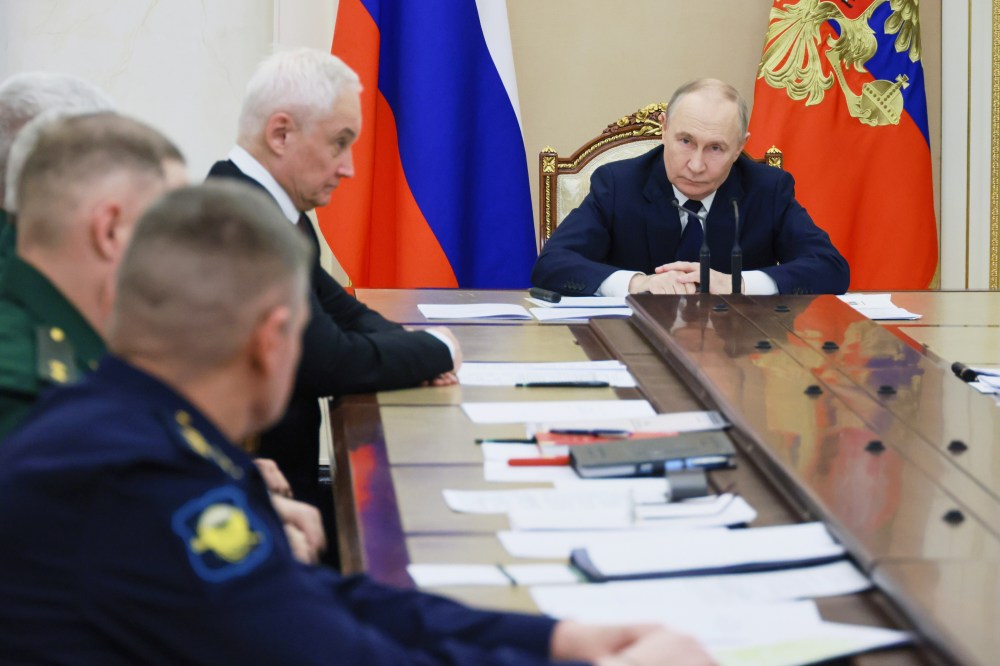
Martelius, of Finland’s intelligence service, said that while some reports on the war in Ukraine may have been “sanitized” before reaching President Vladimir Putin’s desk, he believes the Russian leader has a fairly clear picture of the economic challenges.
But that does not mean there will be political change.
It is “very dangerous … to start analyzing Russia as if it is some country like ours,” Martelius said. “It is not.”