China can build humanoids at scale. The hard part is finding enough buyers
Advertisement
Read this article for free:
or
Already have an account? Log in here »
To continue reading, please subscribe:

Digital Subscription
One year of digital access for only $205*
- Enjoy unlimited reading on winnipegfreepress.com
- Read the E-Edition, our digital replica newspaper
- Access News Break, our award-winning app
- Play interactive puzzles
*First annual payment billed as $205.00 + GST for one year. This annual subscription will automatically renew at $233.00 + GST every 52 weeks (10% off the regular annual price of $259.35). Offer available to new and qualified returning subscribers only. Cancel any time.
To continue reading, please subscribe:
Add Free Press access to your Brandon Sun subscription for only an additional
$1 for the first 4 weeks*
- Enjoy unlimited reading on winnipegfreepress.com
- Read the E-Edition, our digital replica newspaper
- Access News Break, our award-winning app
- Play interactive puzzles
*Your next Brandon Sun subscription payment will increase by $1.00 and you will be charged $17.95 plus GST for four weeks. After four weeks, your payment will increase to $24.95 plus GST every four weeks.
Read unlimited articles for free today:
or
Already have an account? Log in here »
HONG KONG (AP) — Chinese-made humanoid robots are making waves with their ability to do backflips, direct traffic, and even make coffee as the companies developing them seek ways to expand and dominate the market.
Robot makers in China say they have thousands of orders from both the government and private businesses for humanoids that can do such things as sort parcels at postal centers, as the country finds ways to cope with an aging population and rising labor costs. However, some experts believe demand for humanoids lags the capacity to build them.
China and the United States dominate research for what Morgan Stanley estimates is a $5 trillion humanoid robots market.
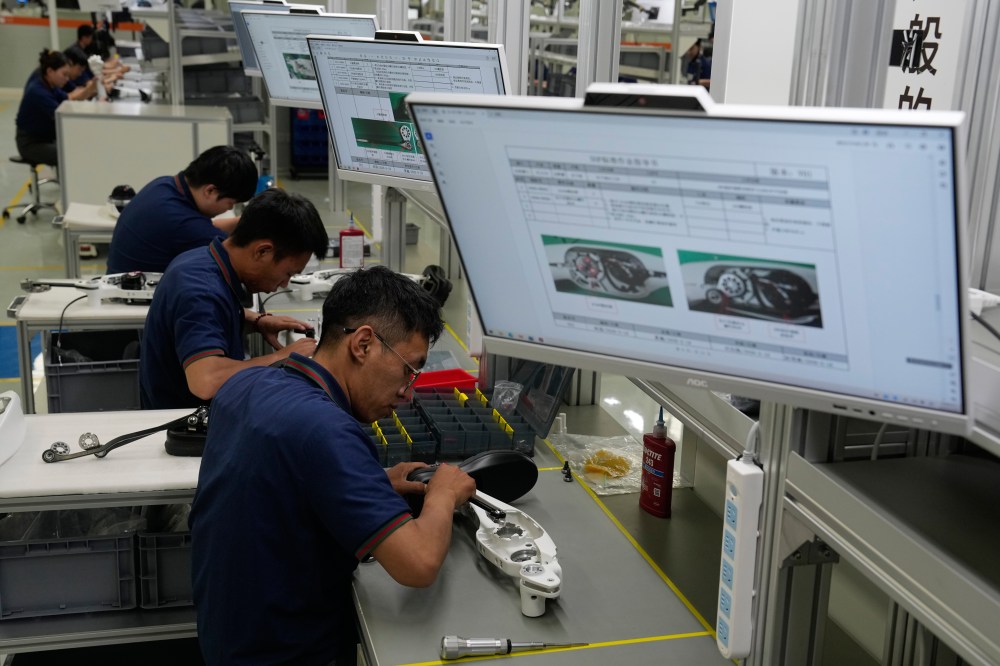
By some measures, the U.S. holds an upper hand in developing the artificial intelligence for such robots’ high-level computing power, or “brains.” But as the world’s factory floor, China leads in mass production capacity, supplies of hardware and harvesting of data for training robots.
Robot makers say real-life demand is growing
The Shanghai-based startup Matrix Robotics makes humanoid robots that employ AI. Its flagship humanoid robot, the “MATRIX-3,” stands nearly 5.6 feet (1.7 meters) tall and is equipped with hands able to make finely controlled movements. They are priced at around $99,000 per unit.
Customers for the roughly 1,000 orders it has received include coffee chains and hotels, its founder and CEO Allen Zhang, who formerly worked for Tesla, said at a recent robotics expo in Macao.
So far, Matrix has made only a few hundred of the robots, though it said it will be capable of delivering 5,000 units within this year, depending on the number of orders.
EngineAI, a startup based in southern China’s Shenzhen, says its full-sized humanoid robots could be used as security guards and museum guides. They also perform, with dancing and boxing.
A basic edition of its humanoid costs 180,000 yuan ($26,600). “The next step will be to move into more real-life scenarios,” said Issac Li, EngineAI’s head of brand and marketing.
Demand for robots may lag behind
Most humanoid robots are still performative rather than functional, falling short of working in messy, unpredictable environments, said Samm Sacks, a senior fellow at the New America think tank focused on Chinese technology.
“The use cases of these robots are still so limited,” said Chibo Tang of the venture capital firm Gobi Partners, which invests in technology startups including robotics companies. “Without the demand and without that scale from the market, these companies are not able to really go into mass production.”
China had more than 140 humanoid robot manufacturers and more than 330 models in 2025, according to the Ministry of Industry and Information Technology. Last year, the Chinese government even publicly warned about the risk of a bubble in the industry given the lagging state of commercialization and applications.
Corporate and academic labs are buying humanoid robots for research. And in China, many of the more than 2 billion yuan ($295 million) worth of orders in 2025 came from state-owned enterprises for use in places such as power plants, data centers or for entertainment, Morgan Stanley said.
“The economics are tough: humanoid robots remain expensive to produce, fragile in operation, and dependent on highly structured environments to function,” Sacks explained. There’s “a long way to go to get to a level of functionality where people will actually feel comfortable having them in their homes providing care for elderly or children,” she said.
Still, compared to other countries, China is keen on humanoids
The more viable commercial path will more likely be through industrial and logistics settings, Sacks said. But many factories in China and elsewhere already are equipped with non-humanoid robotic arms that perform repetitive single functions and may not need many humanoid robots.
In Japan and in the U.S., humanoid robot startups are also struggling to find buyers in industrial and other work settings.
Yet over the past year, real-world deployment of humanoid robots in China has accelerated.
Chinese people are relatively “used to this rapid change in terms of technology,” said Ye Tian, an ex-Apple engineer and founder and CEO of the Chinese startup RoboScience, which focuses on developing the systems behind AI-powered robots.
As the technology matures, humanoids could perform heavy-lifting and mundane tasks in warehouses, factories and ports, said Lian Jye Su, with the technology research group Omdia.
Humanoid robots also can fill in gaps where work is dangerous or repetitive, Matrix’s Zhang said. There’s also a “very large household market” for handling chores in hundreds of millions of homes in China, he believes.
In Beijing, freelance social media content creator Yang Ning recently tried out a cleaning service with a helper robot with mechanical arms and hands. It can do simple tasks like organizing shoes, folding clothes and changing garbage bags, but it’s accompanied by a human cleaner.
Watching the robot sort shoes at her doorway was “amazing,” she said. Still, she thought the helper robot was not that efficient and was “a bit too big and difficult to move around in a small house.”
China leads the global humanoid robots market
Last year, Chinese humanoid robots accounted for around 85% globally, according to a recent research report by Barclays.
Startups in China have the advantage of massive state support, in line with the ruling Communist Party’s 2026-2030 five-year plan targeting the frontiers of technology, including advancements of humanoid robots.
Of the more than 13,000 humanoid robots shipped in 2025, AGIBOT and Unitree, two of China’s leading robotics companies, each shipped over 5,000, while U.S. rivals like Figure AI and Tesla each shipped a few hundred or less, according to Omdia.
Morgan Stanley expects China’s humanoid sales to more than double this year to around 28,000 units. Omdia forecasts that annual shipments of advanced robots could surpass 1 million units by the early 2030s.
Some robot makers say they are already profitable. Unitree said it made 1.7 billion yuan (around $250 million) in revenue last year, with a profit of over 278 million yuan ($41 million).
Robot makers argue that as production of humanoid robots increases, costs will drop. Using more locally made parts also helped make Chinese robots 20% or more cheaper than foreign models on average, Morgan Stanley said. It estimates the average price could fall to about $21,000 by 2050, from $46,000 last year.
Some humanoid robots in China were priced at below $6,000.
Even so, cost remains an obstacle
A report by the Mercator Institute for China Studies said while China’s humanoids are already cheaper than those made elsewhere, they are still “far too expensive for widespread deployment.”
Another challenge for manufacturers is to accumulate enough good data to train more robots.
Wang Xiaogang, co-founder of the Chinese AI software company SenseTime and chairman of ACE Robotics, said his company is collecting a lot of human-centric data from factories, retailing and offices settings that could guide advanced robots to perform complicated functions.
For humanoid robots to learn more than single tasks, data from a wide variety of scenarios in public and private settings with a reasonable level of difficulty is needed, said Eric Guo, founder and CEO of Shenzhen-based AI² Robotics. But that could take years to massively scale up.
“The mass production capability in (the) robotic area is still at the very early stage,” Guo said.
___
Associated Press video journalists Olivia Zhang and Wu Jia in Beijing contributed to this report.
___
This story was first published on June 6. It was updated on June 9 to correct the spelling of the first name of the CEO of Matrix Robotics to Allen.