At World Cup stadiums, there will be zero tolerance for drones because of the threat they pose
Advertisement
Read this article for free:
or
Already have an account? Log in here »
To continue reading, please subscribe:

Digital Subscription
One year of digital access for only $205*
- Enjoy unlimited reading on winnipegfreepress.com
- Read the E-Edition, our digital replica newspaper
- Access News Break, our award-winning app
- Play interactive puzzles
*First annual payment billed as $205.00 + GST for one year. This annual subscription will automatically renew at $233.00 + GST every 52 weeks (10% off the regular annual price of $259.35). Offer available to new and qualified returning subscribers only. Cancel any time.
To continue reading, please subscribe:
Add Free Press access to your Brandon Sun subscription for only an additional
$1 for the first 4 weeks*
- Enjoy unlimited reading on winnipegfreepress.com
- Read the E-Edition, our digital replica newspaper
- Access News Break, our award-winning app
- Play interactive puzzles
*Your next Brandon Sun subscription payment will increase by $1.00 and you will be charged $17.95 plus GST for four weeks. After four weeks, your payment will increase to $24.95 plus GST every four weeks.
Read unlimited articles for free today:
or
Already have an account? Log in here »
Fans who hear the whirring sound of a drone over a stadium might see it as a nuisance but law enforcement has long viewed those aircraft as a potential weapon of mass destruction.
With the World Cup about to kick off, security is heightened and there’s a zero-tolerance policy for drones over or near stadiums during the 78 matches in 11 U.S. cities.
Authorities have ratcheted up counter-drone measures used at the Super Bowl and other major events, while Congress has given law enforcement broader authority to electronically disable drones or shoot them down.
“The war in Ukraine has become a real-world testing ground for drone technology, and if there is one threat that keeps me up at night, it is from drones,” New York Police Department Commissioner Jessica Tisch said.
Taking the threat seriously
Congress just gave state and local law enforcement the green light to take control of a threatening drone or even shoot them down if needed in December, though the first option will be to disable them electronically and land them safely. Key federal agencies already had that power.
The Federal Aviation Administration will restrict the airspace around and over crowded stadiums for World Cup games and fan events — much like it has done for years around NFL and Major League Baseball games. Violators can face fines up to $100,000, see their drones confiscated and even face criminal charges for flying within three miles of one of the games. But those penalties likely wouldn’t deter a determined terrorist.
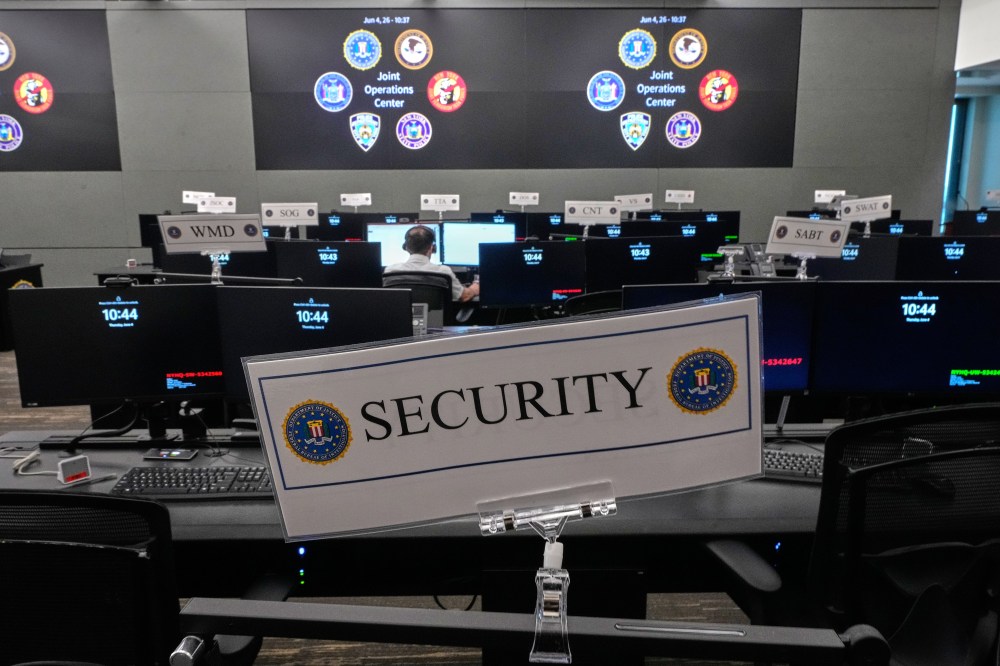
The FBI has spent the last seven years building up its capability to deal with drones by investing in the technology needed to quickly identify drones and take control of them, and authorities have been using that already at major events. The bureau also provided counter drone technology training this year to law enforcement in all World Cup host cities that taught them how to recognize dangerous drones and respond.
The military has also developed counter drone lasers like the ones used along the Mexican border earlier this year and other systems to shoot down drones, but the FBI is not planning to do that during the World Cup because of the dangers involved with the wreckage of a drone falling over a major city.
“If the drone is intercepted and it no longer flies, it’s going to fall. And as we say, no matter what you do, you can’t change the law of gravity,” said national security expert Hal Kempfer, who estimates that he has trained more than 30,000 law enforcement officers on counter-terrorism techniques.
‘Everybody’s a little behind’
The government has invested heavily in systems that should allow officers to take control of suspicious drones and land them safely or jam their signals, including handing out $250 million to help states prepare to protect World Cup matches and the big public events planned this summer to honor America’s 250th birthday.
Homeland Security Secretary Markwayne Mullin told Congress at a recent hearing that federal officers have successfully dealt with drones over several recent events, including bringing down eight drones over a Formula 1 race in Miami and 12 that entered the no fly zone over the Masters golf tournament, but “everybody’s a little behind” the rapidly evolving technology.
“Biggest concern I have is honestly with drones,” Mullin said. “I wouldn’t say a vulnerability, but it is, it is one of the areas that we are struggling with every single day.”
Drones are scary in the wrong hands
The FBI is taking a “zero-tolerance” approach to protecting the airspace around World Cup events. Devin Kowalski, an FBI assistant director in charge of the bureau’s Critical Incident Response Group, said the agency plans to treat all drones “like they could be a real-deal threat.” Other federal agencies, including Customs and Border Protection and the U.S. Coast Guard, will take the lead at several stadiums while the FBI protects three of them.
“When that drone comes into the TFR (Temporary Flight Restricted area), we’re handling it as if it’s something that could hurt people, and we’re aggressively locating its operator and conducting the logical investigation to determine the nature of the situation as well as to hold that person accountable,” Kowalksi said in an interview with The Associated Press.
ATF Director Rob Cekada said in an interview that the focus now is on protecting the World Cup, but the America 250 events, World Series, Super Bowl and the 2028 Olympics aren’t far behind. “Then think about all the events in every community in the country — high school and college games — that are a concern for our state and local partners. So we want to do what we can to help them as best as possible,” he said.
Derek Reisfield, who is the former president of one of the companies providing counter-drone technology to the host cities, said “this technology in the wrong hands is very scary,” and there are many around the globe who want to harm America.
“We have to assume that there’s somebody in Iran who’s spending every day thinking about how they can attack the United States on our home turf,” said Reisfield, who used to lead Ondas and now serves on the board of a Ukrainian company called Swarmer that makes software that allows one person to control hundreds of drones.
Early detection could be key to stopping drones
Some of the technology could allow authorities to detect drones up to 25 miles (40 kilometers) out, which would provide more time to mitigate the threat, according to Matt Sloane, the co-founder of SkyfireAI. But it’s possible that someone could sneak a drone up close to a stadium and launch it from less than a mile away (less than 1.6 kilometers), which would leave little time to act.
And the systems designed to jam the signal from an operator or take control of a drone might not be effective if it is preprogrammed to crash into a stadium full of fans while carrying an explosive payload or if it is controlled over a fiber optic line.

The battlefield tactic that might pose the greatest threat would be sending a swarm of multiple drones to attack at the same time. Even with the best defenses, a few drones might sneak through to the target as Iran has been able to do with large numbers of its Shaheed drones. The U.S. military has an assortment of weapons to knock drones out of the sky, but Iran has still be able to hit targets across the Middle East.
But Sloane he feels like the government is doing what it can to be ready.
“The threat is real, certainly. But I do think that there’s a lot being done to prepare for it. To educate about it,” said Sloane, whose company has helped protect Super Bowls in the past. “And then we just need to tell everybody who’s just trying to take pretty pictures ‘Hey this is not the time. Keep your drone in the box.’”
___
Associated Press writers Eric Tucker and Rebecca Santana contributed to this report.