Climate change makes once-rare coastal floods more likely, study says
Advertisement
Read this article for free:
or
Already have an account? Log in here »
To continue reading, please subscribe:

Digital Subscription
One year of digital access for only $205*
- Enjoy unlimited reading on winnipegfreepress.com
- Read the E-Edition, our digital replica newspaper
- Access News Break, our award-winning app
- Play interactive puzzles
*First annual payment billed as $205.00 + GST for one year. This annual subscription will automatically renew at $233.00 + GST every 52 weeks (10% off the regular annual price of $259.35). Offer available to new and qualified returning subscribers only. Cancel any time.
To continue reading, please subscribe:
Add Free Press access to your Brandon Sun subscription for only an additional
$1 for the first 4 weeks*
- Enjoy unlimited reading on winnipegfreepress.com
- Read the E-Edition, our digital replica newspaper
- Access News Break, our award-winning app
- Play interactive puzzles
*Your next Brandon Sun subscription payment will increase by $1.00 and you will be charged $17.95 plus GST for four weeks. After four weeks, your payment will increase to $24.95 plus GST every four weeks.
Read unlimited articles for free today:
or
Already have an account? Log in here »
Extreme floods that once swamped coastal communities only rarely are becoming far more common as climate change caused by humans pushes sea levels higher, according to new research published Wednesday. Experts say the findings are crucial for making plans about floods and coastal infrastructure as the planet warms.
These big coastal floods happen when high tides and storm surges — the amount above normal tide level — combine with seas that are already rising. Those pile on top of natural climate patterns and other human influence.
Climate change has strengthened storms like Hurricane Ian, which caused significant flooding in 2022, scientists say. Flooding threatens hundreds of millions of people each year in low-lying coastal areas across the globe. It also causes billions of dollars in damage and can be deadly.
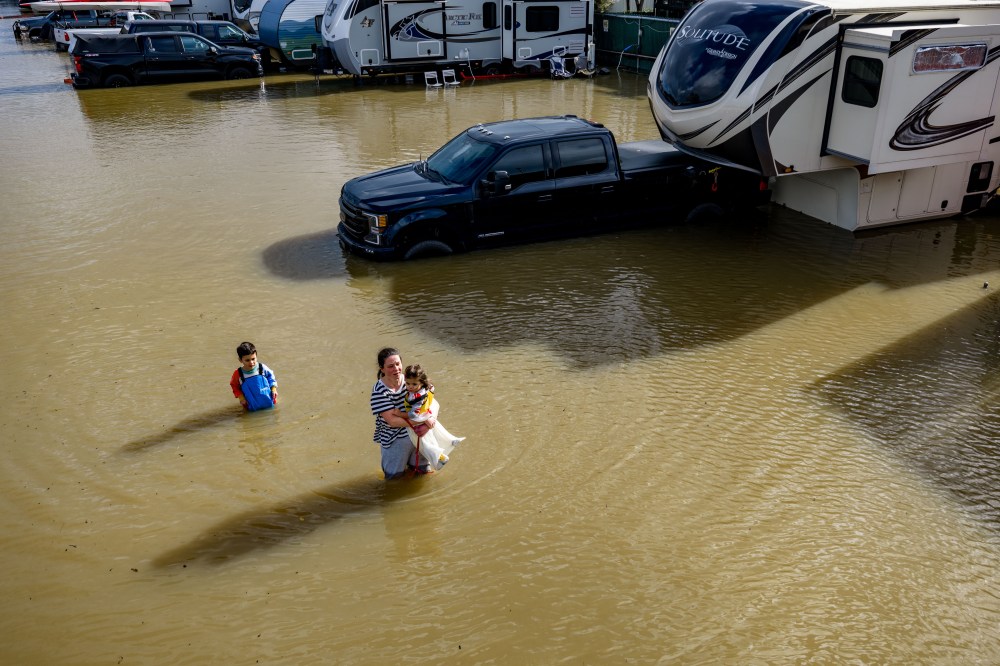
Floods that historically had a 1% chance of striking a coastline in a year are now about 12 times more likely, on average, according to a new study published in the journal Nature Climate Change on Wednesday. Those events have become about four times more likely due to human-driven climate change, the research shows.
Researchers looked at how often extreme sea level events — which cause coastal flooding — happen by considering long-term records from tide gauges at more than 100 sites, as well as using climate modeling. The study looked at the increase from 1900 to 2005. It was limited through 2005 because after that, there weren’t enough models that could point to instances of human-driven climate change. The researchers said their findings likely understate today’s risk, because human contributions to changes in coastal extremes have only increased since then.
Researchers looked at which changes were caused by human activity, natural forces or shifts in the landscape. Although sea level changes earlier in the 20th century could mostly be chalked up to natural forces, the scientists found that since the 1960s, human-caused warming was the main reason sea levels are going up.
A separate study published in the journal Science Advances on Wednesday also supports the idea that extreme ocean heights come from climate change, specifically around 58% of the days with big floods from 2000 to 2018. Climate change has also, on average, nearly tripled the number of days where the sea tops extreme flood levels since the 1970s, according to that study.
“Essentially every coastal flood today has human fingerprints on it through climate change,” said Ben Strauss, chief scientist at Climate Central and a co-author of the Science Advances study. “Without the extra bit of sea level rise caused by global heating, most of these events would not have reached the status of flood.”
The research in Nature Climate Change didn’t fully examine individual human factors, said Sönke Dangendorf, the lead author, but he noted greenhouse gases — the result of burning fossil fuels such as oil, gas and coal — are the most significant.
“Since the 1970s, it’s by far the dominating factor, and this is of course not good news,” said Dangendorf, also an associate professor at Tulane University. He said the threat is growing, and communities need to do more to prepare.
Jeff Williams, a retired United States Geological Survey oceanographer who wasn’t part of either study, said the research shows that planners need to take the growing threats into account. They should also think about how much money they’ll need to increase coastal protection, he said, and figure out who pays for it.
The current protections for New Orleans, for instance, “will likely not be adequate beyond the next couple decades,” Williams said.
Nations across the globe are increasingly using renewable energies like solar and wind. Last year, clean power generation exceeded overall global electricity demand growth, and the share of renewables hit more than one-third of the world’s electricity mix for the first time.
Even in the United States, where the Trump administration has boosted fossil fuels, solar is growing as coal power declines. As such, scientists have recently said the world is no longer on track for the worst case scenario for warming — but it’s also not on track to the best case, either.
“The impacts, even of a relatively little sea level rise, can be pretty impactful on our coasts,” Dangendorf, the Tulane author, said.
“There is a silver lining because we have control about how much we emit, right?” he said. “So we can stop that development, at least to some degree.”
___

Alexa St. John is an Associated Press climate reporter. Follow her on X: @alexa_stjohn. Reach her at ast.john@ap.org.
___
Read more of AP’s climate coverage.
___
The Associated Press’ climate and environmental coverage receives financial support from multiple private foundations. AP is solely responsible for all content. Find AP’s standards for working with philanthropies, a list of supporters and funded coverage areas at AP.org.