A city’s push for facial recognition on public buses ignites debate over security and privacy
Advertisement
Read this article for free:
or
Already have an account? Log in here »
To continue reading, please subscribe:

Digital Subscription
One year of digital access for only $205*
- Enjoy unlimited reading on winnipegfreepress.com
- Read the E-Edition, our digital replica newspaper
- Access News Break, our award-winning app
- Play interactive puzzles
*First annual payment billed as $205.00 + GST for one year. This annual subscription will automatically renew at $233.00 + GST every 52 weeks (10% off the regular annual price of $259.35). Offer available to new and qualified returning subscribers only. Cancel any time.
To continue reading, please subscribe:
Add Free Press access to your Brandon Sun subscription for only an additional
$1 for the first 4 weeks*
- Enjoy unlimited reading on winnipegfreepress.com
- Read the E-Edition, our digital replica newspaper
- Access News Break, our award-winning app
- Play interactive puzzles
*Your next Brandon Sun subscription payment will increase by $1.00 and you will be charged $17.95 plus GST for four weeks. After four weeks, your payment will increase to $24.95 plus GST every four weeks.
Read unlimited articles for free today:
or
Already have an account? Log in here »
Officials in Kansas City, Missouri, are preparing to equip cameras on some public buses with facial recognition software capable of identifying passengers who appear on a list of banned riders or missing persons.
Supporters and opponents alike view the effort as a major litmus test for tapping the AI-powered software on a U.S. public transportation system, positioning Kansas City as the latest epicenter of a fierce debate over whether the safety benefits of artificial intelligence are worth the privacy costs.
“The idea of running face recognition on a camera that is pointed on live spaces in public is a line that until recently has never really been crossed in the last 25 years,” said Jay Stanley, senior policy analyst for the Project on Speech, Privacy and Technology at the American Civil Liberties Union.
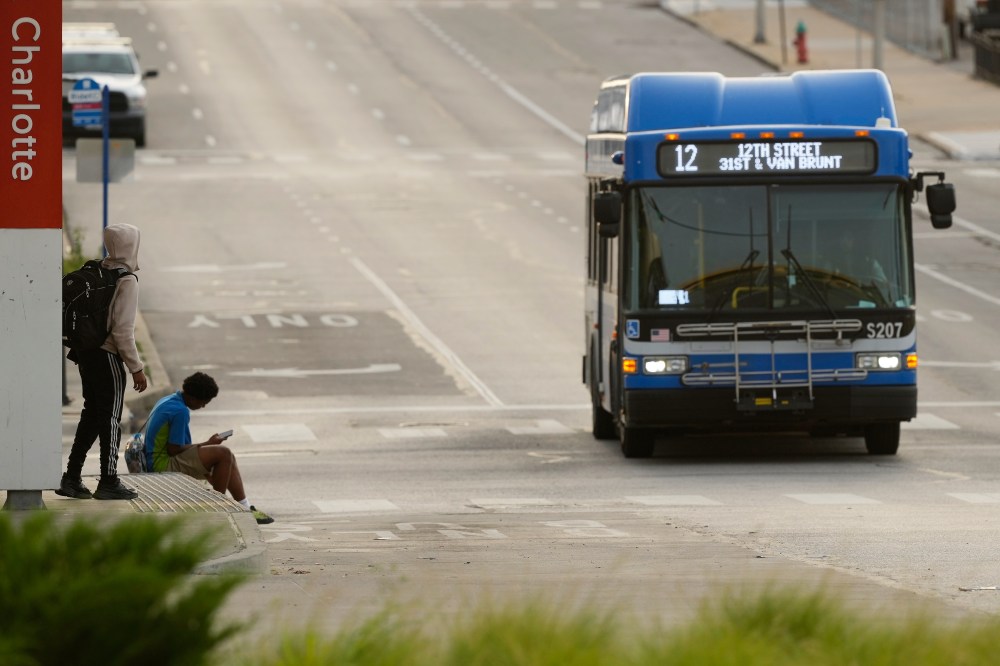
The state of Missouri declined to help fund the project as expected due to concerns with the facial recognition component. Still, the city is pushing ahead with local and federal money, said Tyler Means, chief mobility and strategy officer at the Kansas City Transportation Authority.
“Privacy is always a tricky thing,” Means said. “We’ve always had cameras on our buses. It’s just new technology. I think in time it’ll smooth over and people will realize, ‘Well, it didn’t really feel any different.’”
Cameras that recognize a face
SafeSpace Global, the Knoxville, Tennessee-based company partnering with Kansas City to run the cameras, started using live facial recognition years ago to alert nursing homes when residents left the building, then brought the technology to correctional institutions and schools. Kansas City’s buses represent the company’s inaugural venture in transportation.
Images captured by cameras aboard the buses would immediately be checked against any active alerts, generated when a missing person, banned rider or someone on a law enforcement watch list designated by the transportation authority is identified.
If no match or safety issue is detected, the facial data won’t be retained. After the buses return to the depot, the transportation authority would archive the regular video footage on a local server for up to five years.
“It’s not sitting there filming all the time,” SafeSpace Global CEO Scott Boruff said. “It just captures the face and goes away.”
But Stanley with the ACLU warned that it’s nearly impossible to limit the scope of a surveillance project when artificial intelligence is involved.
“It may be used for a very narrow watch list today, but there are very good reasons to think it’ll expand over time,” he said.
Backers of the effort point out that security cameras are already found nearly everywhere — even on Kansas City’s buses — and some law enforcement agencies have used facial recognition software to identify suspects spotted on video.
Cameras with other types of AI-powered software have been installed on public buses and school buses in other cities to read the license plates of nearby vehicles and ticket the ones spotted committing infractions such as illegally parking in a bus lane. Privacy advocates are concerned about those devices as well, but they’re particularly alarmed by cameras that could actively record faces even when no crime is committed.
“City residents should not be guinea pigs for transit systems to test Silicon Valley’s latest unproven, biased surveillance tech,” said Will Owen, communications director for the Surveillance Technology Oversight Project.
Lessons from elsewhere
Shortly after the 9/11 terrorist attacks, police in Tampa, Florida, used facial recognition cameras in the Ybor City neighborhood to search for crime suspects, but there was immediate opposition and the program was soon abandoned, Stanley said.
More recently, New Orleans police secretly relied on facial recognition surveillance cameras run by a private company despite a city ordinance prohibiting the technology, The Washington Post reported last year. Although the program was believed to have been paused, Stanley wrote a report for the ACLU last month that found it was still operating in some capacity, citing emails an activist obtained through an open records request.
Detroit partnered with some gas stations and liquor stores in 2016 to install high-definition cameras that relayed live feeds of violent crimes directly to the police department. But after a New York Times investigation found footage was paired with facial recognition software to make arrests, some of the accused filed successful lawsuits claiming they were wrongly targeted due to faulty technology that misidentified Black suspects.
James Craig, the police chief at the time, said officials felt the backlash and changed the rules over how facial recognition could be used without scrapping the program entirely. But he still advocates for the technology, provided it’s used correctly, and says it would be a shame for cities to abandon one of their best tools for securing the streets.
“If the police department or the city doesn’t have the insights to build in strong policies, transparent policies and accountability, the knee jerk reaction is, ‘Well, let’s just ban it,’” Craig said.
KC delays rollout, eyes ‘bigger’ plan
The cameras were expected to be installed on Kansas City’s buses this spring, but organizers halted the effort just before launch, derailing hopes that they would be up and running in time for the World Cup matches the city began hosting this week.
The delay was partly technical — a need to upgrade Wi-Fi routers to support both the cameras and a new fare collection system on the buses — and partly financial due to state government funding falling through, illustrating the headwinds U.S. cities often encounter when seeking to deploy facial recognition.
Despite the delays, Means said he’s confident the program will launch this year and “a little bit bigger” than initially planned, with potentially as many as 30 buses instead of the nine that had been planned under the pilot.
Boruff, the SafeSpace Global CEO, said the company is ready to start installing the Kansas City cameras as soon as the money comes through, although it’ll likely take three to four months to configure the software for the city’s specific needs.
Ryana Parks-Shaw, a City Council member serving as mayor pro tem, said she’s not disappointed that the rollout has been delayed.
“I think they need to take their time and do it right,” Parks-Shaw said. “I believe that any use of this kind of technology must be approached carefully, transparently and with clear guardrails.”
As for securing buses during the World Cup without the facial recognition cameras, Means said the reconfigured plan includes up to 40 more officers patrolling stops and transit centers.
“We’re kind of going old school to address what we hoped the technology would do,” he said.