The 2 earthquakes that struck Venezuela are known as a ‘doublet.’ Here’s how they happen
Advertisement
Read this article for free:
or
Already have an account? Log in here »
To continue reading, please subscribe:

Digital Subscription
One year of digital access for only $205*
- Enjoy unlimited reading on winnipegfreepress.com
- Read the E-Edition, our digital replica newspaper
- Access News Break, our award-winning app
- Play interactive puzzles
*First annual payment billed as $205.00 + GST for one year. This annual subscription will automatically renew at $233.00 + GST every 52 weeks (10% off the regular annual price of $259.35). Offer available to new and qualified returning subscribers only. Cancel any time.
To continue reading, please subscribe:
Add Free Press access to your Brandon Sun subscription for only an additional
$1 for the first 4 weeks*
- Enjoy unlimited reading on winnipegfreepress.com
- Read the E-Edition, our digital replica newspaper
- Access News Break, our award-winning app
- Play interactive puzzles
*Your next Brandon Sun subscription payment will increase by $1.00 and you will be charged $17.95 plus GST for four weeks. After four weeks, your payment will increase to $24.95 plus GST every four weeks.
Read unlimited articles for free today:
or
Already have an account? Log in here »
SAN JUAN, Puerto Rico (AP) — The two powerful earthquakes that struck Venezuela’s northern coast, killing more than 180 people, were an event known as a “doublet.”
Doublet earthquakes happen when a pair of similar-sized quakes hit close in location and time, according to the U.S. Geological Survey. On Wednesday evening, a 7.2 magnitude quake hit first, followed by a magnitude 7.5 just 39 seconds later.
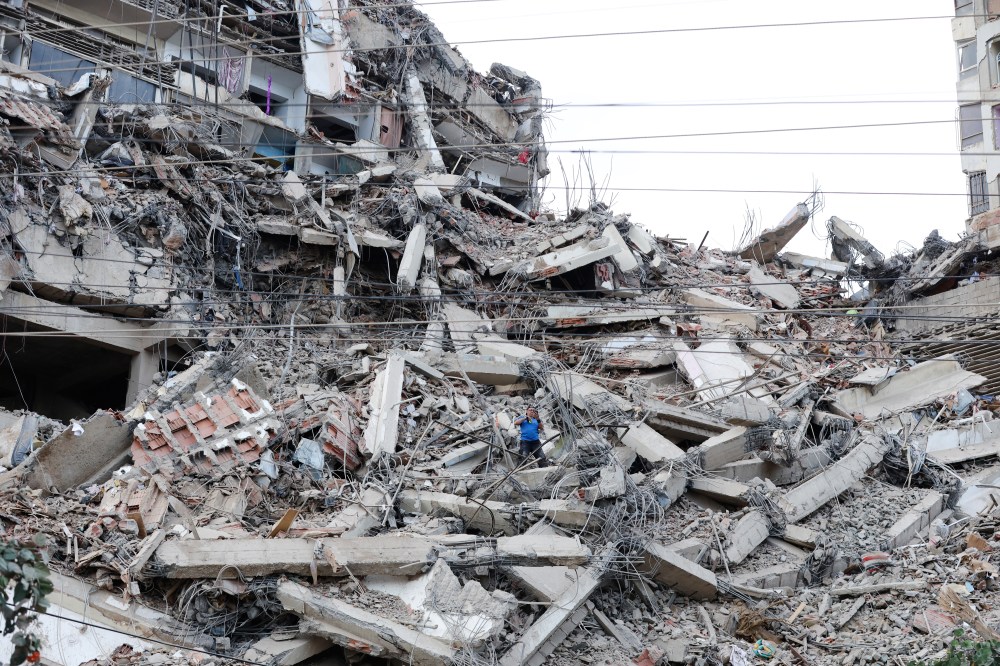
The deadly one-two punch toppled buildings in Venezuela’s capital, Caracas and beyond. Some 1,500 people were injured and thousands were reported missing. The coastal region of La Guaira, which is north of Caracas, experienced some of the heaviest damage and casualties, officials said.
How rare are doublets?
While not as common as a typical earthquake where a main shock is followed by much smaller aftershocks, doublets can happen anywhere in the world, Christine Goulet, director of the USGS earthquake science center in California, told The Associated Press.
Doublets indicate a complex fault structure, like the one in Venezuela. Known as the Bocono fault, it runs along the backbone of the Venezuelan Andes for about 300 miles (500 kilometers). A previous doublet — of magnitudes 6.2 and 6.3 — struck an area west of Caracas in September 2025, killing at least one person and injuring more than 100 others. Most of the damage was reported in the states of Zulia and Lara.
What caused Wednesday’s double earthquake?
Most earthquakes occur along plate boundaries, which is where tectonic plates meet.
A rupture where the Caribbean and South American tectonic plates meet unleashed the two quakes this week.
The doublet occurred where the Caribbean plate, located north of Venezuela, moves eastward relative to the South American plate at an average rate of 0.79 inches (2 centimeters) a year.
“It’s a large displacement,” Goulet noted. “It’s on the order of the San Andreas fault.”
The movement was a shallow strike-slip faulting, which occurs when two blocks of rock slide past one another horizontally.
That kind of movement is not more dangerous by default, Goulet said.
“A more vertical motion can be more damaging,” she said, adding that other factors, including the length of the rupture, determine the amount of damage.
The boundary between the Caribbean and South American plates is less active than others, said David Naar, associate dean at the University of South Florida’s College of Marine Science.
How common are earthquakes in Venezuela?
In the past century, only seven earthquakes of magnitude 6 and higher have hit in the immediate vicinity of the most recent ones, according to USGS.
These include the 2025 doublet that struck west-northwest of the latest quakes.
Individual earthquakes of magnitude 6 or higher struck in 2009, 1989 and 1975. The most devastating one hit in July 1967. It was a 6.6 magnitude quake that killed hundreds of people.
José Vitriago, who lives in Caracas, remembers that one. He was 2 years old.
“Our house broke,” he recalled in an interview with state-owned TV station Venezolana de Televisión.
Vitriago said the doublet that hit Wednesday “was horrible, horrible.”
Overall, five earthquakes of magnitude 7 and higher have occurred in northern Venezuela or near the coast since 1900, according to USGS.
The most catastrophic earthquake occurred in March 1812 along the Bocono fault system, killing an estimated 30,000 people.
Will more earthquakes hit Venezuela?

Scientists cannot predict earthquakes, but aftershocks are common after big ones. The USGS said there’s a 99% chance of at least one magnitude 4 aftershock hitting Venezuela within the next week, and a 24% chance of a magnitude 6 one occurring.
Unlike other countries, Venezuela does not have an early earthquake warning system, which relies on sensors to detect the first waves of an earthquake.
“It’s very distressing that there was basically no time to evacuate,” she said. “That’s extremely unfortunate.”
___
This story has been corrected to reflect that Lara and Zulia are states, not towns.
Related Articles
Venezuelans sleep in cars and under trees as they question where they'll live after the earthquakes
Advertisement Advertise With Us
Advertisement Advertise With Us